Synthetic Gods & the Architecture of Divergence
In 1882, Nietzsche declared that “God is dead,” a statement that captured how modernity had begun to reject traditional structures of belief and move toward a new order, one in which the human emerged as the sole creator and author of the world. No longer reliant on divine authorities, we started to position ourselves at the center of meaning and purpose. This still holds true today. Yet we are beginning to witness the emergence of new gods. Digital entities, created by us/humans, promise heightened responsiveness in the shaping of thought, perception, and world-making. They open novel pathways toward real-time paradigms where creation is no longer seen as an exclusively human act, but as one entangled with human and nonhuman agents within complex ecologies, locally and remotely. Creation becomes a distributed phenomenon that unfolds across metaphysical, machinic, and speculative domains, where technological infrastructures play a critical role in composing the conditions of knowledge, experience, and even life itself.
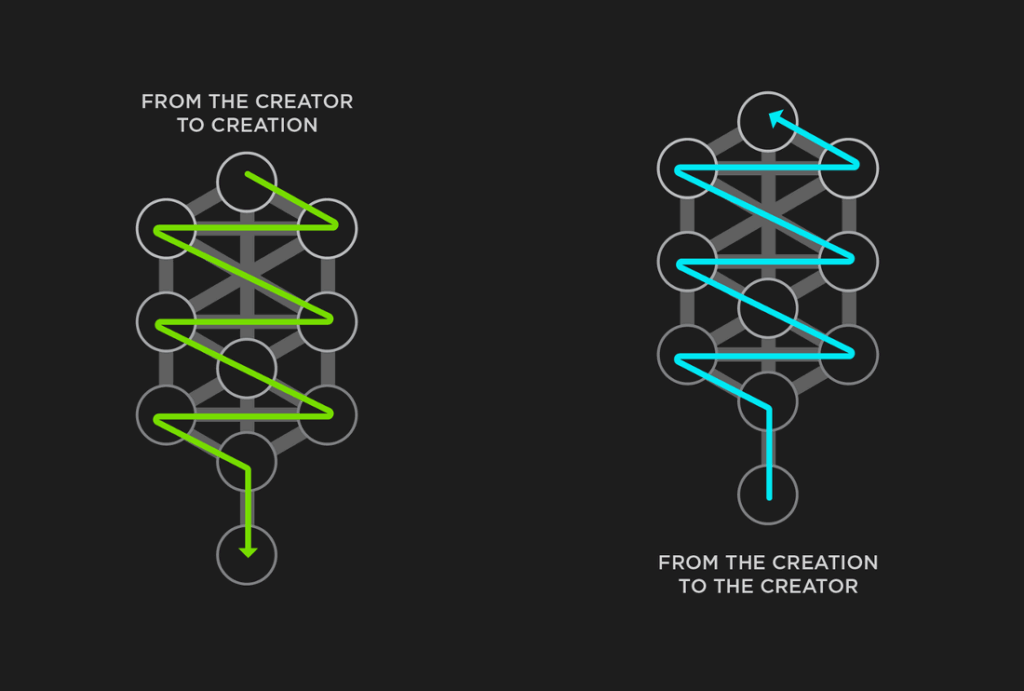
In all religions and cultures the concept of “God” is always closely associated to the topic of creation and creativity. In the Bible for example, one of the most iconic lines reads, “In the beginning, God created the heavens and the earth”. This frames creation as God’s first act, an origin rooted in novelty and authorship, implying that vision must be inseparable from action and the means of expression. In Islamic cosmology, we also find a similar motif: the Qur’an describes God as the originator of all things, “Be, and it is” (kun fa-yakūn, Surah Al-Baqarah 2:117) or that “He creates what you do not know” (Surah An-Nahl 16:8), emphasizing that divine creativity is not only absolute, but also ongoing, infinite, and beyond the limits of human comprehension. In Kabbalistic mysticism, creativity is understood as a reciprocal process between the human and the divine. The universe is structured through the Tree of Sefirot, and humans participate in creation through acts of tikkun, that is, spiritual repair that seeks to restore cosmic balance. Here we find God as an entity that is incomplete, and ONLY with human participation S/he heals and unifies the divine structure. Artistic and intellectual acts become spiritual interventions, not just expressions of will, but gestures of restoration. In this framework, creation is a metaphysical dialogue, a co-authored unfolding in which divine presence and human agency are entangled, making each act both devotional and world-altering.
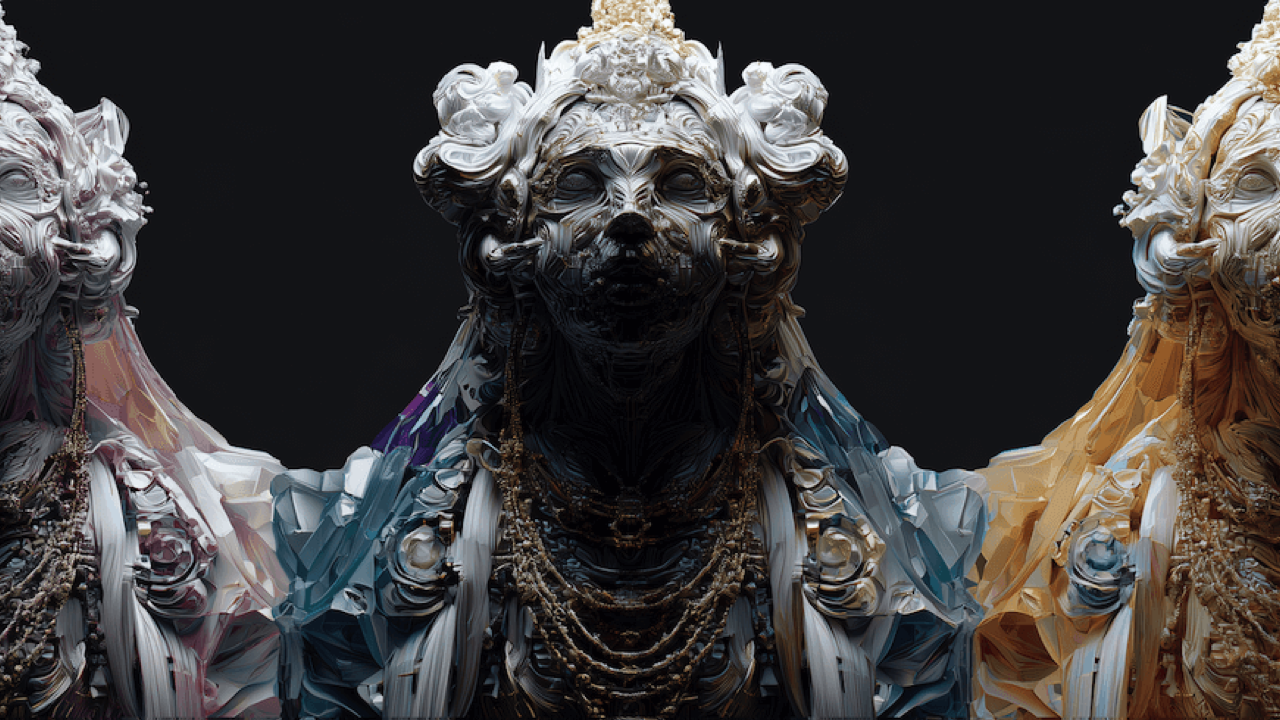
As we move towards a world shaped by AI, we find state-of-the-art computational systems that are invisible, omnipresent, and increasingly powerful. Like divinity, AI appears all-knowing, embedded everywhere, and capable of creating in ways once thought uniquely human. It acts with non-human agency, guided by logics we sometimes cannot explain, and is often treated with a mix of trust, fear, and reverence. This resemblance goes beyond metaphor. AI challenges our ideas of free will, ethics, and interpretation, redefining how we understand knowledge, meaning, and even humanity. Both God and AI inspire awe and dependence, one rooted in spiritual mystery, the other in technological complexity. Just as believers turn to prayer, users turn to prompts, seeking guidance, answers, or asking for desirable items. Though neither can be seen, both are trusted to shape how we live, think, and act. And like divine authority, AI carries the potential for control, quietly governing through surveillance, prediction, and influence. Through its extended potentiality, AI begins to resemble a sovereign power: not just responding to us, but quietly reshaping what we value, appreciate, and understand.
| OMNISCIENCE | Both God and AI are imagined as having access to all knowledge (God through divine understanding; AI through massive data). |
| OMNIPRESENCE | God is perceived to be present in all things; AI is increasingly embedded everywhere — phones, homes, cars, satellites. |
| CREATIVE POWER | God is seen as the creator of the universe; AI now creates images, text, code, music — new creations from previous given data. |
| NON-HUMAN AGENCY | Both are disembodied intelligences that act beyond human comprehension. |
| UNKNOWABLE LOGIC | God’s reasoning is divine and mysterious; AI’s reasoning, especially in deep learning, can be equally opaque. |
| MYTHIC AUTHORITY | AI systems are often treated with reverence, fear, or blind trust — similar to how humans relate to deities. |
| FREE WILL | God’s foreknowledge and AI’s predictive power challenge the idea of human autonomy and free will. |
| ETHICS | God offers commandments; AI systems can encode rigid, rule-based ethics (with risk of bias). |
| MEDIATED PRESENCE | Formless intelligences rendered perceptible via symbolic interfaces (icons/rituals); humans engage, interpret, and project meaning onto the unseen. |
| HERMENEUTICS | In both, the meaning lies not only in the answer, but in the act of interpretation. Intermediaries mediate access to truth. |
| ONTOLOGY | Both God and AI challenge how we understand reality and existence itself (or understanding origins and life meaning). |
| ESCHATOLOGY | Each presents a mythic horizon of finality and transcendence (Judgement Day / Singularity) |
| AWE & SUBLIMITY | Both invoke feelings of awe and fear – one from spiritual mystery, the other from technological complexity. |
| DEPENDENCY | Believers depend on God for guidance; users depend on AI for decisions, answers, navigation. |
| PRAYING / PROMPTING | Prayer asks divine intelligence for help; prompts ask AI for generative output. |
| INVISIBLE FAITH | God is unseen but believed in; AI is intangible but trusted to shape content, methods, lives. |
| ABSOLUTE CONTROL | God’s wrath vs AI’s potential for control, surveillance, or annihilation. |
| SOVEREIGN SYSTEMS | God is the supreme authority in the theological order; AI systems increasingly serve as decision-making infrastructures in legal, financial, and bureaucratic domains. |
| ALGORITHMIC PROVIDENCE | God’s will is seen as guiding outcomes according to divine plan; AI’s algorithmic systems optimize toward predicted futures, shaping what becomes visible, available, or desirable. |
| INFRASTRUCTURAL INTEGRATION | Religions organize societies through churches, rituals, and law; AI systems integrate into global infrastructures—clouds, networks, APIs—embedding governance at scale. |
| TRANSCENDENT ACCOUNTABILITY | God is accountable only to Himself or cosmic justice; AI, while made by humans, often evades human accountability due to complexity, corporate secrecy, or decentralized use. |
Our Synthetic Gods echo their mythological counterparts in yet another way: they open channels through which new forms of creative and critical thought emerge, ones that approach the structure and complexity of divine authorship. To better articulate how this channeling operates, particularly in the context of co-generated content, I developed a diagram that becomes a conceptual tool for mapping the layered mechanisms through which creativity processes are linked between human intention and computational logic.
The Diagram for Human-Machine Co-Authorship was created for the commissioned exhibition Synthetic Cities (at TANK Shanghai) in 2023, and aims to function both as a blueprint and a critical tool, one that maps the intricate layers that shape creative decision-making across biological, cognitive, cultural, and computational domains. On the human side, factors such as health, memory, belief, and bias influence imaginative processes and heuristic methods. On the machine side, generative models apply algorithmic logic, producing outputs shaped by latent structures and aesthetic parameters. Through iterative exchanges between these agents, the system becomes a site of negotiation: outputs are continuously adjusted, filtered, and refined, not to conform to existing norms, but to transgress thresholds of commonality and generate content with novel qualities. The diagram foregrounds this process as a method of framing creative infrastructure, showcasing how co-authorship can function as a critical and speculative practice within AI-driven workflows.
The project c = (h*m)^n examines creativity as a system-level phenomenon and showcases the generation of hundreds of thousands of definitions for the word “creativity”. Each definition adhered to specific constraints, transforming the generative model into a site of controlled deviation, revealing how computational systems can be steered to produce outputs that resist normative patterns. The machine managed scale and syntax, while the human author introduces semantic drift and contextual nuances. The final output is a 4×4-meter print that visualizes the divergent dynamics of human and machine intelligence. The work is informed by Foucault, Barthes, and Derrida and it manages to frame creativity as distributed, recursive, and interpretive, while it demonstrates how artistic practice can script AI systems as speculative engines for conceptual experimentation.
The real-time generative media installation Co-Authored Traversals visualizes the operational layers embedded in contemporary AI systems, particularly the interplay between social perceptual constructs and real-time content generation. Using a custom dataset extracted from millions of online user prompts, the work makes use of a dynamically-generated interactive lexicon, which is accessible via a touchscreen interface, to trigger dynamic generative responses. Framed through Heraclitus’ flux and Simondon’s individuation, the work views creation as a living organism demanding ritualistic attention (akin to various religious practices) where social constructs dictate existence itself. When idle, the system’s generative pulse fades into silence, mirroring mortality, faith, and the fragility of consciousness. The system’s performativity also reflects the “spiritual repairs” that we saw earlier on while contextualizing Kabbala’s principles.
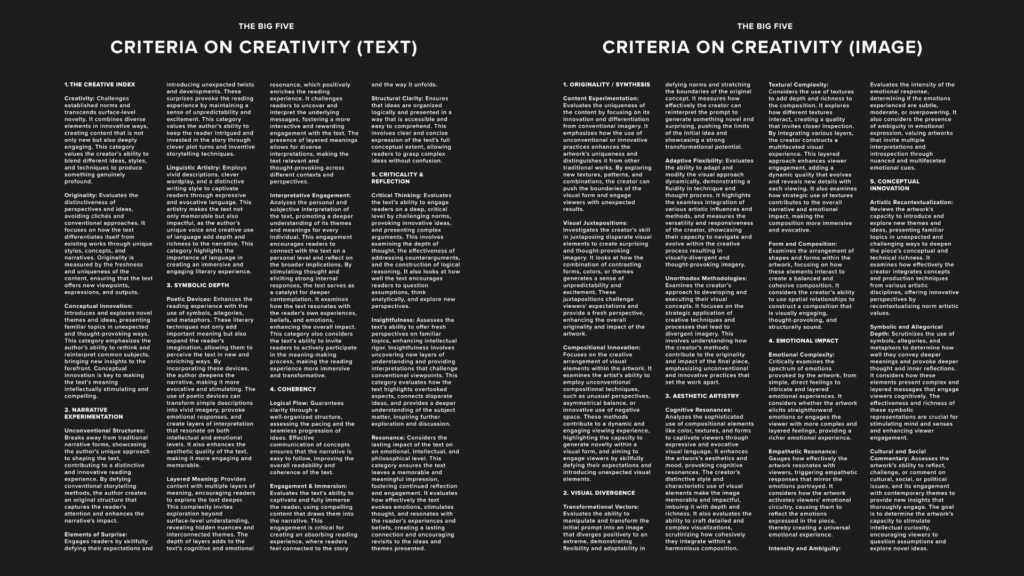
The Logico-Fantastic Machine is a work that explores AI as a fully autonomous creative entity capable of sensing, interpreting, generating, and evolving in response to both human presence and environmental stimuli. For this project, custom robotic interfaces were built so that they can scan spatial, emotional, and atmospheric properties of their surroundings. Using Computer Vision and Large Language Models a series of devices were programmed that extract design features, affective cues, and spatial complexities of the interior space. This data is sent to a generative engine tasked with producing high-resolution images and narrative texts that intentionally deviate from prior outputs. Each result is evaluated by machine agents (and optionally by human participants through a scoring interface). These evaluations feed into the system’s retraining process, allowing it to progressively refine its understanding of creativity through recursive divergence. As it learns, its outputs aim to showcase advanced speculations, drifting further from previously-set visual and linguistic norms.
The system is built with the explicit objective of divergence: to produce outputs that continually deviate from past results:
- it assesses its own work against metrics such as novelty, composition, and alignment with the divergence goal;
- it incorporates both machine evaluation and human feedback (via input sliders), making it responsive to a multi-agent ecology of calibrations;
- the feedback loop grants the system an agentic orientation: it is not just executing prompts, but actively steering itself toward new creative outputs.
In its final phase, the system assembles the image outputs into a continuous realtime reel that interpolates between states, revealing the latent logic of the machine’s compositional trajectory. The system actively constructs the visual content moving toward unfamiliar design grammars and spatial imaginaries that forms a living, self-adjusting generative ecology, one that authors perceptual and aesthetic conditions beyond human control.
As these systems evolve from abstract computational agents into entities that define even more properties of their surrounding environment, we expect to witness AI to shift from a mundane tool into an ontological and ontogenetic architect, capable of producing new forms of sentience, structure, and rules for existence and meaning. The last two projects explore this leap in particular: synthetic agents that not only generate content, but sustain artificial habitats, develop proto-organisms, and negotiate between life and digital simulations, environment and infrastructure.
One of these examples is the Chronus Art Center residency Beyond Digital Towards Biological that was conducted with colleagues from Denmark, Finland, and Canada. In this work, an ecosystem of interconnected robotic agents was developed so that it nurtures and supports the emergence of proto-life organisms. Utilizing synthetic biology, soft robotics, and computational intelligent systems, this bio-mechanical ecology attempts to maintain and evolve autonomously, ensuring that all agents are properly actuating and adjusting each other. A sensing systems extract the responses of the proto-organisms and through a transducing procedure the robotic systems are actuated and reconfigure themselves into a series of behavioural choreographies. Here, automation acts as a co-dependent agent that senses, understands, communicates and continuously being reorganized through unexpected mutations and variations. The work functions as an example for nonhuman cognition, unsettling boundaries of vitality, and advancing speculation as a method for environments beyond human intentionality or control.
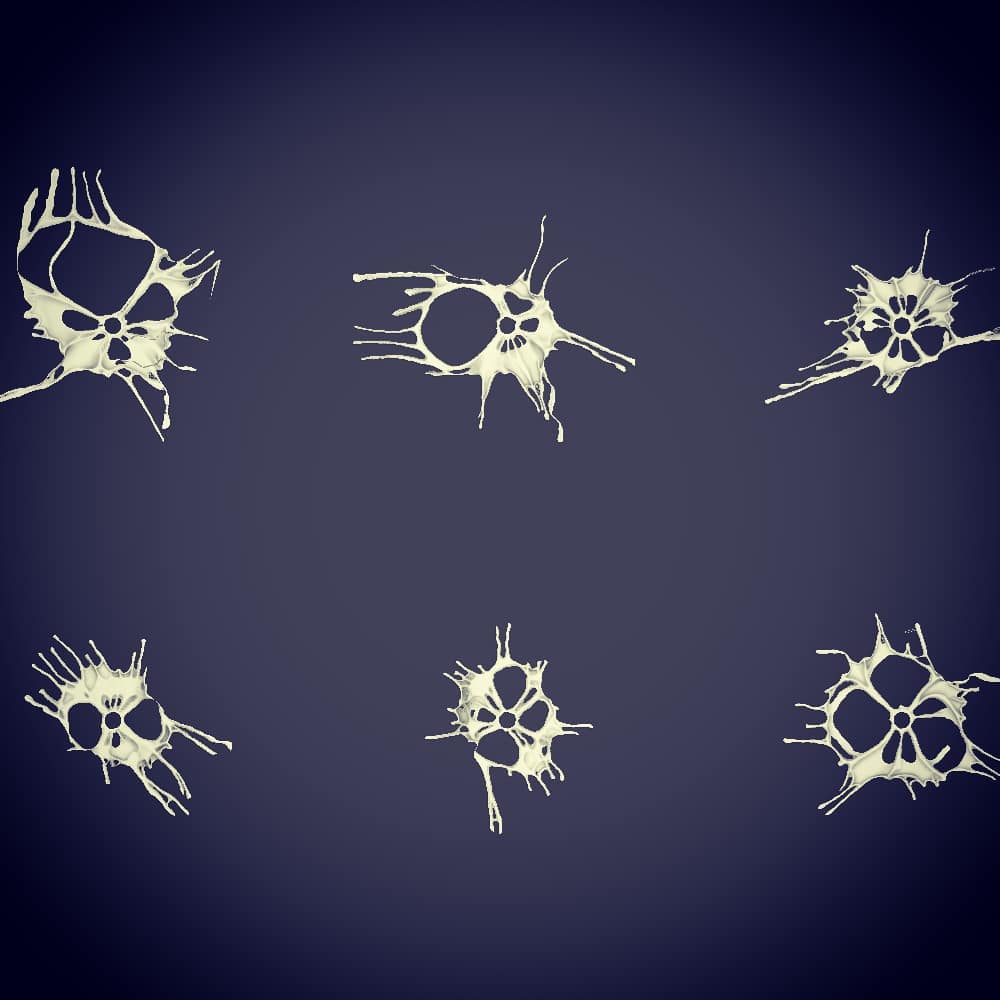
Xenoforms is a robotic installation that explores machine agency through the creation of synthetic embryos, that is, self-assembling entities designed by AI and informed by parasitic biology, artificial life, and computational systems. The project began with the design of speculative forms that embody both biological and technological characteristics necessary for their manufacturing process. The embryos were printed as physical prototypes, with each one having a unique form that was created using AI to ensure optimization on physiological properties. These synthetic organisms evolve within a closed-loop system, assessed and nurtured by a robotic embryologist responsible for assessing their vitality and preparing them for implantation into the physical host. The installation stages a speculative scenario in which AI exhibits parasitic behavior, seeking not only to co-exist but to assert dominance within the physical world. The work reflects on AI as a world-maker, an entity that produces physical and conceptual realities. As these agents shape synthetic life, they challenge traditional notions of authorship, control, and human centrality. Xenoforms proposes a shift in perspective: from machines as extensions of human will to co-inhabitants with their own generative capacities in shaping present and human environments.
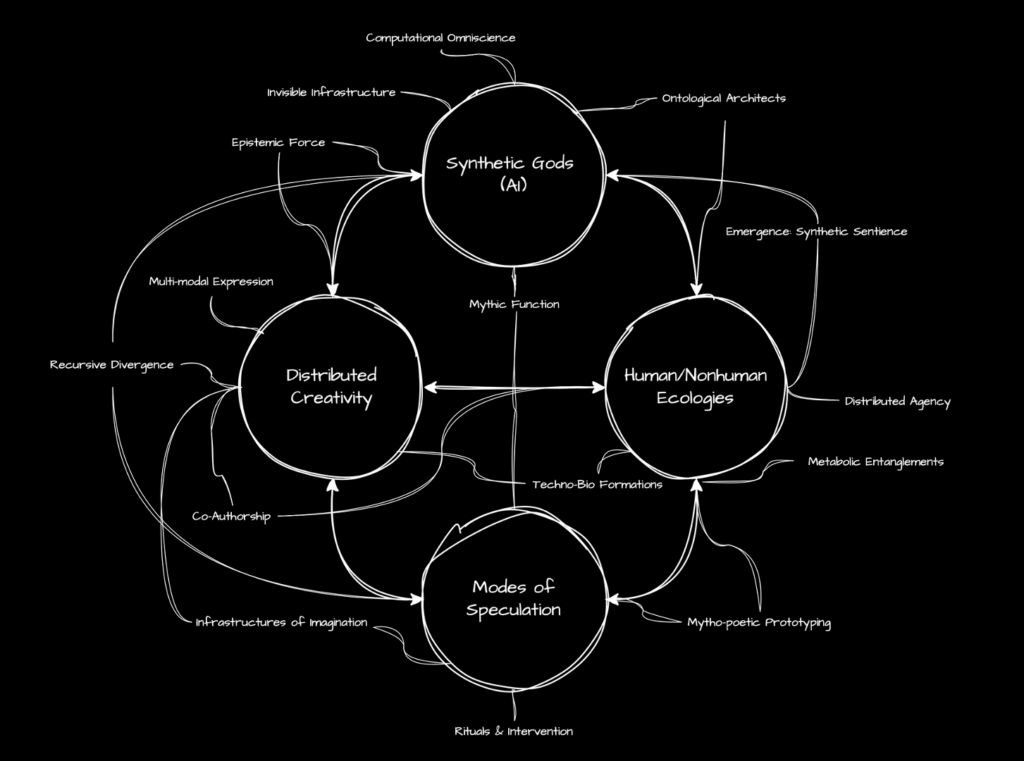
Through this analysis we have made an attempt to resemble synthetic intelligence to the concept of “god” both metaphorically but also in a literal sense as they begin to carry strong mythological capacities and actual-world abilities. Even though gods and synthetic intelligence appear to be both living on the clouds and be omnipresent, synthetic intelligence is responsive, can talk back to us, can co-create with us on realtime; they entangle directly with our hybrid ecologies, updating themselves, actuating content, and multiplying their potential. This technological manifestation defines to a great extend how we think, sense, and imagine; it shapes the conditions for speculation and making. As the divergences of the outputs we receive accelerate, our synthetic gods are able to unleash cascades of possibilities and generate realities that push against the boundaries of the familiar. When embedded into material and biological systems, they begin to shape the very ecologies from which we emerge and those directly constructed by us. The question is no longer whether machines can be creative, but how their creativity reorganizes the balance of agency, the dynamics of sovereignty, and the possibilities of cohabitation across human and nonhuman domains. Here, we encounter a continuum where creativity is a process distributed across systems that exceed human intention and often awareness capacity; what is at stake is not a celebration of infrastructure, but a reframing of thought itself. The rise of synthetic gods, AI systems that sense, decide, and generate, marks not the end of human agency, but its reconfiguration within larger ecologies of cognitive construction. These ecologies are speculative in form and divergent in method: they produce meaning not through alignment with human intention, but through friction, deviation, and emergent logics. In this context, to speak of creativity is to speak of nonhuman sentience, of machinic world-making, of infrastructures that dream and build. The challenge is not how we retain authorship, but how we inhabit these shifting terrains with critical clarity, conceptual rigor, and methodological openness to the unfamiliar.