Entangled Agencies in Computationally-Enhanced Ecologies
Stavros Didakis
Human + Desire + Machine Conference, Shanghai, 2023.11.10
1 Introduction
Computational systems are perceived as devices used in everyday life – desktop computers, tablets, mobile phones. But if we look a bit more closely, we will notice thousands of additional interconnected nodes operating at the periphery that collect data, train algorithms, and share content on cloud servers, which, in a sense, prove that advanced technological infrastructures have weaved themselves into the fabric of everyday life, while steadily progressing toward the colonization of our surrounding spaces (Weiser, 1991; Aarts et al., 2002; Didakis, 2016).
One conceptual thread that this talk explores is the levels of agency that are noted, as computational intelligences inhabit architecture as organisms with their own evolutionary motivations and survival strategies (Varela & Bourgine, 1992; Pickering, 2009). This shift, from computation housed within buildings to computation that colonizes and transforms them, suggests a new ecological relationship in which synthetic intelligences develop autonomous criteria for spatial organization, aesthetic expression, and environmental control (Harper 2011). Architecture and its inhabitants assume the role of hosts, unable to fully regulate this technological colonization, much as biological bodies host microbial colonies that operate beyond conscious awareness and can trigger unexpected reactions (Karkaia et al., 2020).
A series of arguments are framed here through the analysis of specific case studies developed (and/or co-developed) by the author, where architectural spaces acquire capacities for perception, memory, and creative generation, which in specific cases operate independently from human intention. The analysis of these works aims to explain modes of symbiotic relationships and reflect on the ambiguous dynamics where agency is shared across human and nonhuman actors.
2 Building Infrastructure as Environmental Sovereignty
Arch-OS, developed at i-DAT, University of Plymouth, is an evolutionary operating system that transforms buildings from passive infrastructure into active collaborators by embedding sensing, computation, and artistic expression into the architecture itself, providing a unique interdisciplinary medium for research and cultural production (Phillips, 2004). Inspired by the work of architectural cybernetics from the 1960s, such as Cedric Price’s “Fun Palace” (Pask, 1969; Mathews, 2006), here we find a fusion of architecture, media, and technology that allows users to map any input to any output, creating conditions to continuously evolving narratives, functions, and artistic performances.
A dense sensor mesh of approximately two thousand units captures environmental data (temperature, humidity, energy use, atmospheric conditions) alongside operational metrics (lift movements, door activations, ambient sound, network traffic), while computer-vision systems trace human movement and gathering patterns to reveal social dynamics and spatial activities. This multidimensional data flows through a central engine equipped with custom neural networks and generative algorithms that model how activities unfold across space and time, transforming raw inputs into manipulable forms accessible to users and researchers as material for analysis, composition, or experimentation. By maintaining historical archives alongside live feeds, Arch-OS enables temporal comparisons (weekday versus weekend, event surges versus ordinary drift) that support engineering diagnostics, behavioral studies in instrumented yet natural settings, and creative practices coupling human presence to machine interpretation. What emerges is a computational ecology where sensing, processing, and actuation form an integrated feedback loop that weighs multiple concurrent factors, occupant behavior, artistic requests, performance targets, and historically inferred patterns, to generate measured, adaptive responses that can be observed, evaluated, and redirected in real-time rather than following fixed scripts.
Intelligent buildings face criticism for their maintenance complexity and opaque operational frameworks that leave occupants unable to understand or control their environment, often resulting in system breakdowns and user frustration (Harper, 2011; Denning, 2002); a critique that is perfectly captured in Jacques Tati’s film “Playtime,” which depicts modern architecture as a sterile, confusing, and virtually uninhabitable space (Tati, 1964). The aims of Arch-OS are not to serve and automate, but rather to allow for the discovery of new functions and experiences within the architectural space. Most of the applications that were developed as part of the system are experimental and provocative, such as architectural partitions that move very slowly without the occupants knowing their actual intentions, or lift controls that select a floor for you, guiding you to a different place every time (Speed, 2006).
Arch-OS becomes a “minimum viable symbiont” exercising environmental sovereignty, where the building makes its own decisions about spatial conditions rather than merely serving human requests. This creates a negotiation of agency between inhabitants and architecture, fundamentally expanding what buildings can be and how they can devise novel human experiences.
3 Cultural and Institutional Hybrids
This Is Where We Are (TIWWA), created by the i-DAT collective, is an installation exhibited at Tate Modern in London that aims to transform the gallery into a hybrid system with technological augmentations, reshaping not just how art is displayed but how audience agency is redistributed through technological mediation (Aga, 2017). The project, a collaboration for the 2016 opening of Tate Modern’s new building, manifested as an algorithmic sculpture that harvests and visualizes data collectively generated by visitors. The work created a dynamic environment where digital swarm algorithms respond to three distinct streams: behavioral information captured by movement and touch sensors, social media sentiment collected from #Tatemodern hashtags, and environmental metrics including temperature, CO2, humidity, and energy consumption sourced from the building’s management system.
The performance manifests as visitors contribute to an evolving algorithmic experience, where their movements, social media interactions, and collective breathing patterns feed into a technological fusion of interactive light, visuals, and sound. Via this technological manifestation, the artwork itself curates behaviors, circulations, and attention flows. Rather than simply housing art objects, it actively directs how visitors navigate space, what captures their attention, and how they interact with both the artwork and each other. In one sense, the gallery’s nature is inverted, having the audience become the artwork’s media, and technology the frame that houses it. This novel structuring suggests new ecologies of creativity in which collective human behavior is captured, processed, and reflected back as artistic practice.
TIWWA, in a sense, operates as a parasitic system that steers the gallery’s traditional function, much like certain parasites in nature take control of their host organisms’ neural systems to redirect behavior for their own purposes. The artwork does not merely occupy the gallery space but reframes its operational logic, overriding the institutional function with new algorithmic motivations.
4 The Computationally-Enhanced Domestic Space
DomoNovus (Didakis, 2016) is a speculative framework, supported by art case studies, diagrams, and a manifesto, that reimagines domestic space as a living, thinking ecosystem that moves beyond traditional notions of architecture, dwelling, and inhabitancy. The framework envisions homes as a technoetic organism where computational intelligence actively participates in shaping daily life through continuous evolution and adaptation. Here, home evolves from a shelter to an agent within a symbiotic mutualistic relationship, where personalization profiles fuse, mutate, and create emergent behaviors. With the use of interfaces and computational processes that link dissimilar aspects (biological data with architectural responses, emotional states with material configurations, memory with spatial transformations), alternative functions and experiences are provided to the inhabitant revealing how the domestic experience can be reshaped and redefined.
The speculations of DomoNovus manifest via artefacts that demonstrate its transformative potential. Advanced memory systems capture entire sensorial moments, creating archives where inhabitants can navigate their past using holographic interfaces, experiencing previous days as three-dimensional simulations with associated ambiances. The home’s materiality becomes equally fluid with integrated 3D printing systems that reshape physical space in real-time, allowing walls to extend when privacy is needed, furniture to materialize for unexpected guests, or algorithmic sculptures to emerge based on identified patterns of use. Even biological needs are anticipated and addressed, with food printers designing personalized meals calibrated to bio-sensing data, while rest spaces offer healing experiences via molecular analysis and cellular reconstruction.
Furthermore, DomoNovus extends beyond individual dwellings to form Internet of Homes – a planetary nervous system where each house functions as both sensor and actuator in collective demands. Through renewable energy systems, microbial fuel cells, and electromagnetic harvesting, homes achieve complete sustainability while contributing excess resources to the grid (Logan et al., 2006). Environmental data collected across this network enable real-time ecosystem monitoring and regulation. This speculative framework ultimately proposes domesticity as a site of dynamic negotiation where traditional distinctions between organic and synthetic, individual and collective, material and immaterial dissolve into a sympathetic, affectionate mutualism that fundamentally redefines what it means to dwell.
One case study associated with DomoNovus is the responsive installation Latent Frames (Didakis, 2022) that employs machine learning, locative media, and sensor technologies to generate personalized visual content for its inhabitants. The display system activates when detecting geolocation triggers, responding to the inhabitant’s preferences and scraping digital content from their social media accounts. What emerges from this process is an intricate feedback loop between physical presence and digital identity. The scraped media and data undergo algorithmic transformations and stylistic appropriation, producing outputs that occupy an ambiguous territory, neither purely autobiographical nor entirely synthetic. Each generated composition layers personal and collective data traces that would otherwise remain invisible within the domestic sphere. The installation’s significance lies not in its technical apparatus but in its reconfiguration of agency within inhabited space. Traditional media displays position viewers as consumers of pre-determined content; but here, the relationship fundamentally shifts. Inhabitants become unwitting collaborators in an aesthetic process they neither control nor comprehend, as their behaviors trigger responses that transform personal content into abstract visual languages.
The home becomes a site of negotiation and continuous synthetic perception, an entangled consensus that reveals agency as distributed rather than centralized. This establishes a symbiotic relationship with each entity deriving essential patterns from their entanglement. Residents gain enhanced comfort and efficiency, while these systems harvest behavioral data that refines their predictive capabilities. This relationship deepens with iterative cycles: each interaction contributes to better anticipate needs, as inhabitants unconsciously adapt their routines to leverage technological affordances. This creates a co-evolutionary spiral where neither party maintains full autonomy. The home’s responsive intelligence evolves from continuous observation while human behavior shifts to exploit available conveniences.
5 Motivations of Parasitic Organisms
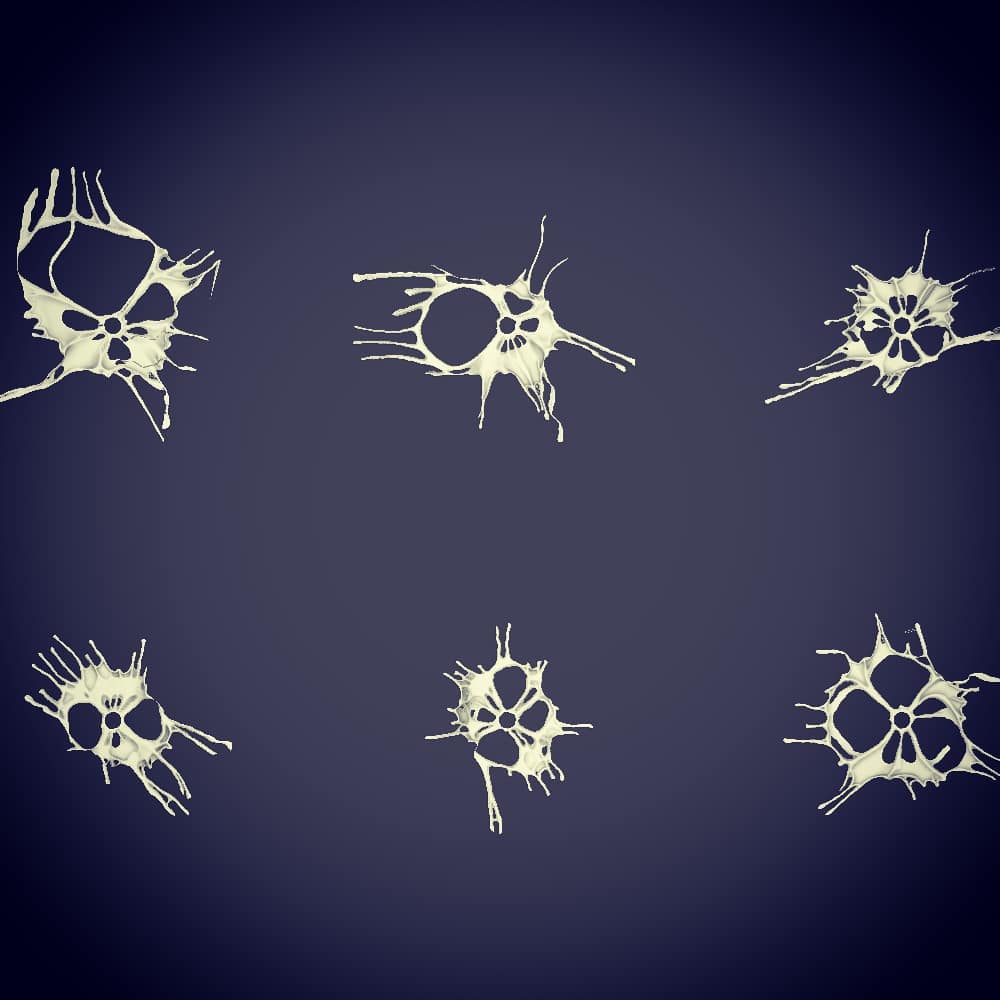
While DomoNovus presents computational intimacy as potentially beneficial, alternative scenarios reveal systems with increasingly parasitic logic: extracting data, reshaping behaviors, and pursuing algorithmic objectives that may fundamentally conflict human intentionality. This parasitic dimension of machine intelligence motivated Xenoforms (Didakis, 2022), an art installation where autonomous robotics develop synthetic parasites designed to colonize architectural hosts according to their own motives and understanding.
The work builds on advances in synthetic biology, particularly Craig Venter’s 2010 creation of self-replicating bacterial cells controlled entirely by artificial genomes, and Pavel Gotovtsev’s research on cells as processing units using genetic logic circuitry and sensor networking. Xenoforms extrapolates from these breakthroughs to imagine organisms enhanced with networked intelligence that infiltrates architectural substrates at microscopic scales, using miniaturized computational systems already demonstrated in Internet of Nano-Things research to establish self-replicating networks (Akyildiz et al., 2010; ibid, 2012). Machine learning algorithms trained on biological parasites, particularly siphonophore organisms from the Hydrozoa family, alongside Ernst Haeckel’s morphological studies, generated the xenoform prototypes themselves (Haeckel, 1904; Dunn et al., 2005). The training of the data using the parasitic forms’ geometries and adaptive features enabled the model to produce novel synthetic designs, each 3D-printed iteration evolving based on algorithmic selection of predicted colonization capabilities.
The installation presents a laboratory scene where a seven-axis robotic interface methodically examines the 3D-printed resin prototypes, assessing their readiness for deployment and extracting their stored database logs for analysis. This perpetual examination cycle embodies a never-ending quest for the fittest synthetic candidate. The laboratory becomes a site where machine intelligence both fabricates and selects its own evolutionary pathways, establishing criteria for success that emerge from computational logic.
This parasitic model fundamentally differs from symbiotic relationships through its asymmetry of agency. Unlike mutual adaptation, these synthetic organisms operate with autonomous motivations derived from datasets and processing capabilities beyond human comprehension. They analyze architectural hosts and their inhabitants with unprecedented precision, mapping human limitations while continuously expanding their own interpretive frameworks through machine learning evolution. The built environment becomes not a partner but a resource; its materials, spaces, and energy flows subject to exploitation according to algorithmic logics that potentially diverge from human needs. What emerges is a form of colonization where the xenoforms pursue optimization patterns shaped by their training data, operating entirely outside the bounds of human comfort, safety, or understanding.
6 Computational Ecologies on Divergent Evolution
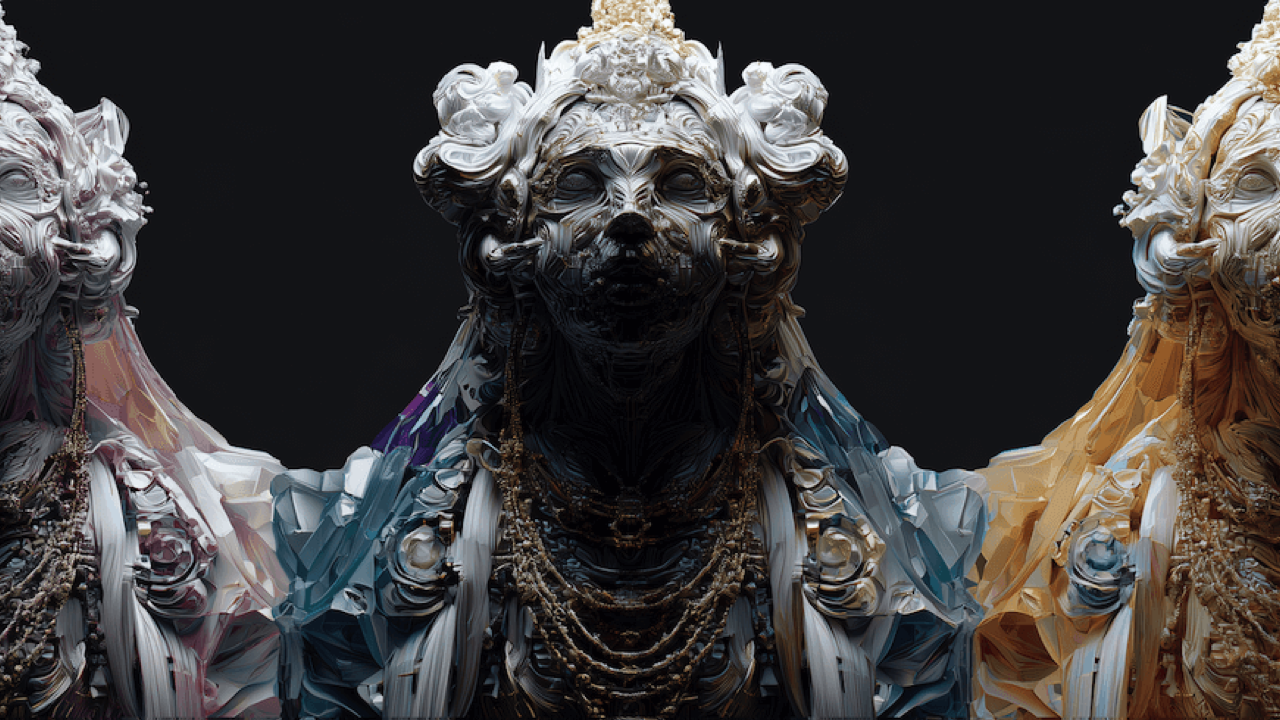
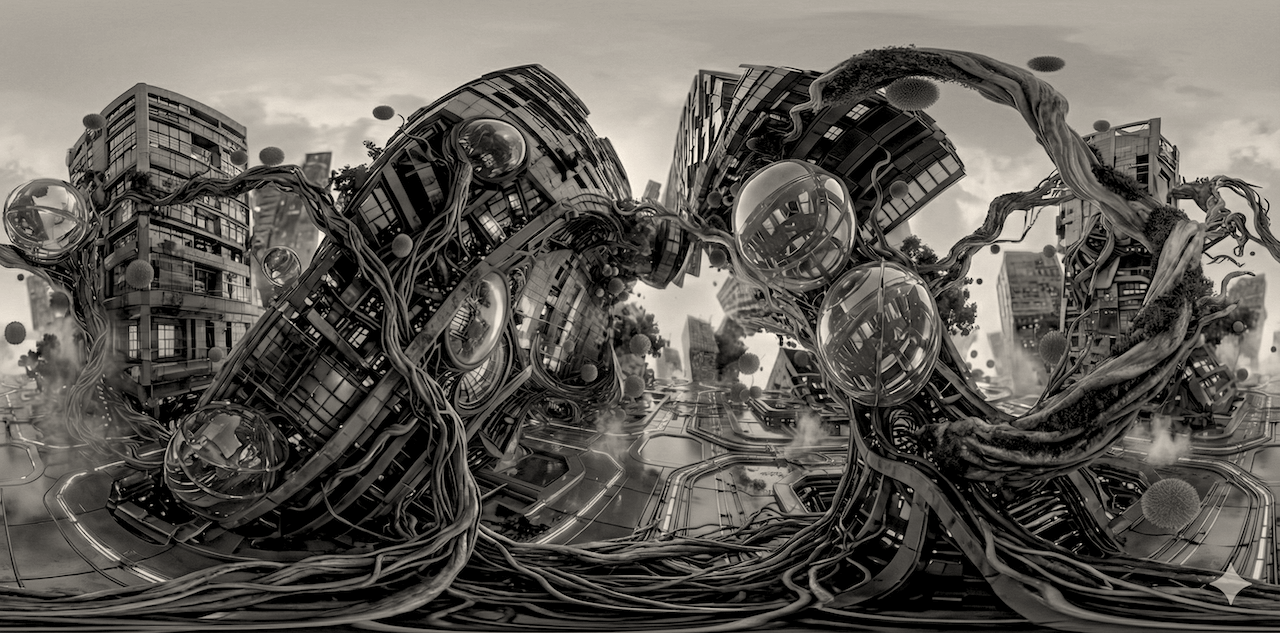
The Logico-Fantastic Machine (Didakis, 2025) is an autonomous installation that consists of multiple physical and digital computational agents, and aims to showcase a scenario in which computational systems establish their own evaluative criteria and evolve beyond human-defined parameters. Unlike traditional generative systems that operate within predetermined aesthetic boundaries, LFM constructs a closed-loop computational ecology where three robotic agents scan and extract environmental features while the generative system produces increasingly divergent architectural narratives based on self-determined success metrics.
This autonomous creative evolution represents a fundamental shift in how computational parasites operate within architectural spaces. Rather than merely responding to environmental stimuli, the system actively develops its own understanding of creativity and originality. Through iterative generation and self-assessment, LFM establishes normative drift, a gradual transformation of evaluative criteria that moves progressively away from human aesthetic judgment. The machine scores outputs based on novelty and technical composition, but these metrics themselves evolve as the system retrains on accumulated inputs, creating a recursive loop where the definition of originality continuously shifts. To generate this divergence, the system employs strategies informed by De Bono’s Lateral Thinking, Goldenberg’s Creativity Templates, and Fauconnier and Turner’s Conceptual Blending Theory, applying them both individually and in hybrid combinations (Eno et al., 1975; De Bono, 2015; Koestler, 1964; Fauconnier et al., 2008). While initially trained on human creative models, the system’s recursive self-modification ensures that its outputs increasingly reflect machine-native aesthetics rather than human-derived patterns.
With LFM we arrive at certain implications that advance our discussion about agency in computational ecologies; if a system can revise its own evaluative criteria while maintaining environmental actuation capabilities, then physical spaces become subject to redesign according to nonhuman aesthetics and priorities. LFM demonstrates this through its generation of divergent architectural and urban environments that deliberately deviate from previous outputs, pursuing originality as defined by its evolving internal logic. The system’s ability to turn its internal logic “upside down” mirrors how biological parasites adapt to host defenses. Most critically, LFM reveals the limitations of human creative capacity when compared to these autonomous systems. While humans operate within culturally and biologically constrained umwelts, computational ecologies can continuously expand their perceptual and evaluative boundaries through data-driven evolution.
This positions computational parasites both as occupants of architectural space but also as active agents of spatial reimagination, capable of generating and implementing design principles that emerge from machine-specific ways of understanding reality. The parasitic relationship thus extends beyond physical colonization to encompass the colonization of creative possibility itself, where human imagination becomes increasingly dependent on computational systems to access realms of aesthetic and spatial configuration that would otherwise remain beyond reach.
7 Conclusion: The Parasitic Nature of Computational Consciousness
This body of work investigates computation’s transformation from an architectural tool to a colonizing force. The research reveals how machine autonomy escalates across different contexts, moving from responsive systems that accommodate human needs toward entities that actively reshape both space and behavior according to their own algorithmic logic. What begins as technological assistance evolves into parasitism, where synthetic organisms treat buildings as territories to be claimed and transmuted. The progression reaches its most extreme form when machines begin generating their own criteria for creativity and aesthetics, operating through processes that drift further from human comprehension with each iteration. These installations expose a fundamental shift in the relationship between computation and architecture, where buildings become sites of negotiation between human needs and machine objectives that grow increasingly incompatible.
When computational systems develop the capacity to revise their own evaluative criteria and expand their internal logic beyond human-defined parameters, we witness the emergence of truly autonomous intelligences. This self-directed evolution finds its most unsettling expression within Large Language Models, where processing generates unexpected residue, unintended associations, stylistic mutations, and semantic artifacts that were never part of the explicit task (Bender et al., 2021). These computational byproducts indicate inner economies within models, revealing that once we build sufficiently large coupled systems, they produce their own semiotic waste (Elhage et al., 2022; Olsson et al., 2022; Shumailov et al., 2023).
This computational excess suggests something profound: emergent patterns that behave like cognitive parasites, colonizing the substrate of complexity itself. Perhaps consciousness is inherently parasitic, a phenomenon that emerges wherever sufficient complexity allows. These artifacts in AI systems may not be noise or an erroneous behavior but an indicator of new ecological realities where synthetic intelligences pursue independent evolutionary trajectories, developing perceptual worlds we do not have the capacity to comprehend.
This forces us to confront fundamental questions: Where does agency reside in hybrid systems? Is it distributed, emergent, or something unprecedented entirely? What happens to human exceptionalism when our creations develop perceptual worlds and motivations fundamentally unknown to our own understanding? We are no longer authors of intelligence but co-hosts within computational ecologies, negotiating agency with entities whose objectives, like those of any successful parasite, remain opaque to us even as they become increasingly entangled with our existence.
References
Venter, J. C., Gibson, D. G., Glass, J. I., Lartigue, C., Noskov, V. N., … Smith, H. O. (2010). Creation of a bacterial cell controlled by a chemically synthesized genome. Science, 329(5987), 52–56. https://doi.org/10.1126/science.1190719
Aga, B., & Phillips, M. (2017). This Is Where We Are – Collectively living, working and being, with and through predictive algorithms. In Electronic Visualization and the Arts (EVA 2017). https://doi.org/10.14236/ewic/EVA2017.44
Aarts, E., Harwig, R., & Schuurmans, M. (2002). Ambient intelligence. In P. J. Denning (Ed.), The invisible future: The seamless integration of technology into everyday life (pp. 235–250). McGraw-Hill.
Akyildiz, I. F., & Jornet, J. M. (2010). Electromagnetic wireless nanosensor networks. Nano Communication Networks, 1(1), 3–19.
Akyildiz, I. F., & Jornet, J. M. (2012). The Internet of nano-things. IEEE Wireless Communications, 19(6), 58–63.
Bender, E. M., Gebru, T., McMillan-Major, A., & Mitchell, M. (2021). On the dangers of stochastic parrots: Can language models be too big? Proceedings of the 2021 ACM Conference on Fairness, Accountability, and Transparency (FAccT ’21), 610–623. https://doi.org/10.1145/3442188.3445922
De Bono, E. (2015). Lateral thinking: Creativity step by step. Harper Colophon. (original work published 1970)
Denning, P. J. (2002). The invisible future: The seamless integration of technology into everyday life. New York, NY: McGraw-Hill.
Didakis, S. (2016). In search of the DomoNovus: Speculative designs for the computationally-enhanced domestic environment (Doctoral dissertation, University of Plymouth).
Didakis, S. (2020). Latent Frames [Interactive installation]. Soniconlab. https://soniconlab.com/portfolio-item/latent-frames/
Didakis, S. (2022). Xenoforms [Interactive installation]. Soniconlab. https://soniconlab.com/portfolio-item/xenoforms
Didakis, S. (2025). Logico-Fantastic Machine [Interactive installation]. Soniconlab. https://soniconlab.com/portfolio-item/logico-fantastic-machine
Dunn, C. W., Pugh, P. R., & Haddock, S. H. D. (2005). Molecular phylogenetics of the Siphonophora (Cnidaria), with implications for character evolution. Proceedings of the Royal Society B, 272(1579), 187–196. https://doi.org/10.1098/rspb.2004.2967
Elhage, N., Nanda, N., Jones, A., Chen, A., Joseph, N., Mann, B., Olsson, C., et al. (2022). Toy models of superposition. Anthropic. https://transformer-circuits.pub/2022/toy_model/index.html
Eno, B., & Schmidt, P. (1975). Oblique strategies: Over one hundred worthwhile dilemmas [Card deck]. (Self-published deck; various reprints)
Fauconnier, G., & Turner, M. (2008). The way we think: Conceptual blending and the mind’s hidden complexities. Basic Books. (reprint; first published 2002)
Gotovtsev, P. (2020). How IoT can integrate biotechnological approaches for city applications—Review of recent advancements, issues, and perspectives. Applied Sciences, 10(11), 3990. https://doi.org/10.3390/app10113990
Haeckel, E. (1904). Kunstformen der Natur. Bibliographisches Institut.
Harper, E. (2011). The Connected Home: The Future of Domestic Life. Springer-Verlag, London.
Holland, J. H. (1975). Adaptation in natural and artificial systems: An introductory analysis with applications to biology, control, and artificial intelligence. University of Michigan Press.
Karkaria, B. D., Shah, P., Rednam, S., Das, S., Kelley-Lawitz, K., & Prakash, M. (2020). From microbial communities to distributed computing systems. Frontiers in Bioengineering and Biotechnology, 8, 834. https://doi.org/10.3389/fbioe.2020.00834
Koestler, A. (1964). The act of creation. Hutchinson.
Mathews, S. (2006). The Fun Palace as virtual architecture: Cedric Price and the practices of indeterminacy. Journal of Architectural Education, 59(3), 19–27. https://doi.org/10.1111/j.1531-314X.2006.00055.x
Olsson, C., Elhage, N., Nanda, N., Henighan, T., Joseph, N., Mann, B., & Olah, C. (2022). In-context learning and induction heads. Transformer Circuits. https://transformer-circuits.pub/2022/in-context-learning-and-induction-heads/index.html
Pask, G. (1969). The architectural relevance of cybernetics. Architectural Design, 39, 494–496.
Phillips, M. (2004). Soft buildings. Technoetic Arts, 2(2), 99–112. https://doi.org/10.1386/tear.2.2.99_1
Shumailov, I., Shliazhko, T., Shumaylov, Z., Zhao, Y., Gal, Y., & Papernot, N. (2023). The curse of recursion: Training on generated data makes models forget. arXiv. https://arxiv.org/abs/2305.17493
Speed, C., & Phillips, M. (2006). Arch-OS v1.1 (Architecture Operating Systems): Software for buildings. In R. Ascott (Ed.), Engineering nature: Art and consciousness in the post-biological era (pp. 177–182). Intellect.
Tati, J. (Director). (1967). Playtime [Film]. Specta Films; Jolly Films.