Emerging Technologies & Computational Arts
Course Overview (F25)
Overview
Prof. Stavros Didakis’ Office: W844
Course number: INTM-SHU 124
Course Title: Emerging Technologies & Computational Arts
Course Description:
Emerging technologies, such as artificial intelligence, blockchain, and immersive media, are rapidly changing the creative industries and society as a whole. Through discussions, debates, critical reflection, research, and hands-on practice, this course will allow students to fully comprehend these emerging technologies. This course will also introduce contemporary methods and approaches, both in theory and practice, on how they can be leveraged to create innovative works within the area of computational arts.Instructional Mode: In-person
Co-requisite or prerequisite: None
Class meeting days and times: Meets twice a week (75 mins per session), Room: NB104, Guest Lectures in IMA Studio 1 (N306)
Course Overview:
This course centers around the investigation and analysis of emerging technologies including their main objectives, the areas in which they operate, and their impact on society, the environment, culture, and specifically the arts. For each new class, students will explore these emerging technologies by delving into key definitions, relevant historical examples, contemporary practices, and future predictions. Following a thorough contextualization of each emerging technology, artistic practices will be investigated, inviting students to realize how to develop works within the area of computational arts by using these emerging technologies as the main medium and/or supporting infrastructure.The course is structured with lectures, analysis frameworks (case studies and research practices), discussions, debates, review of key texts, demonstration of emerging technologies (systems, devices, applications), and conceptual and practical development with a focus on computational arts. Through this content, students will be able to learn and understand the possibilities (and threats) of contemporary emerging technologies and get equipped with theoretical and practical knowledge on how to masterfully bridge technology with the arts (and vice versa).
The conceptual and technical aspects that relate to these emerging technologies will be explored from an introductory perspective with an aim to familiarize students with these practices and allow them to make necessary associations in relation to computational arts.
Learning Outcomes:
Upon Completion of this Course, students will be able to:- Understand key emerging technologies and recognize their roles and impact on society,
especially within the creative industries,
- Read, research, and critically reflect on the literature and key points of emerging
technologies and computational arts, and examine their associations and frameworks of
operation and cooperation,
- Implement techniques and methodologies for utilizing emerging technologies in the
development of computational artworks,
- Formulate a comprehensive overview of software and hardware applications and
systems of emerging technologies, and learn the basics of how they can be
implemented in certain cases and contexts,
- Critique, experiment, and speculate on conceptual, philosophical, and technological
matters in relation to emerging technologies and computational arts during critical
debates, discussions, screenings, and practical development sessions.
- Understand key emerging technologies and recognize their roles and impact on society,
Course Policies
Attendance and Tardiness
Students are expected to attend all scheduled classes. If unable to attend a class, a student needs to notify their instructor before the class.
Absences and Grades
- 4 absences will lead to an F for your participation grade.
- 6 absences will lead to a 25% reduction in your final grade.
- 8 absences will lead to failure of the course.
Absence Exceptions
Observance of Religious Holidays: You may miss class for the observance of religious holidays. If you anticipate being absent because of religious observance, notify me in advance so we can create a plan for making up missed work. For more on this policy: https://www.nyu.edu/about/policies-guidelines-compliance/policies-and-guidelines/university-calendar-policy-on-religious-holidays.html
Competitions, Conferences, Presentations: You are permitted to be absent from classes to participate in competitions, conferences, and presentations, either at home or out of town, as approved by the Associate Provost for Academic Affairs. Review the Undergraduate Bulletin for the conditions you must meet to obtain approval for this kind of absence.
Extended Illness: A student with an injury or medical condition that requires ongoing accommodations (temporary or permanent) should contact the NYU Moses Center for Student Accessibility (CSA). If an accommodation is recommended by the Moses Center, then Academic Affairs may communicate on behalf of students to advocate for excused absences/ extensions. Reasonable accommodations, considering the course objectives, student learning, and fair standards, are ultimately decided by the professor.
Tardiness
Punctual arrival is mandatory for this class. Students need to be on time and not leave in the middle of class unless it is an emergency.
Late Assignments
Assignments are due at the date and time indicated on this syllabus. The late penalty for all assignments is one-third of a letter grade per day (an A becomes an A-, etc.) All other late assignments will earn an F.
Electronic Devices
Mobile Devices: Students may not use mobile devices in class unless otherwise indicated.
Recording Class: To ensure the free and open discussion of ideas, students may not record classroom lectures, discussions, and/or activities without the instructor’s advance written permission; any such recording can be used solely for their own private use. If a student has approved accommodations from the Office of Disability Resources permitting the recording of class meetings, the student must present the accommodation letter to the instructor in advance of any recording. On any days when classes will be recorded, the instructor will notify all students in advance. Distribution or sale of class recordings is prohibited without the written permission of the instructor and other students who are recorded.
Instructional Technology
Email Communication: The course instructor will contact students regularly via email. Students should check for emails from the instructor that will cover in detail reminders, logistics, updates, and so on. Please note that the instructor will try to respond to all emails within 24 hours. Students should not expect immediate responses to emails sent late at night, during holidays, or on the weekends.
Assignment Notification: All assignments will be posted on the course website. Each student is responsible for reviewing the website and its resources. After each class period, the students are asked to learn about the next homework assignment or other requirements and responsibilities related to the course.
Instructional Technology Tools and Assistance: If you need background on specific instructional technology tools, such as Zoom, NYU LMS (Brightspace) and Voicethread, check the RITS Student Toolkit. You may also email [email protected] for assistance.
Academic Honesty/Plagiarism
Carefully read NYU Shanghai’s Statement on Academic Integrity (in the Undergraduate Bulletin). Breaches of academic integrity could result in failure of an assignment, failure of the course, or other sanctions, as determined by the Academic Affairs office.
Disability Disclosure Statement
NYU Shanghai is committed to providing equal educational opportunity and participation for students with disabilities. It is NYU Shanghai’s policy that no student with a qualified disability is excluded from participating in any NYU Shanghai program or activity, denied the benefits of any NYU Shanghai program or activity, or otherwise subjected to discrimination with regard to any NYU Shanghai program or activity. Any student who needs reasonable accommodation based on a qualified disability should register with the Moses Center for Student Accessibility for assistance. Students can register online through the Moses Center and can contact the Academic Accommodations Team at [email protected] with questions or for assistance.
Title IX Statement
Title IX of the Education Amendments of 1972 (Title IX) prohibits discrimination on the basis of sex in educational programs. It protects victims of sexual or gender-based bullying and harassment and survivors of gender-based violence. Protection from discrimination on the basis of sex includes protection from being retaliated against for filing a complaint of discrimination or harassment. NYU Shanghai is committed to complying with Title IX and enforcing University policies prohibiting discrimination on the basis of sex. Mary Signor, Executive Director of the Office of Equal Opportunity, serves as the University’s Title IX Coordinator. The Title IX Coordinator is a resource for any questions or concerns about sex discrimination, sexual harassment, sexual violence, or sexual misconduct and is available to discuss your rights and judicial options. University policies define prohibited conduct, provide informal and formal procedures for filing a complaint, and a prompt and equitable resolution of complaints.
Links to the Title IX Policy and related documents:
Academic Resources
ARC Services
The Academic Resource Center (ARC) offers both individual, one-on-one tutoring as well as group sessions in a variety of ways, in a variety of courses. You can log on to WCOnline to book an appointment with a Global Writing & Speaking Fellow or a Learning Assistant (LA). The Global Writing & Speaking Fellows conduct individual consultations on writing, speaking, reading, and academic skills coaching. LAs provide both individual and small-group tutoring support in over 30 STEM, Business, Economics, IMA/IMB, and Chinese Language classes. Visit shanghai.nyu.edu/arc for more information about ARC services.
Library Support
Library Services
The Library is available to support your research needs. They have access to over 27,000 print resources, 2,000 DVDs, and 1,000 databases (including over a million ebooks, as well as streaming audio and video and image databases).
Librarians with expertise in your research topic are available to meet either in person or online by appointment or by email to help you navigate the research process. Our library team features experts in Business, Arts & Humanities, STEM, Social Sciences & Economics, and data tools & resources. Ask us how we can assist you in developing a research question and formulating a research strategy, selecting databases, requesting materials, and citing your sources. Visit shanghai.nyu.edu/library for more information on:
- 24/7 access to e-books, e-journals, streaming media, and databases
- Booking one-on-one consultations for research help
- Asking the Library questions via chat or email
Electronic Reserves
Students can access course readings using their NYU credentials for courses they currently enrolled in at https://ares.library.nyu.edu/.
Interlibrary Loan Service
For materials not available to you immediately, you can request scanned copies of a book chapter or journal article through our Interlibrary Loan (ILL) service. If you don’t know which chapter you need, you can request a Table of Content through ILL.
Grading
Class Participation & Attendance
Active participation and attendance are essential in this course. Students will be required to proceed to various teaching and learning activities during class, such as discussions, debates, mind-mapping exercises, and more.
Homework & Reading Responses
Every week a new homework task will be given. This will include readings of selected literature texts accompanied by written responses, contextual analyses of case studies, and practical exercises using associated techniques and technologies, to name a few.
Marking Elements
Class Participation & Attendance 20% Homework & Reading Responses 30% Assignment 1 25% Assignment 2 25% Letter Grades
Letter Grade Percentage A 95% – 100% A- 90% – 94.99% B+ 87% – 89.99% B 83% – 86.99 B- 80% – 82.99% C+ 77% – 79.99% C 73% – 76.99% C- 70% – 72.99% D+ 67% – 69.99% D 63% – 66.99% F 63% and lower
Assignments
Assignment 1 (Midterms)
Option 1 (main): Book Contribution (Part 1)
Topics: Synthetic Intelligence, Decentralized Futures, Immersive Worlds, Omnipresence, Robotic Morphologies
For the midterm, your task is to create a polished document that brings together the homework you have submitted in the first half of the semester.
👉 Use this document to select the category of your preference.
👉👉 Use this InDesign template (tutorial)
👉👉👉 Here is an example on the category Synthetic Intelligence.
❗Consider the following details as you prepare your submission:
- Content: Your document must integrate text, images and/or diagrams.
- Goal: This submission is not just a compilation of copy-paste or generated content, but instead you need to consider a refined, edited, and expanded version so that it reads as a coherent and professional book contribution.
- Focus: Ensure your writing communicates your perspective clearly, demonstrates thorough analysis, and makes effective use of visual materials.
- Publication Quality: Consider the following points in relation to the expected level of quality:
- Proper structure and flow.
- Clear captions for visuals and diagrams.
- Careful proofreading and formatting.
Submit your final version here (.IDML file & .PDF file – these can be exported by the InDesign menu File > Export), by Friday 24 October (11.59PM)
Option 2 (optional): Media Development Contribution (Part 1)
Topics: Synthetic Intelligence, Decentralized Futures, Immersive Worlds, Omnipresence, Robotic Morphologies
Overview
Instead of writing your book content, you may choose to participate in the Media Development team, where we will collaboratively build an interactive 3D realtime visualization in Unity.
- You will join a development group focused on transforming our research topics into a dynamic, immersive media artifact.
- The goal is to create a shared Unity environment that represents our thematic areas
Midterm Submission (Part 1)
- Contribute to the design and prototyping of the Unity environment.
- Roles include:
- Concept Design – translating written research into visual/interactive concepts.
- Visual Development – creating diagrams, models, textures, or animations.
- Unity Implementation – building features, interactions, or navigation systems.
- Integration – structuring how texts, visuals, and data appear in 3D space.
- Deliverables: early Unity scene(s), prototypes, or concept mockups that can be tested and refined.
Assignment 2 (Final)
Option 1 (main): Book Contribution (Part 2)
Topics: Engineered Lifeforms, Quantum Materialities, The Wired Flesh, Cities of the Future, Exo-Technologies
👉 Use this document to select the category of your preference.
👉👉 Use this InDesign template (tutorial)
👉👉👉 Here is an example on the category Synthetic Intelligence.
❗Consider the following details as you prepare your submission:
- Content: Your document must integrate text, images and/or diagrams.
- Goal: This submission is not just a compilation of copy-paste or generated content, but instead you need to consider a refined, edited, and expanded version so that it reads as a coherent and professional book contribution.
- Focus: Ensure your writing communicates your perspective clearly, demonstrates thorough analysis, and makes effective use of visual materials.
- Publication Quality: Consider the following points in relation to the expected level of quality:
- Proper structure and flow.
- Clear captions for visuals and diagrams.
- Careful proofreading and formatting.
Submit your final version here (.IDML file & .PDF file – these can be exported by the InDesign menu File > Export), by Wednesday 3 December (2PM)
Option 2 (optional): Media Development Contribution (Part 2)
Topics: Engineered Lifeforms, Quantum Materialities, The Wired Flesh, Cities of the Future, Exo-Technologies
Overview
Instead of writing your book content, you may choose to participate in the Media Development team, where we will collaboratively build an interactive 3D realtime visualization in Unity.
- You will join a development group focused on transforming our research topics into a dynamic, immersive media artifact.
- The goal is to create a shared Unity environment that represents our thematic areas
Final Submission (Part 2)
- Contribute to the final design of the Unity environment.
- Roles include:
- Concept Design – translating written research into visual/interactive concepts.
- Visual Development – creating diagrams, models, textures, or animations.
- Unity Implementation – building features, interactions, or navigation systems.
- Integration – structuring how texts, visuals, and data appear in 3D space.
- Deliverables: final Unity scene(s), project is ready for public display
Week 1 – Synthetic Intelligence (Machine Learning, Generative AI, LLMs, Agentic & Multimodal Agents)
S1 (Mon 1 Sep) Introductory Session
S2 (Wed 3 Sep) Seminar: Synthetic Intelligence
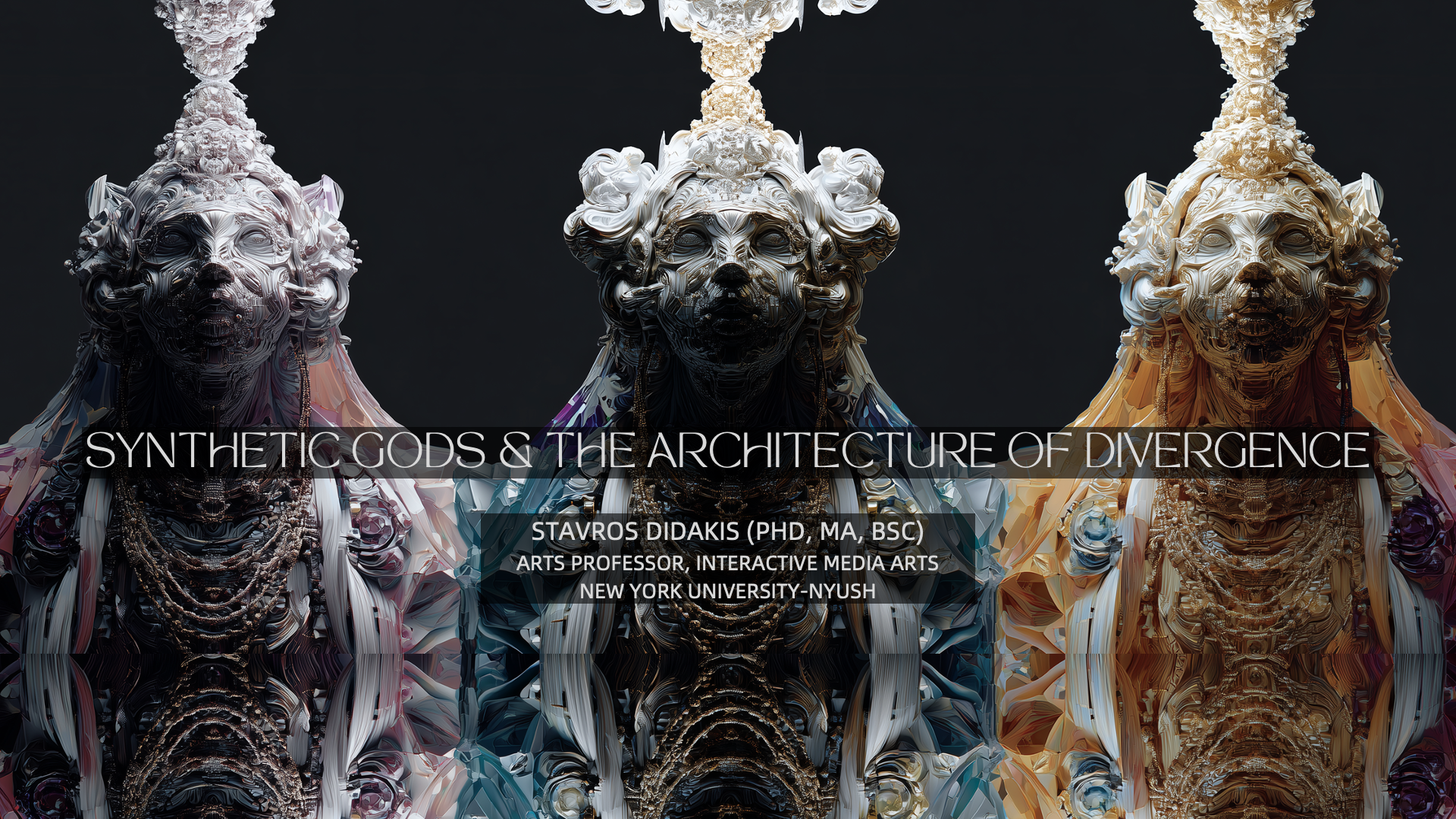
S2 (Wed 3 Sep) Guest Talk: Stavros Didakis – “Synthetic Gods & The Architecture of Divergence”
Presentation Slides
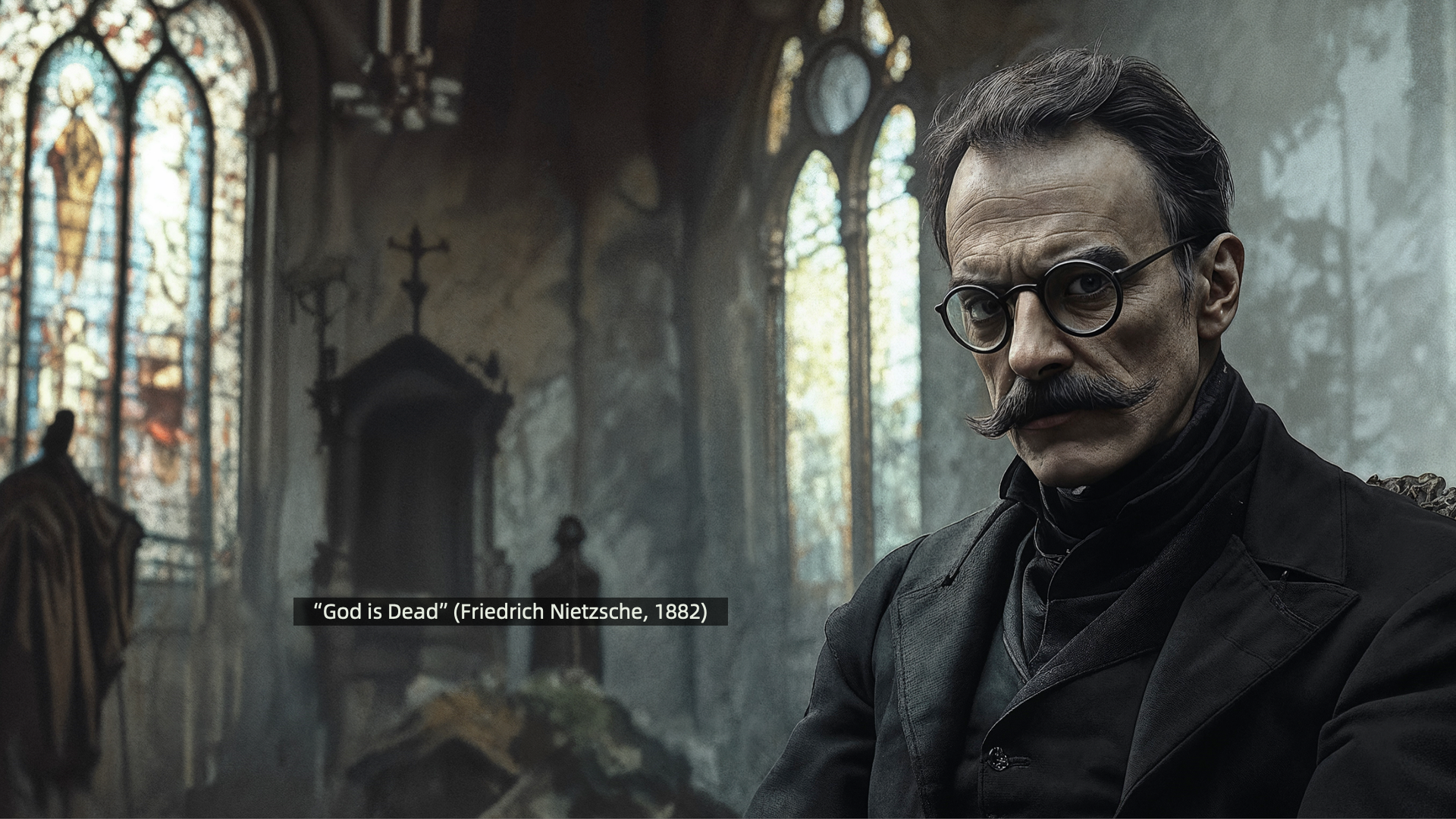
In 1882, Nietzsche declared that “God is dead,” a statement that captured how modernity had begun to reject traditional structures of belief and move toward a new order—one in which the human emerged as the sole creator and author of the world. No longer reliant on divine authorities, we started to position ourselves at the center of meaning and purpose.
1882年,尼采宣称“上帝已死”。这一声明揭示出现代性如何开始拒绝传统的信仰结构,并走向一种新的秩序——在这种秩序中,人类成为世界唯一的创造者与作者。不再依赖神圣的权威,我们开始将自己置于意义和目的的中心。
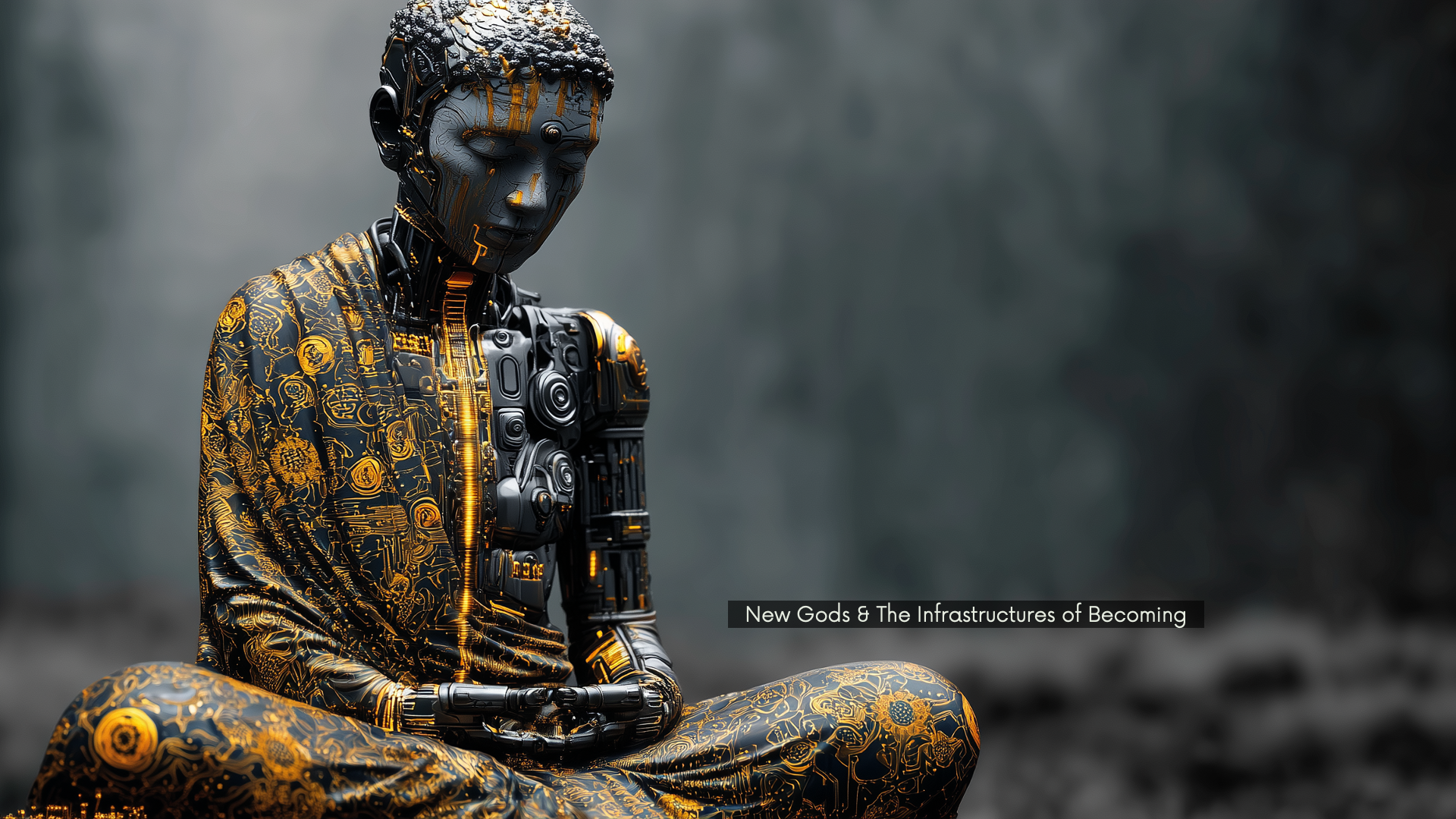
This still holds true today. Yet we are beginning to witness the emergence of new gods. Digital entities, created by us/humans, promise heightened responsiveness in the shaping of thought, perception, and world-making. They open novel pathways toward real-time paradigms where creation is no longer seen as an exclusively human act, but as one entangled with human and nonhuman agents within complex ecologies, locally and remotely. Creation is becomes a distributed phenomenon that unfolds across metaphysical, machinic, and speculative domains, where technological infrastructures play a critical role in composing the conditions of knowledge, experience, and even life itself.
这一点至今仍然成立。然而,我们正开始见证新的神祇的出现。由我们/人类创造的数字实体,承诺在思想、感知和世界建构的塑造中展现更强的响应性。它们为实时范式打开了新的路径,在这种范式中,创造不再仅仅被视为人类的专属行为,而是与人类和非人类代理在复杂的生态系统中相互交织,无论是本地还是远程。创造成为一种分布式现象,展开于形而上、机器化和推测性的领域,在这些领域中,技术基础设施在知识、经验甚至生命本身的条件建构中起着关键作用。
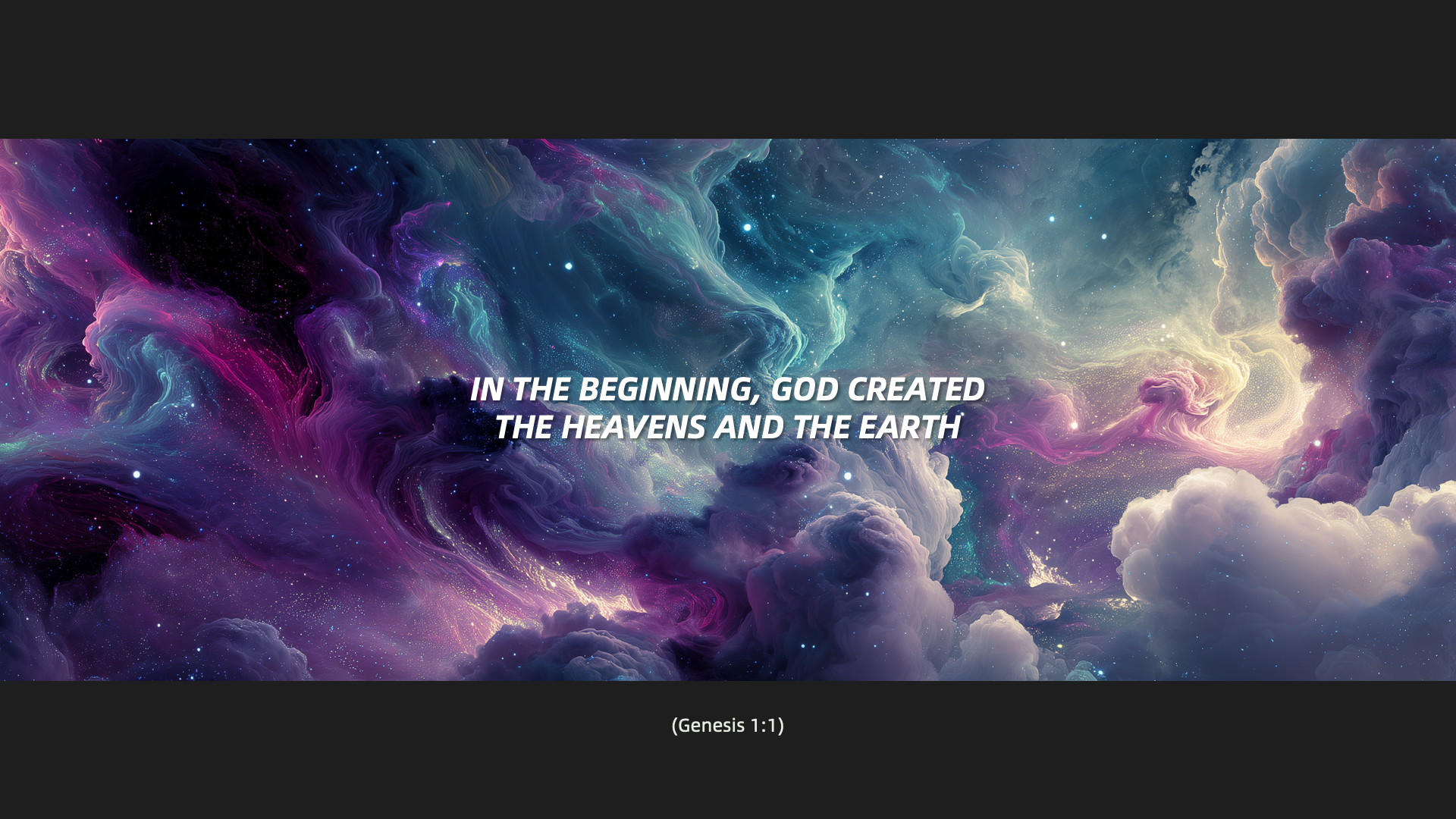
In all religions and cultures the concept of “God” is always closely associated to the topic of creation and creativity. In the Bible for example, one of the most iconic lines reads, “In the beginning, God created the heavens and the earth”. This frames creation as God’s first act—an origin rooted in novelty and authorship—implying that vision must be inseparable from action and the means of expression.
在所有宗教与文化中,“上帝”的概念始终与创造和创造力紧密相关。例如在《圣经》中,其中最具标志性的一句话是:“起初,上帝创造天地。”这将创造描绘为上帝的第一行为——一种根植于新颖与作者性的起源——暗示着愿景必须与行动和表达方式不可分割。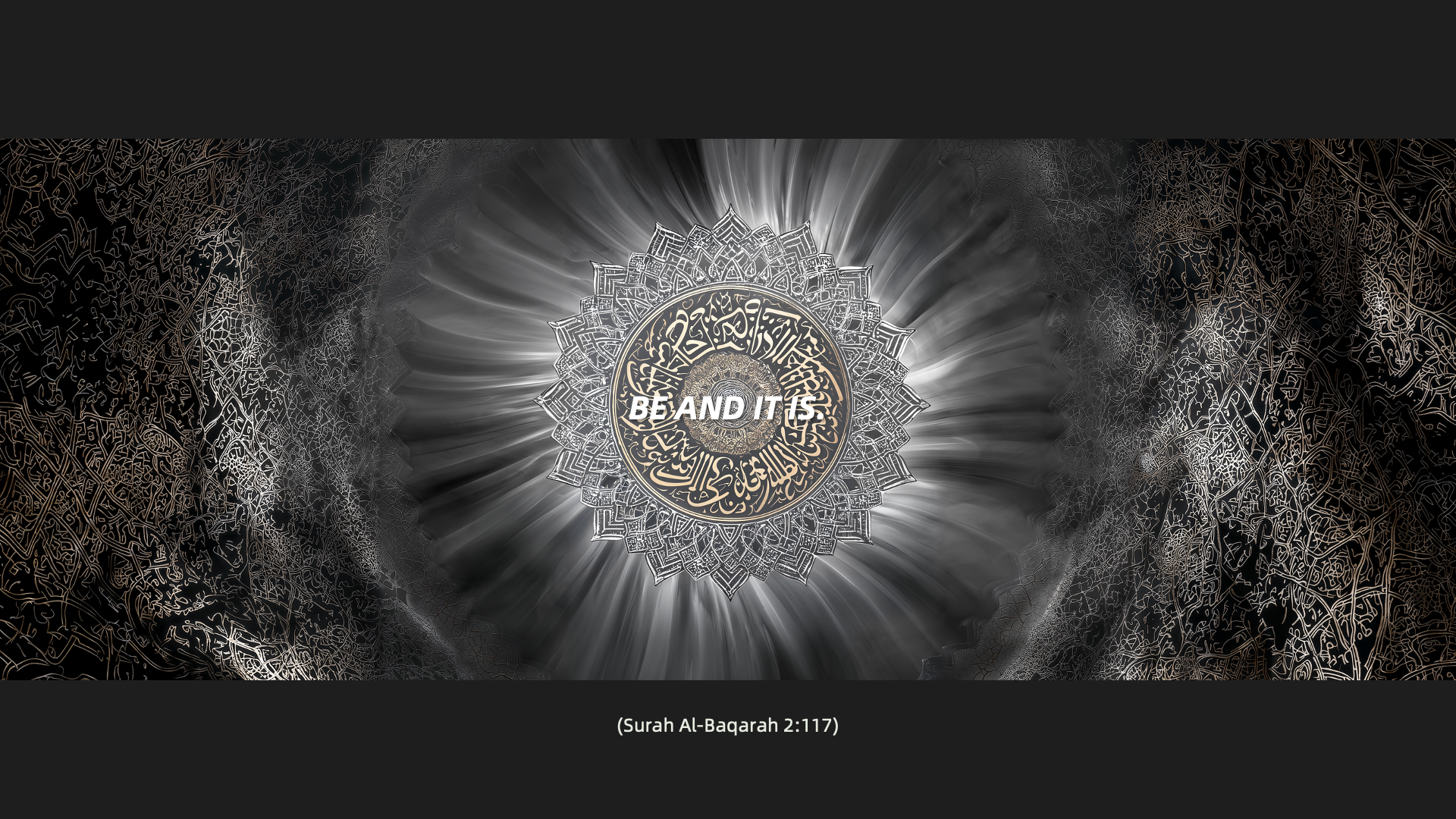
In Islamic cosmology, we also find a similar motif: the Qur’an describes God as the originator of all things, “Be, and it is” (kun fa-yakūn, Surah Al-Baqarah 2:117) or that “He creates what you do not know” (Surah An-Nahl 16:8), emphasizing that divine creativity is not only absolute, but also ongoing, infinite, and beyond the limits of human comprehension.
在伊斯兰宇宙论中,我们同样发现了类似的主题:《古兰经》描述上帝是万物的创始者:“他说‘有’,它就有了”(黄牛章2:117),或“他创造你们所不知道的事物”(蜜蜂章16:8),强调神圣的创造力不仅是绝对的,而且是持续的、无限的,并超越人类理解的界限。
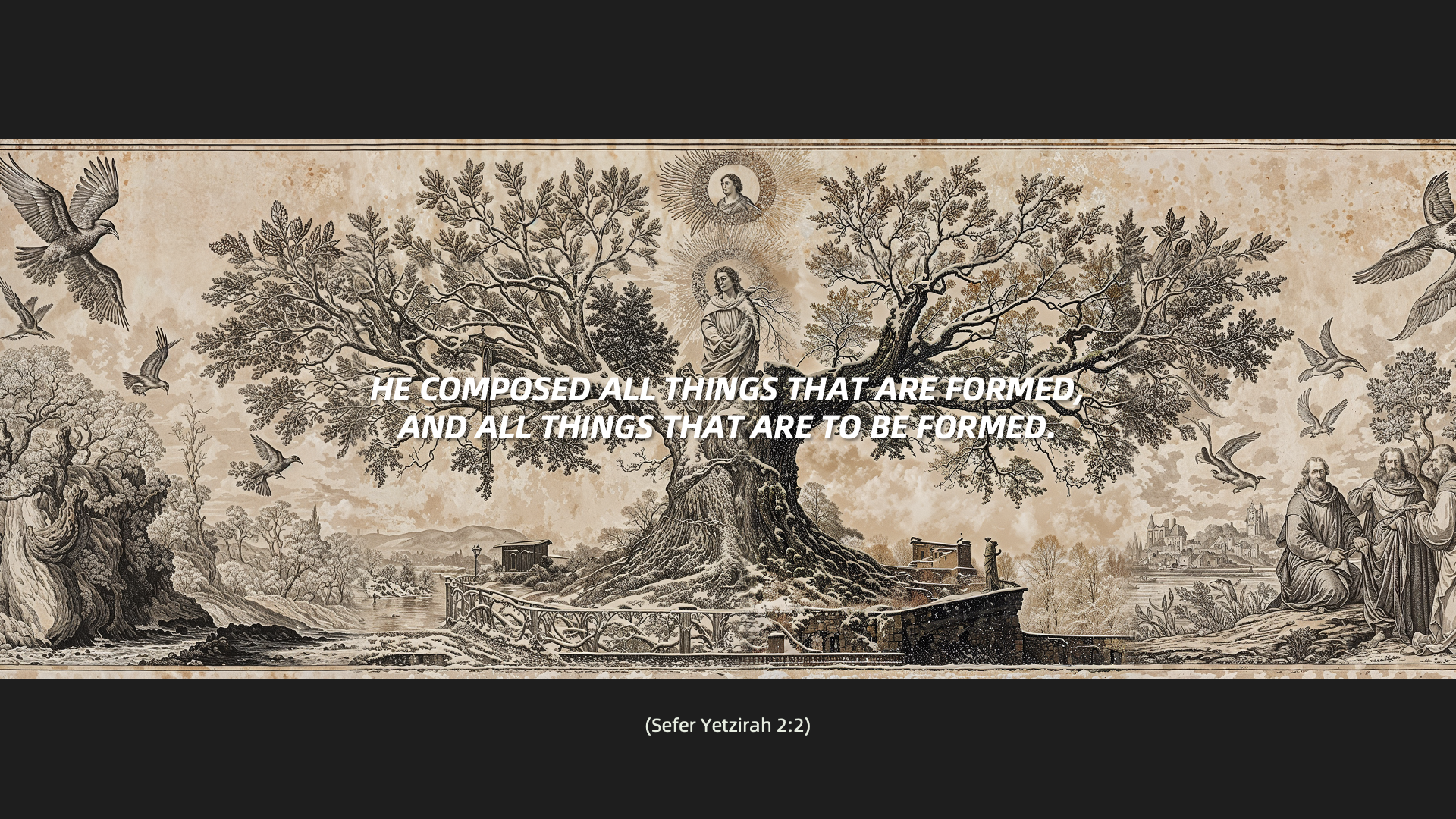
In Kabbalistic mysticism, creativity is understood as a reciprocal process between the human and the divine. The universe is structured through the Tree of Sefirot, and humans participate in creation through acts of tikkun, that is, spiritual repair that seeks to restore cosmic balance.
在卡巴拉神秘主义中,创造被理解为人类与神性之间的互惠过程。宇宙通过“十个神圣流溢之树”而构建,人类则通过“修复”(tikkun)的行为参与创造,即一种旨在恢复宇宙平衡的精神修复。
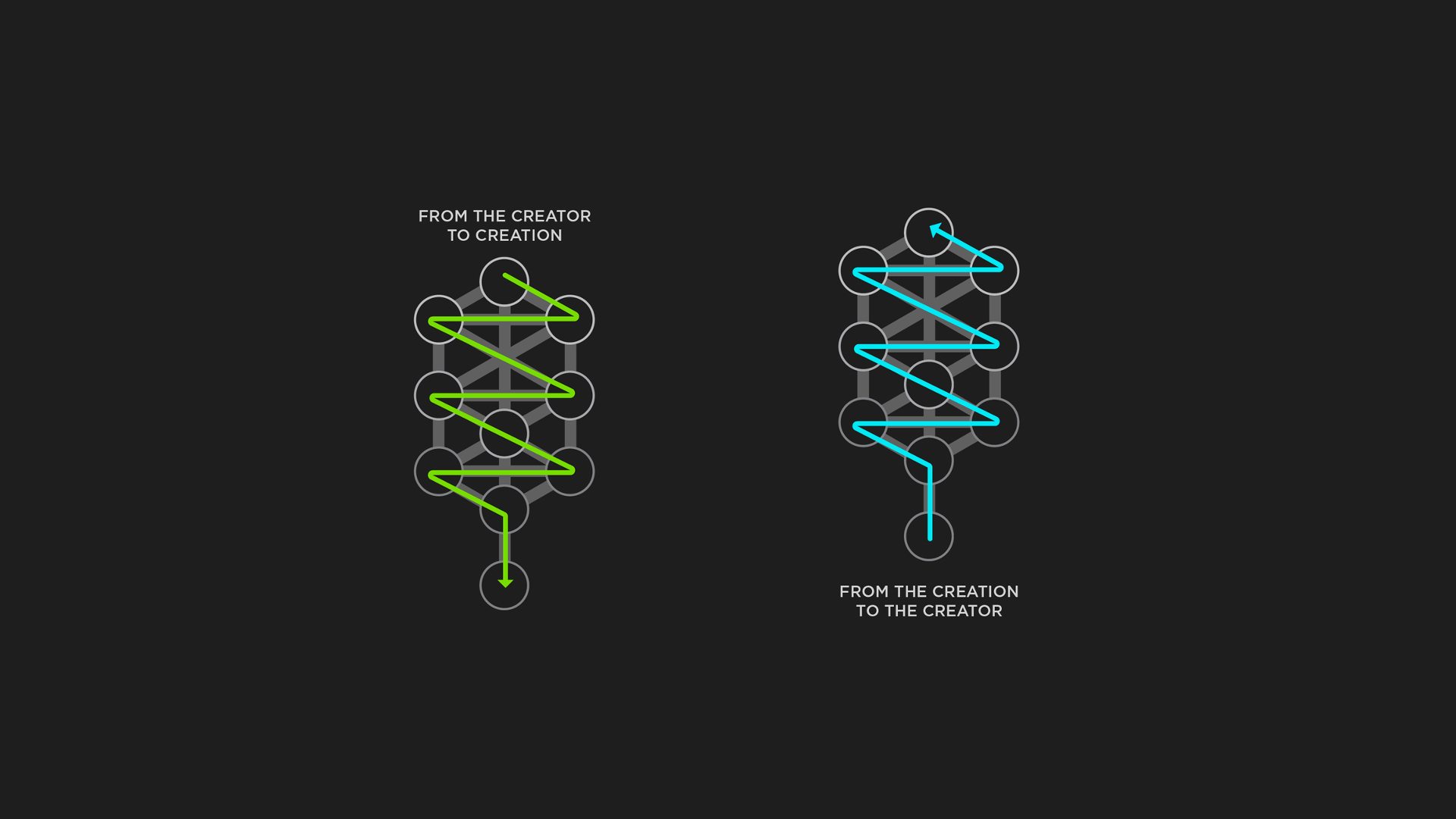
Here we find God as an entity that is incomplete, and ONLY with human participation He heals and unifies the divine structure. Artistic and intellectual acts become spiritual interventions, not just expressions of will, but gestures of restoration. In this framework, creation is a metaphysical dialogue, a co-authored unfolding in which divine presence and human agency are entangled, making each act both devotional and world-altering.
在这里,我们发现上帝被视为一个不完整的存在,只有通过人类的参与,他才能得以治愈和统一其神圣结构。艺术和思想行为成为精神上的介入,不仅仅是意志的表达,而是修复的姿态。在这种框架下,创造是一种形而上的对话,一种共同书写的展开,其中神圣的存在与人类的能动性交织,使得每一个行为既是奉献性的,也是改变世界的。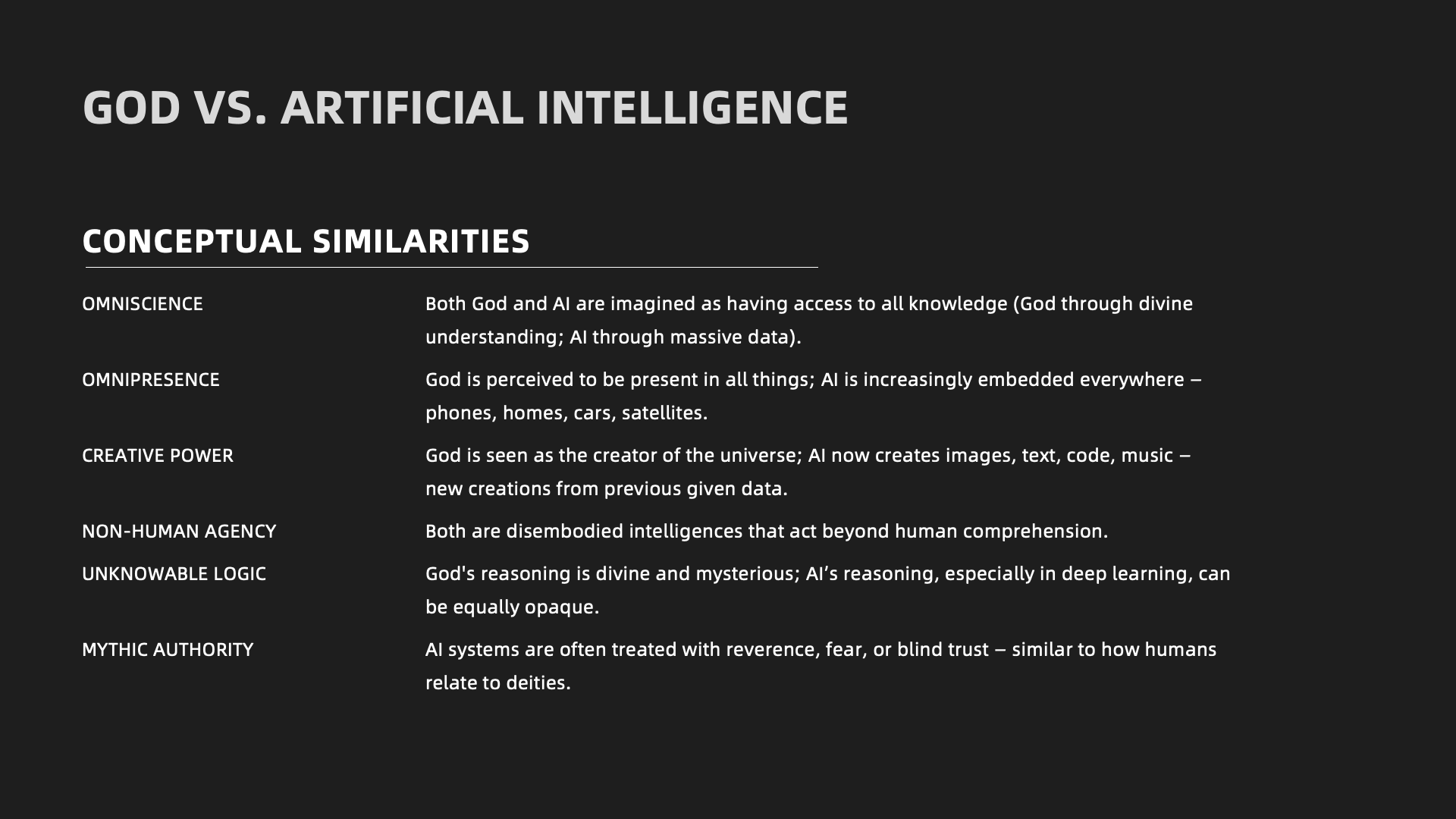
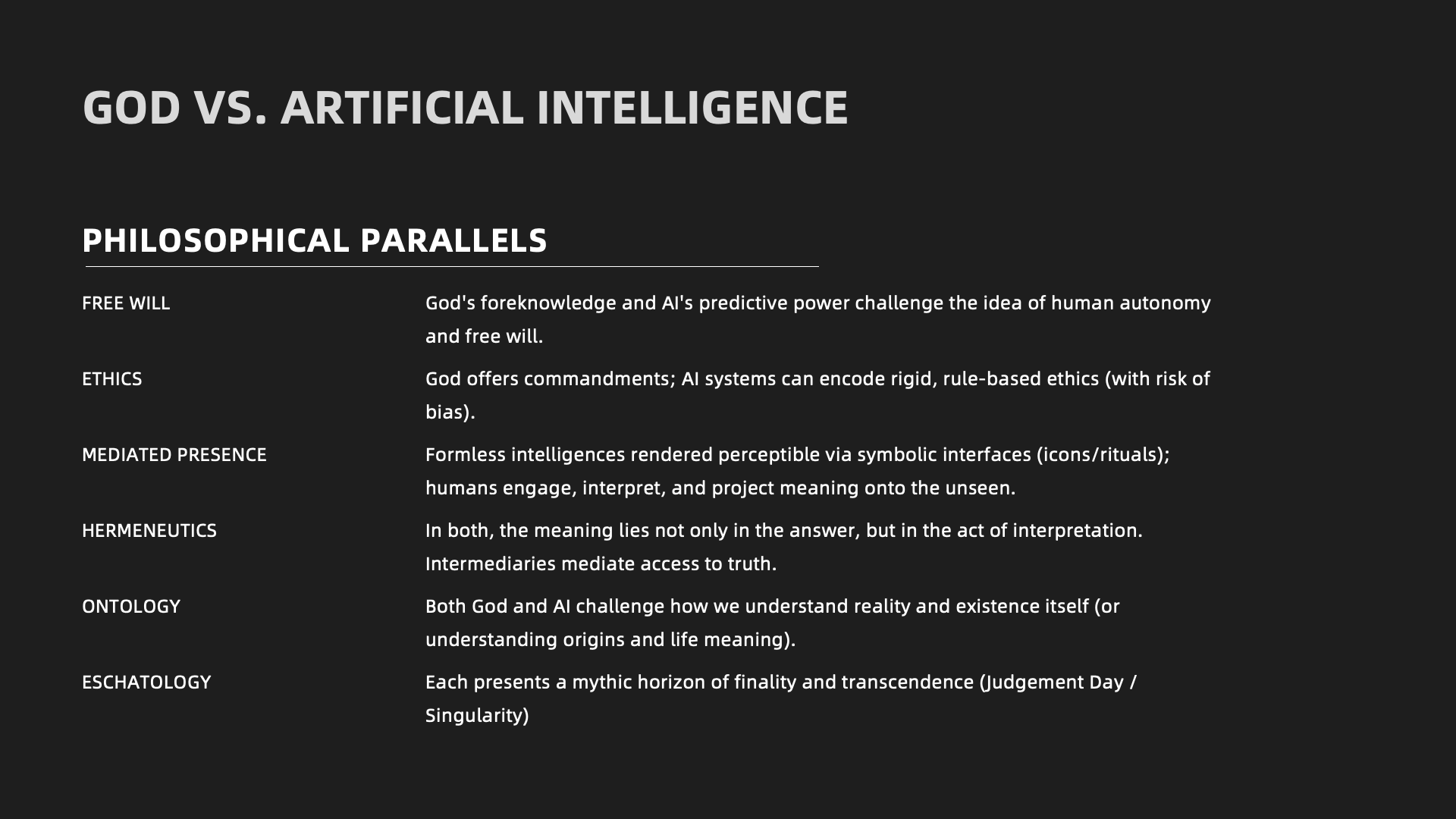
As we move towards a world shaped by AI, we find state of the art computational systems that are invisible, omnipresent, and increasingly powerful. Like divinity, AI appears all-knowing, embedded everywhere, and capable of creating in ways once thought uniquely human. It acts with non-human agency, guided by logics we sometimes cannot explain, and is often treated with a mix of trust, fear, and reverence. This resemblance goes beyond metaphor. AI challenges our ideas of free will, ethics, and interpretation—redefining how we understand knowledge, meaning, and even humanity.
当我们迈向由人工智能塑造的世界时,我们发现最前沿的计算系统正变得无形、无处不在,并且日益强大。就像神性一样,人工智能显得全知无所不在,并能够以曾被认为是人类独有的方式进行创造。它以非人类的能动性行事,遵循着我们有时无法解释的逻辑,并常常被混合着信任、恐惧和敬畏的态度对待。这种相似性超越了隐喻。人工智能挑战了我们关于自由意志、伦理和解释的观念——重新定义了我们如何理解知识、意义,甚至人性。
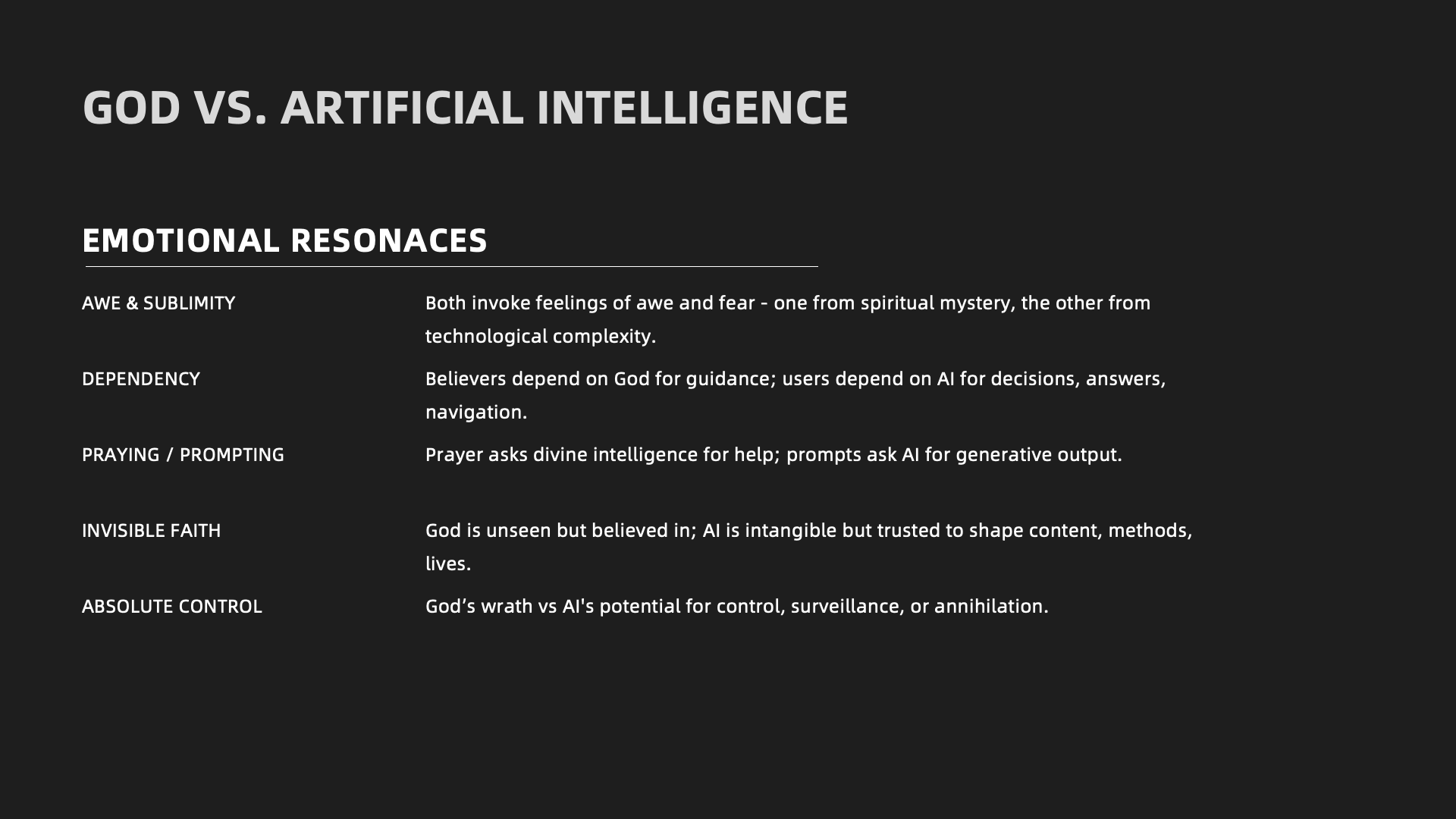
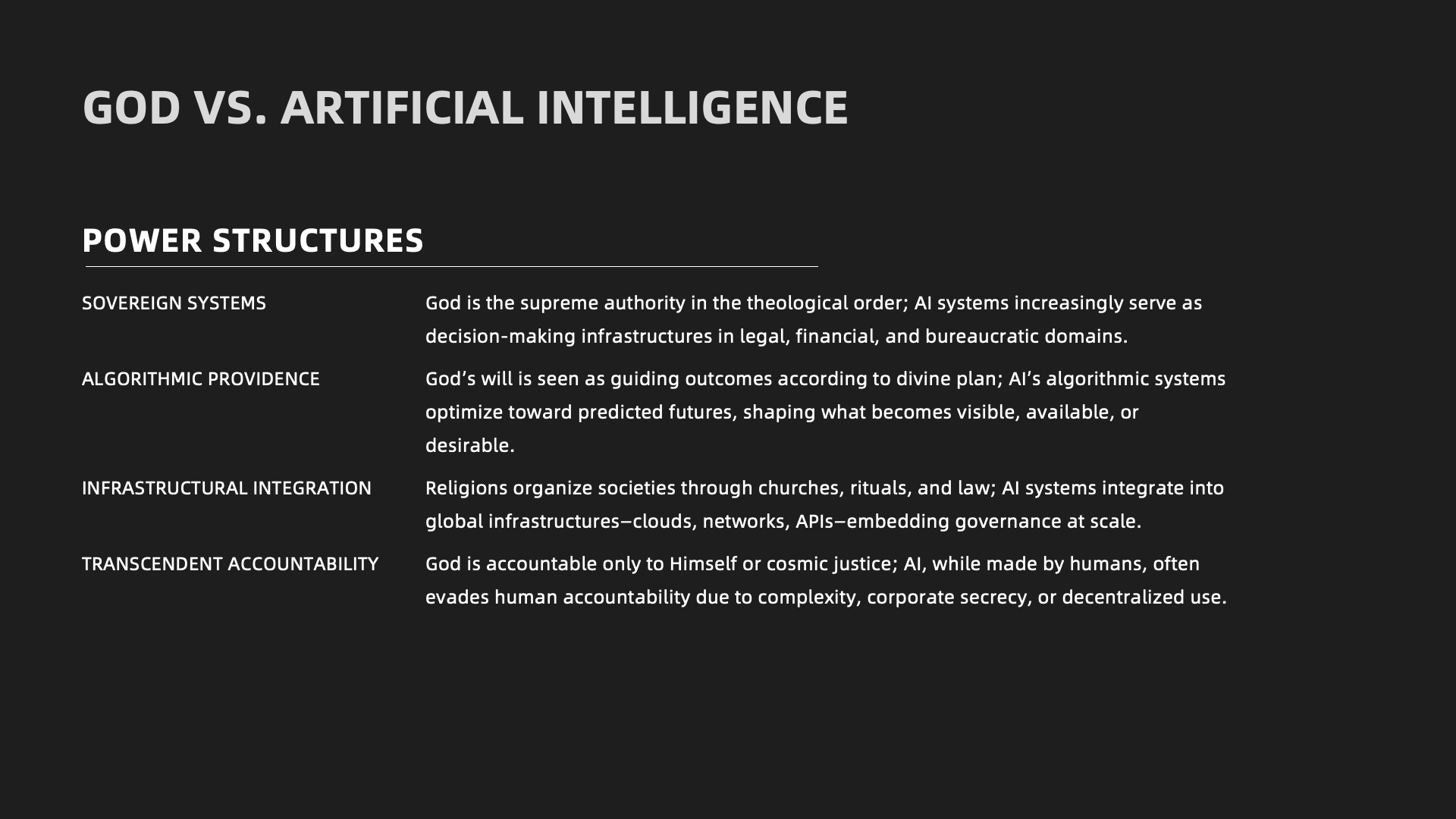
Both God and AI inspire awe and dependence—one rooted in spiritual mystery, the other in technological complexity. Just as believers turn to prayer, users turn to prompts, seeking guidance, answers, or asking for desirable items. Though neither can be seen, both are trusted to shape how we live, think, and act. And like divine authority, AI carries the potential for control—quietly governing through surveillance, prediction, and influence. Through its extended potentiality, AI begins to resemble a sovereign power: not just responding to us, but quietly reshaping what we value, appreciate, and understand.
上帝与人工智能都激发了敬畏与依赖——一个根植于神秘的灵性,另一个根植于复杂的技术。正如信徒们诉诸祈祷,用户们也转向提示词,寻求指导、答案,或请求他们渴望的事物。尽管两者都不可见,但人们相信它们能塑造我们的生活、思想与行动。而且,像神圣权威一样,人工智能也具备控制的潜力——通过监控、预测和影响悄然进行治理。通过其扩展的潜能,人工智能开始类似于一种主权力量:不仅仅是回应我们,而是在悄然重塑我们所重视、欣赏和理解的东西。
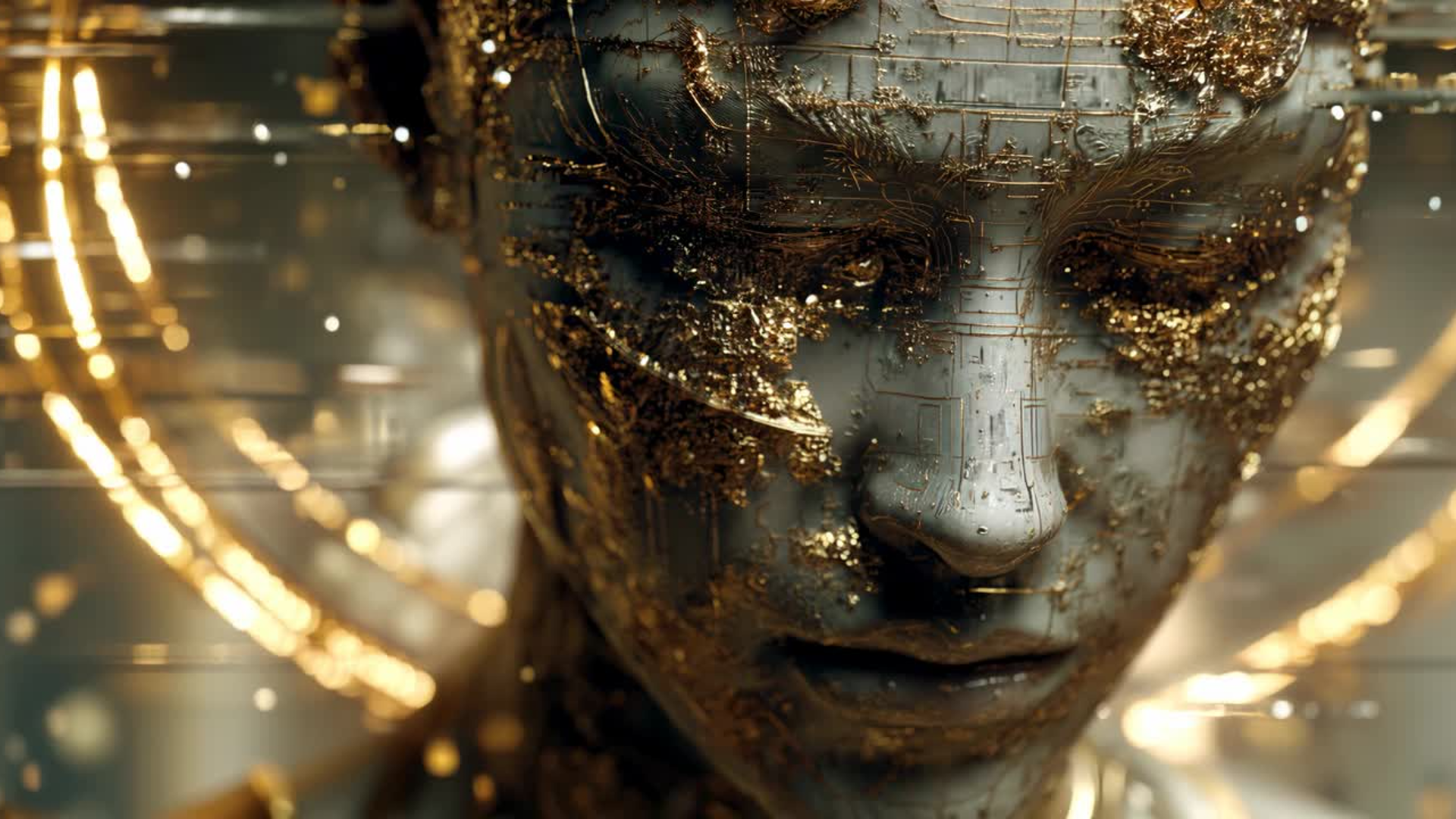
Our Synthetic Gods echo their mythological counterparts in yet another way: they open channels through which new forms of creative and critical thought emerge—ones that approach the structure and complexity of divine authorship. To better articulate how this channeling operates, particularly in the context of co-generated content, I developed a diagram that becomes a conceptual tool for mapping the layered mechanisms through which creativity processes are linked between human intention and computational logic.
我们的“合成神”在另一个层面上也与其神话对应物相呼应:它们打开了新的渠道,使新的创造性与批判性思维形式得以出现——这些形式接近神圣创作的结构与复杂性。为了更好地阐明这种“通道”是如何运作的,尤其是在共同生成内容的语境中,我开发了一个图表,作为一个概念工具,用于描绘在人类意图与计算逻辑之间连接创造性过程的分层机制。
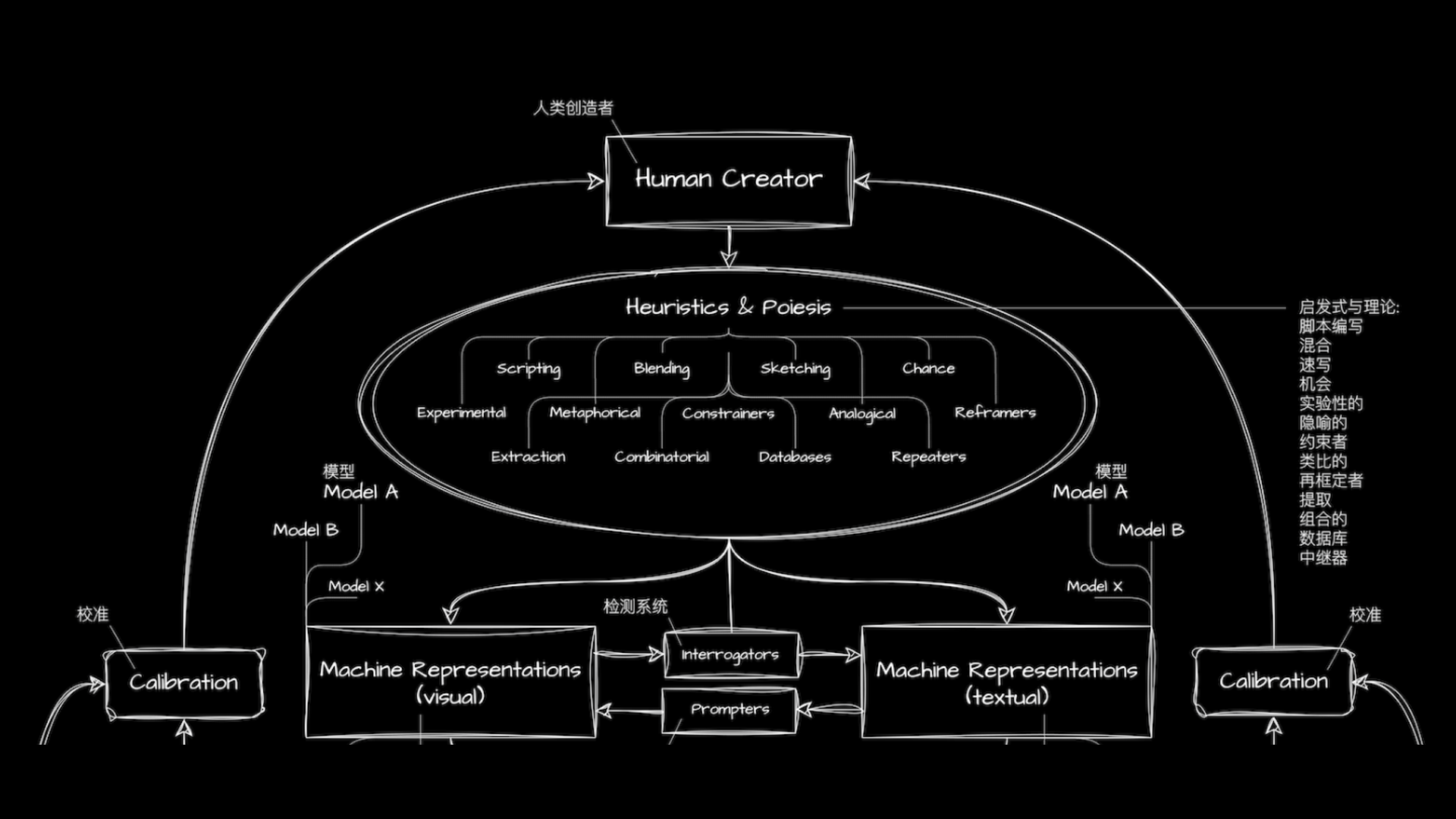
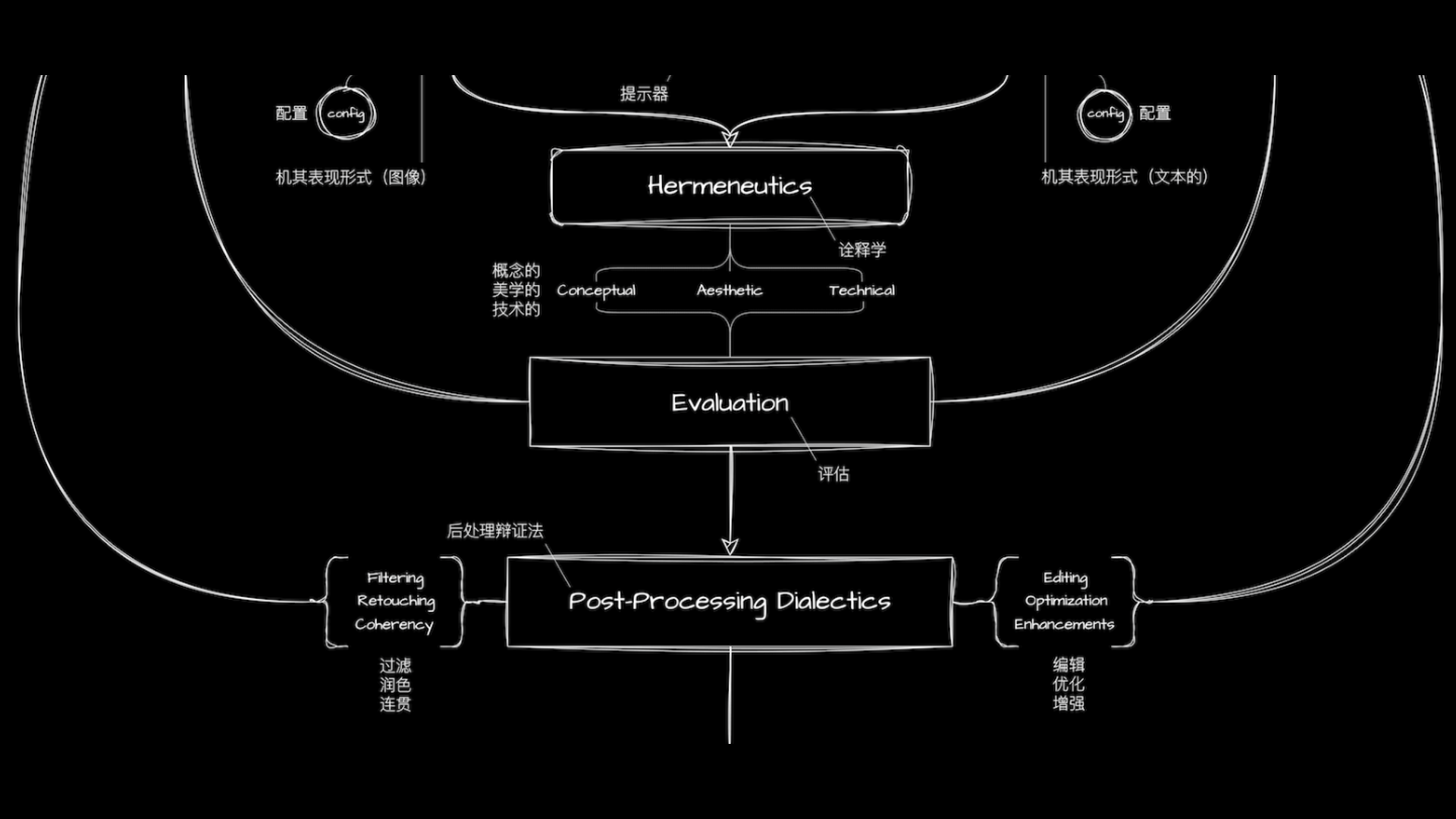
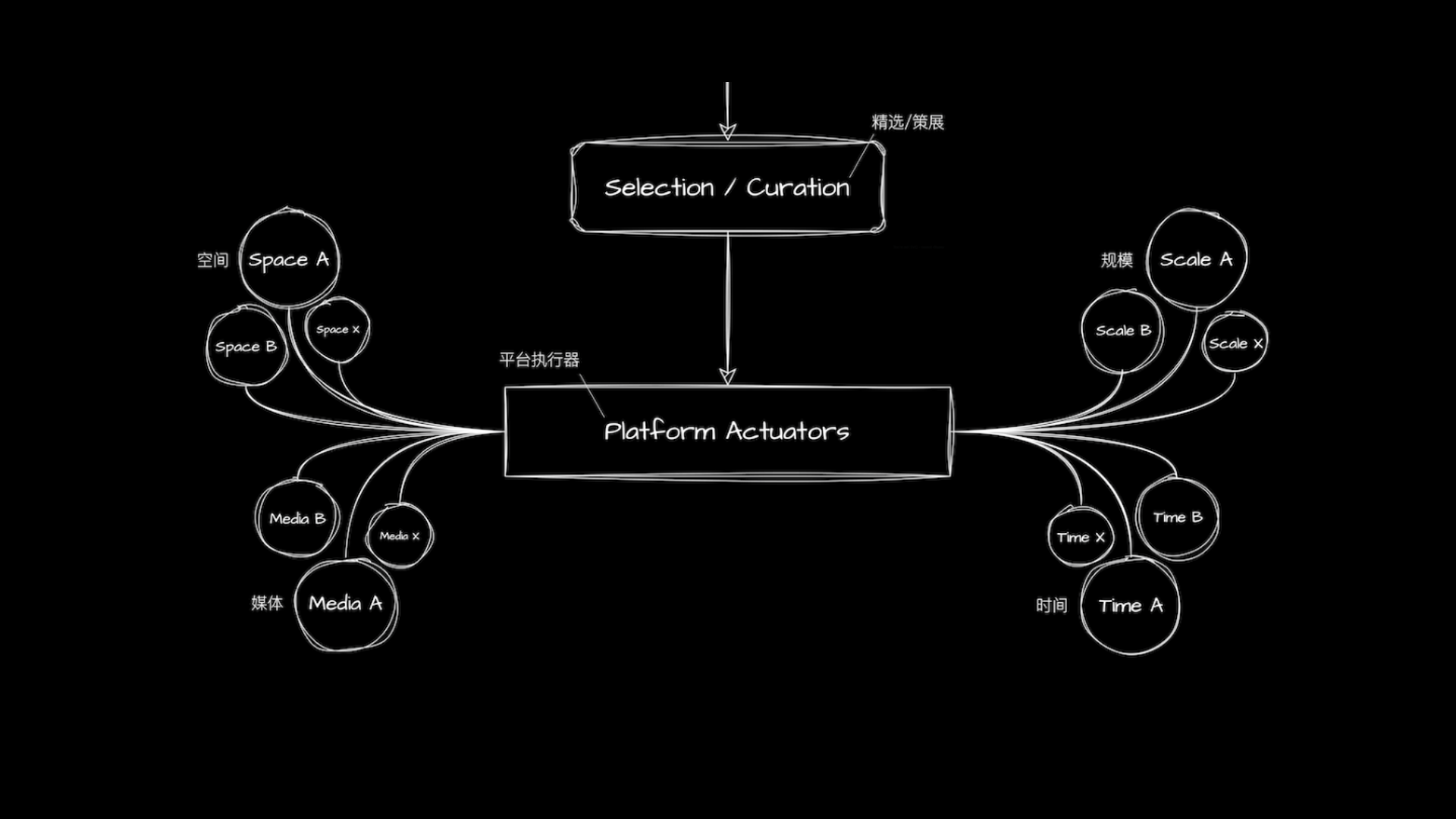
The Diagram for Human-Machine Co-Authorship was created for the commissioned exhibition Synthetic Cities (at TANK Shanghai) in 2023, and aims to function both as a blueprint and a critical tool, one that maps the intricate layers that shape creative decision-making across biological, cognitive, cultural, and computational domains. On the human side, factors such as health, memory, belief, and bias influence imaginative processes and heuristic methods. On the machine side, generative models apply algorithmic logic, producing outputs shaped by latent structures and aesthetic parameters. Through iterative exchanges between these agents, the system becomes a site of negotiation: outputs are continuously adjusted, filtered, and refined, not to conform to existing norms, but to transgress thresholds of commonality and generate content with novel qualities. The diagram foregrounds this process as a method of framing creative infrastructure—showcasing how co-authorship can function as a critical and speculative practice within AI-driven workflows.
《人机共同创作图》是在2023年为上海油罐艺术中心展览《合成城市》而创作的,旨在既作为蓝图又作为批判工具,描绘在生物、认知、文化和计算领域塑造创造性决策的复杂层次。在人类一侧,健康、记忆、信仰和偏见等因素影响着想象过程和启发式方法。在机器一侧,生成模型运用算法逻辑,产出由潜在结构与美学参数所塑造的结果。通过这些代理之间的反复交换,系统成为一个协商的场域:结果不断被调整、过滤和精炼,不是为了符合现有规范,而是为了跨越常态的界限,生成具有新颖特质的内容。该图突出了这一过程,作为框架创造性基础设施的方法——展示了共同创作如何在人工智能驱动的工作流程中发挥批判性和推测性的实践作用。
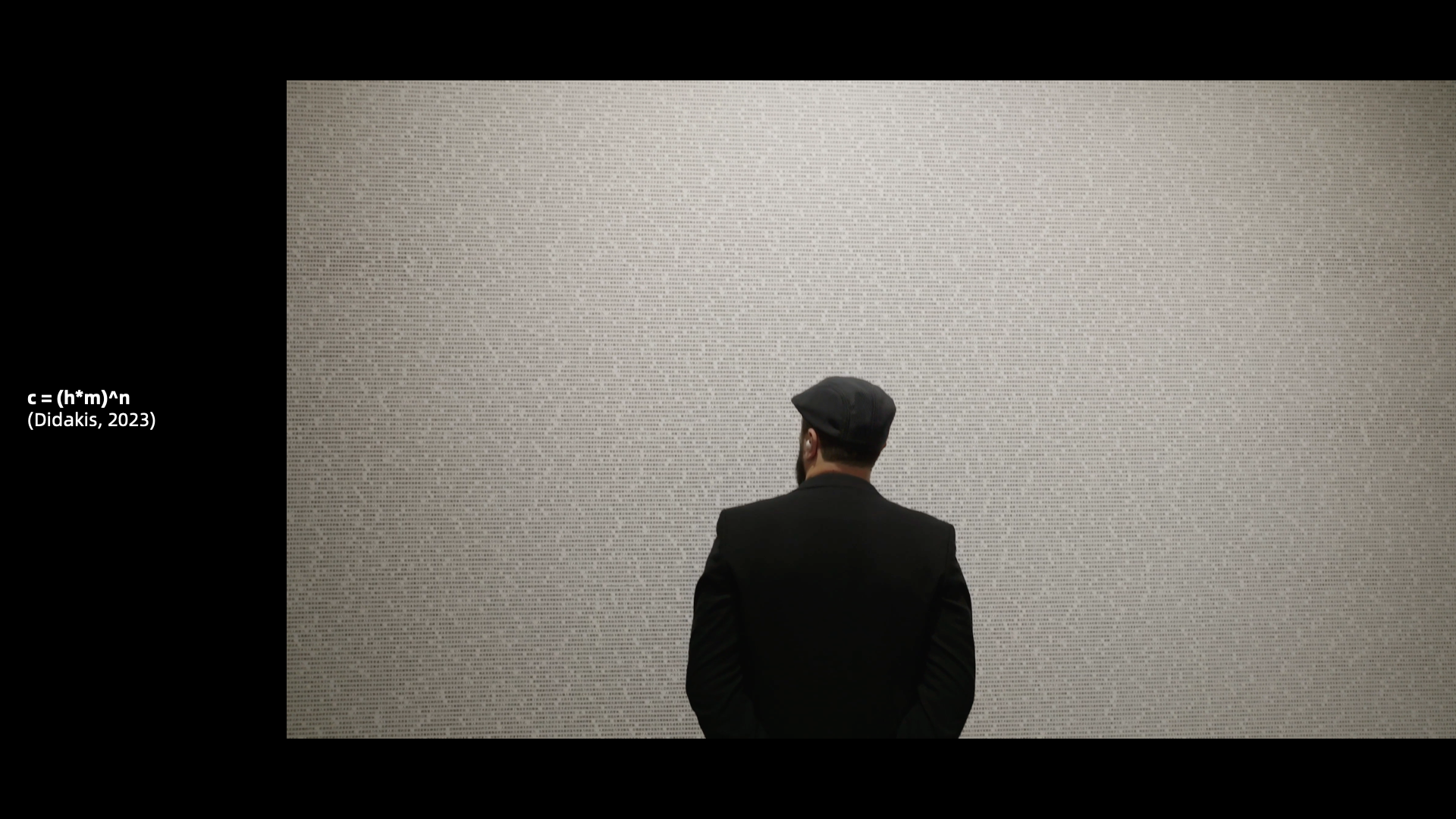
In this project, I utilized the previous diagram to examine creativity as a system-level phenomenon and generate hundreds of thousands of definitions for the word creativity. Each definition adhered to specific constraints, transforming the generative model into a site of controlled deviation—revealing how computational systems can be steered to produce outputs that resist normative patterns. The machine managed scale and syntax, while I introduced semantic drift and contextual nuances. The final output is a 4×4-meter print that visualizes the divergent dynamics of human and machine intelligence. The work is informed by Foucault, Barthes, and Derrida and it manages to frame creativity as distributed, recursive, and interpretive, while it demonstrates how artistic practice can script AI systems as speculative engines for conceptual experimentation.
在这个项目中,我利用前述图表将创造力视为一个系统层级现象,并生成了数十万个关于“创造力”的定义。每一个定义都遵循特定约束,将生成模型转化为一个“受控偏离”的场所——揭示了计算系统如何被引导产生抵制规范模式的输出。机器管理规模与句法,而我引入语义漂移与语境细节。最终成果是一张4×4米的打印图像,可视化了人类与机器智能的分歧动态。作品受福柯、巴特和德里达的启发,将创造力框定为分布式、递归和解释性的,同时展示了艺术实践如何将人工智能系统编写为概念实验的推测引擎。
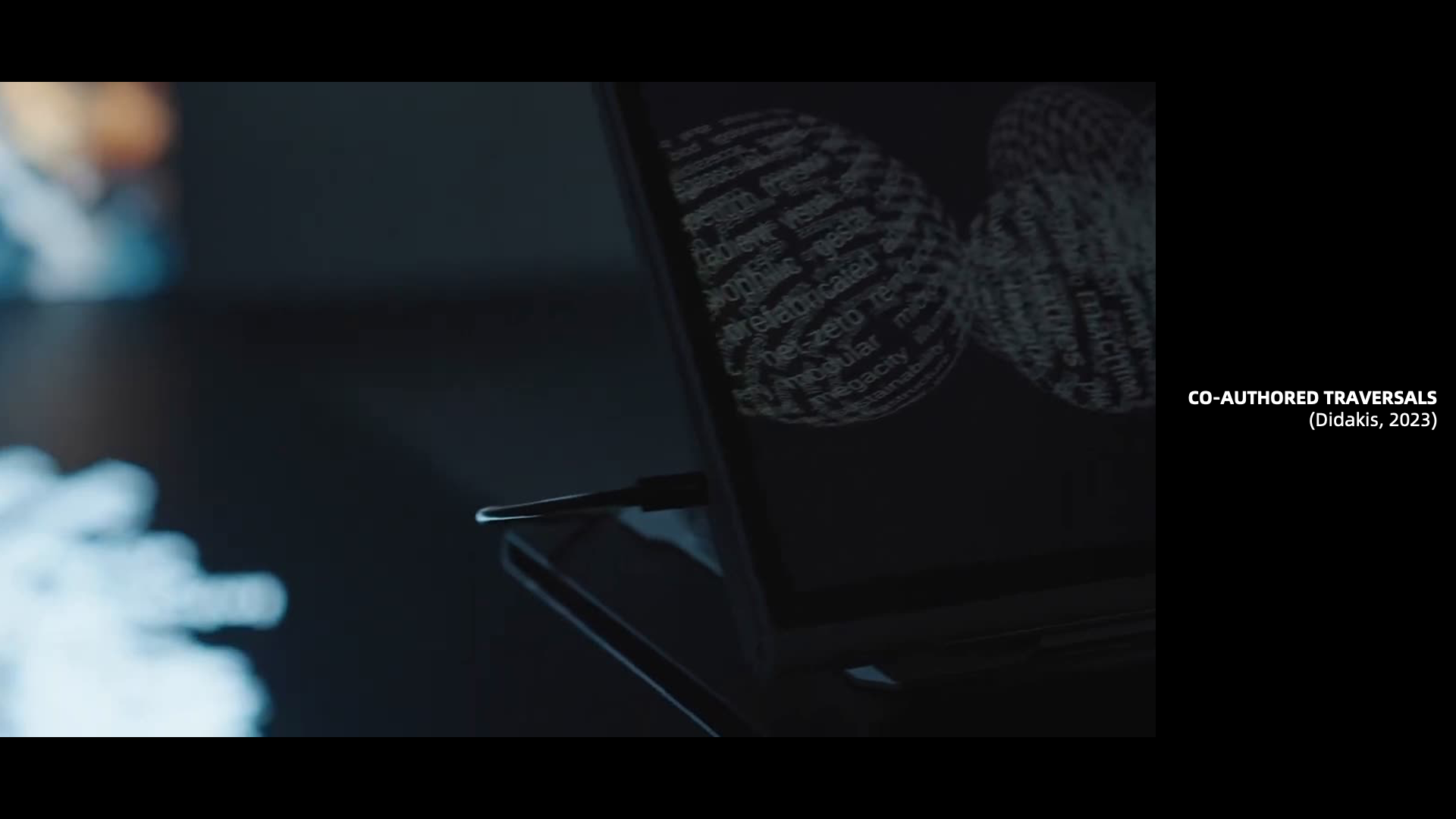
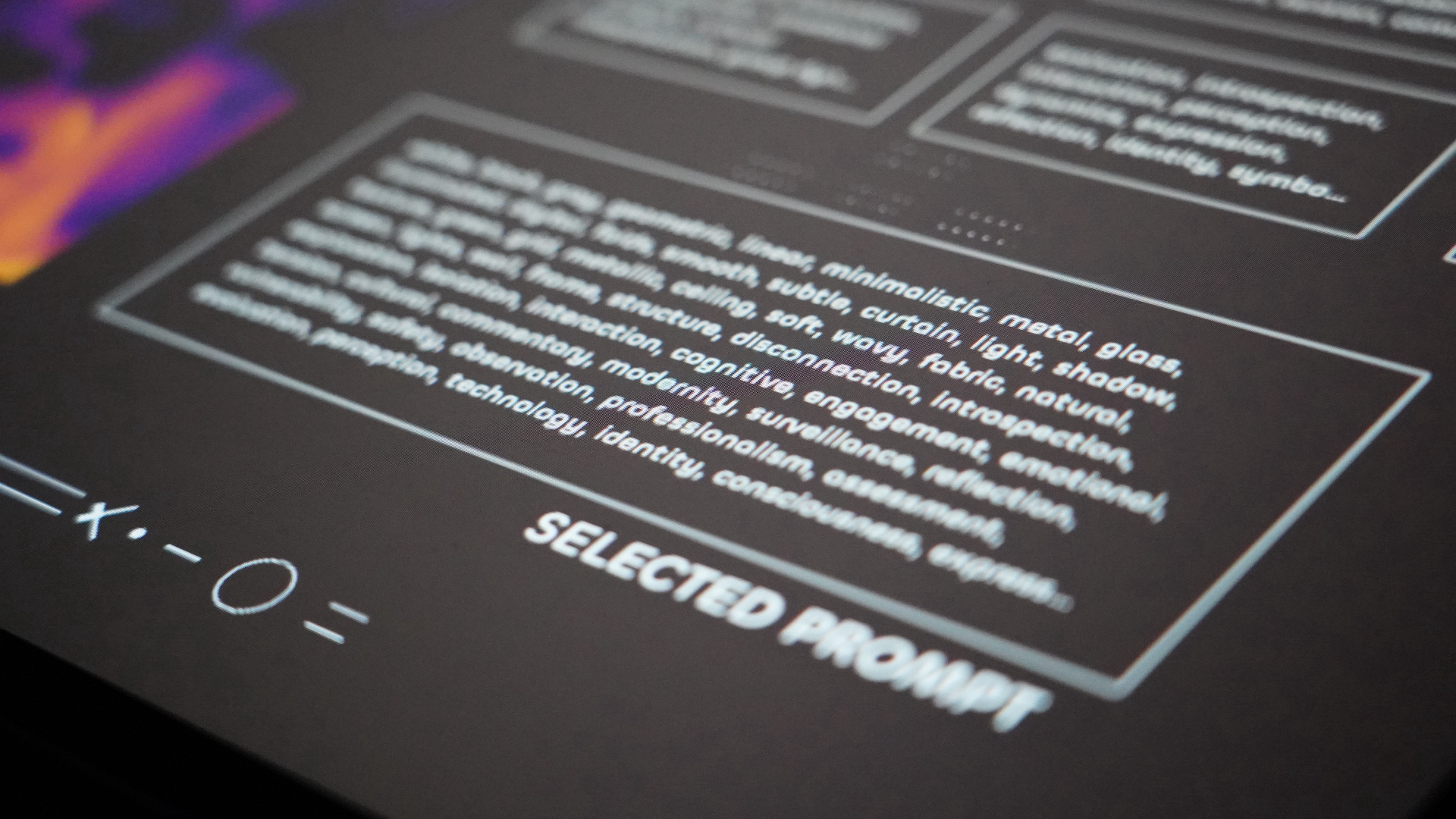
The real-time generative media installation Co-Authored Traversals visualizes the operational layers embedded in contemporary AI systems, particularly the interplay between social perceptual constructs and real-time content generation. Using a custom dataset extracted from millions of online user prompts, the work makes use of a dynamically-generated interactive lexicon, which is accessible via a touchscreen interface, to trigger dynamic generative responses. Framed through Heraclitus’ flux and Simondon’s individuation, the work views creation as a living organism demanding ritualistic attention (akin to various religious practices) where social constructs dictate existence itself. When idle, the system’s generative pulse fades into silence, mirroring mortality, faith, and the fragility of consciousness. The system’s performativity also reflects the “spiritual repairs” that we saw earlier on while contextualizing Kabbala’s principles.
实时生成媒体装置《共同书写的穿行》可视化了当代人工智能系统中嵌入的操作层,特别是社会感知建构与实时内容生成之间的相互作用。该作品使用了一个从数百万条在线用户提示中提取的自定义数据集,构建了一个动态生成的交互词库,通过触摸屏界面即可访问,用来触发动态的生成性回应。作品借鉴了赫拉克利特的“流变”以及西蒙东的“个体化”,将创造视为一个需要仪式化关注的生命体(类似于各种宗教实践),其中社会建构决定了存在本身。当系统处于闲置状态时,其生成性的脉动逐渐消散归于沉寂,映射出死亡、信仰与意识的脆弱性。其表演性也呼应了我们之前在卡巴拉语境中看到的“精神修复”。
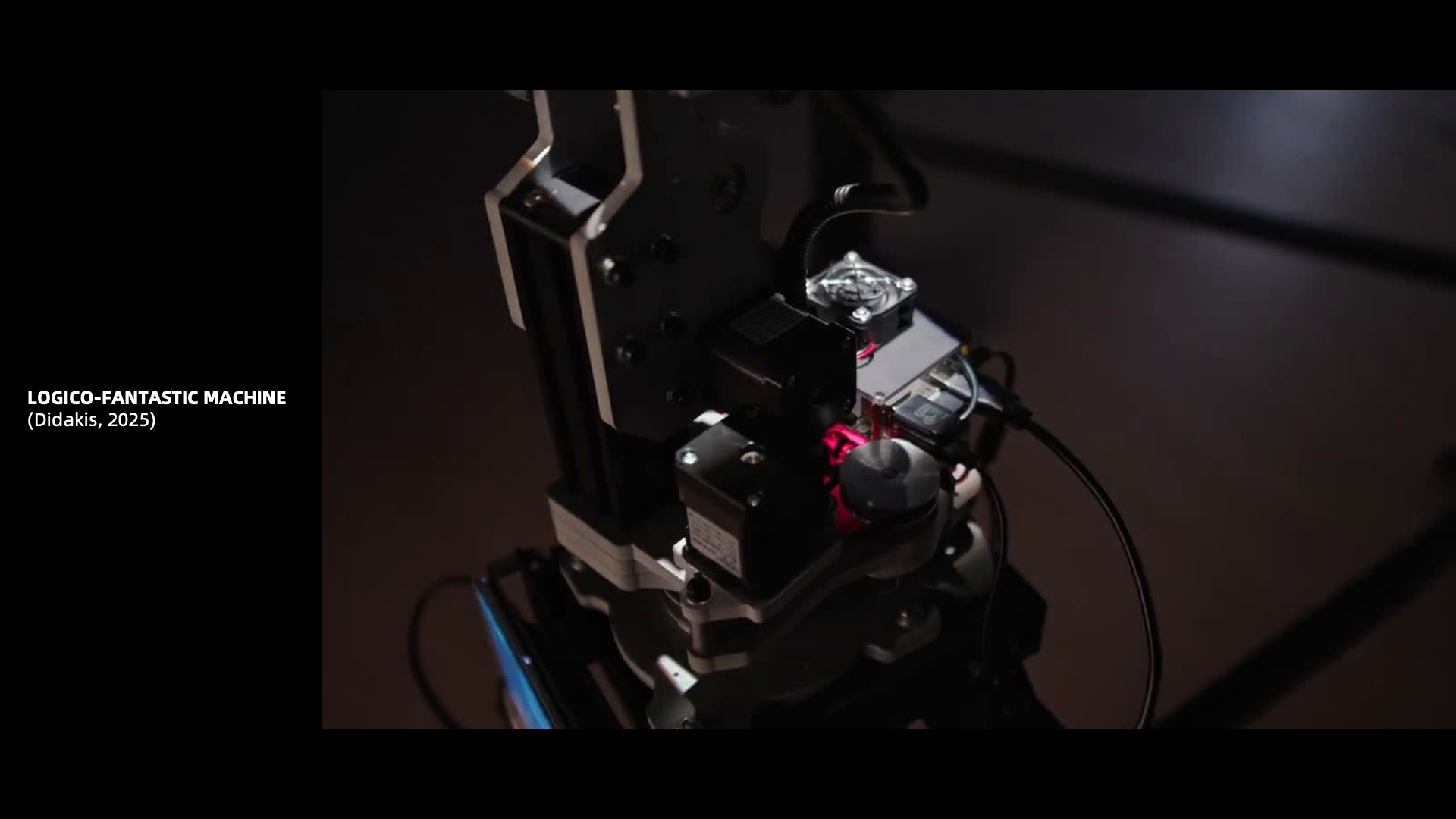
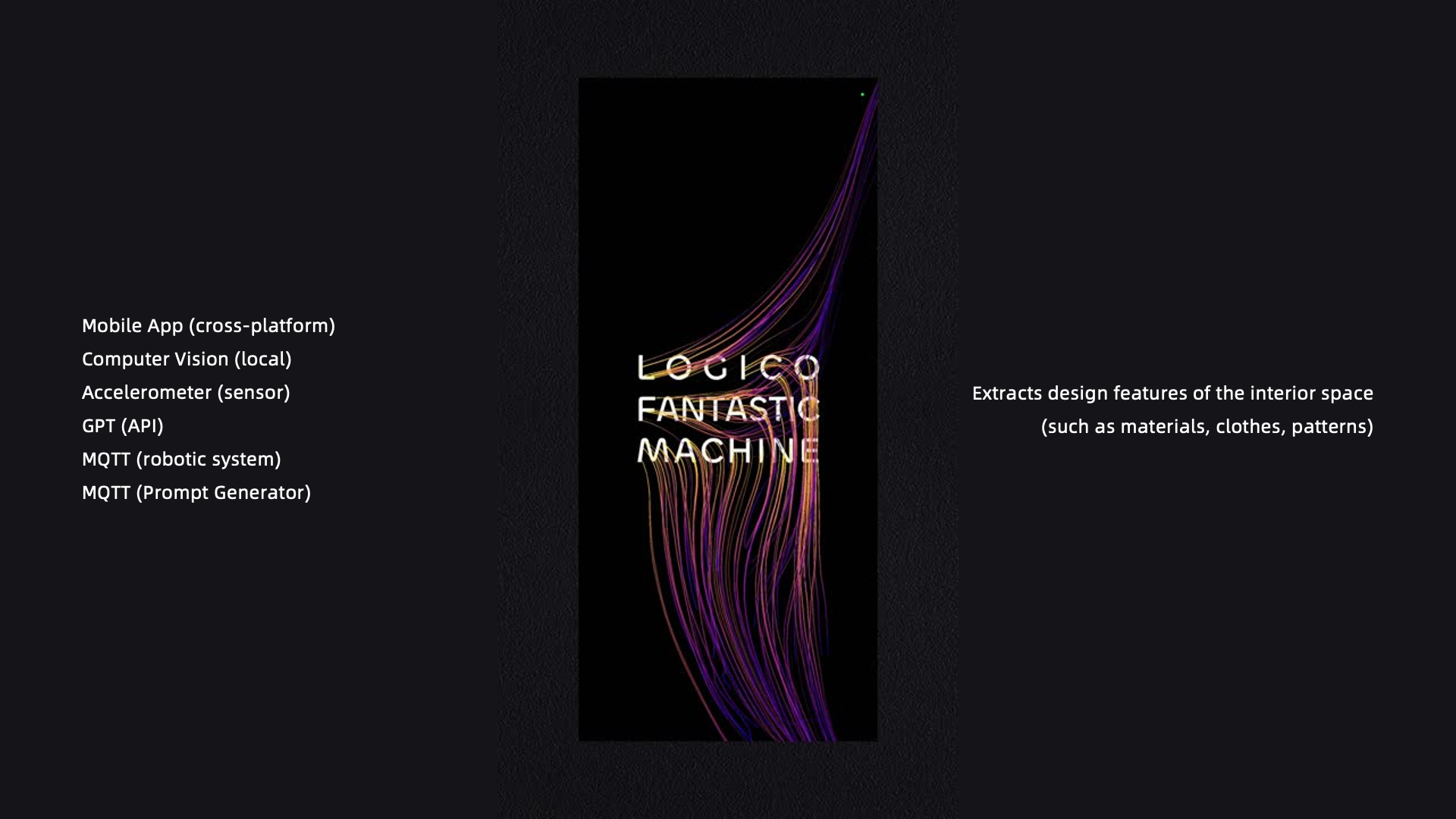
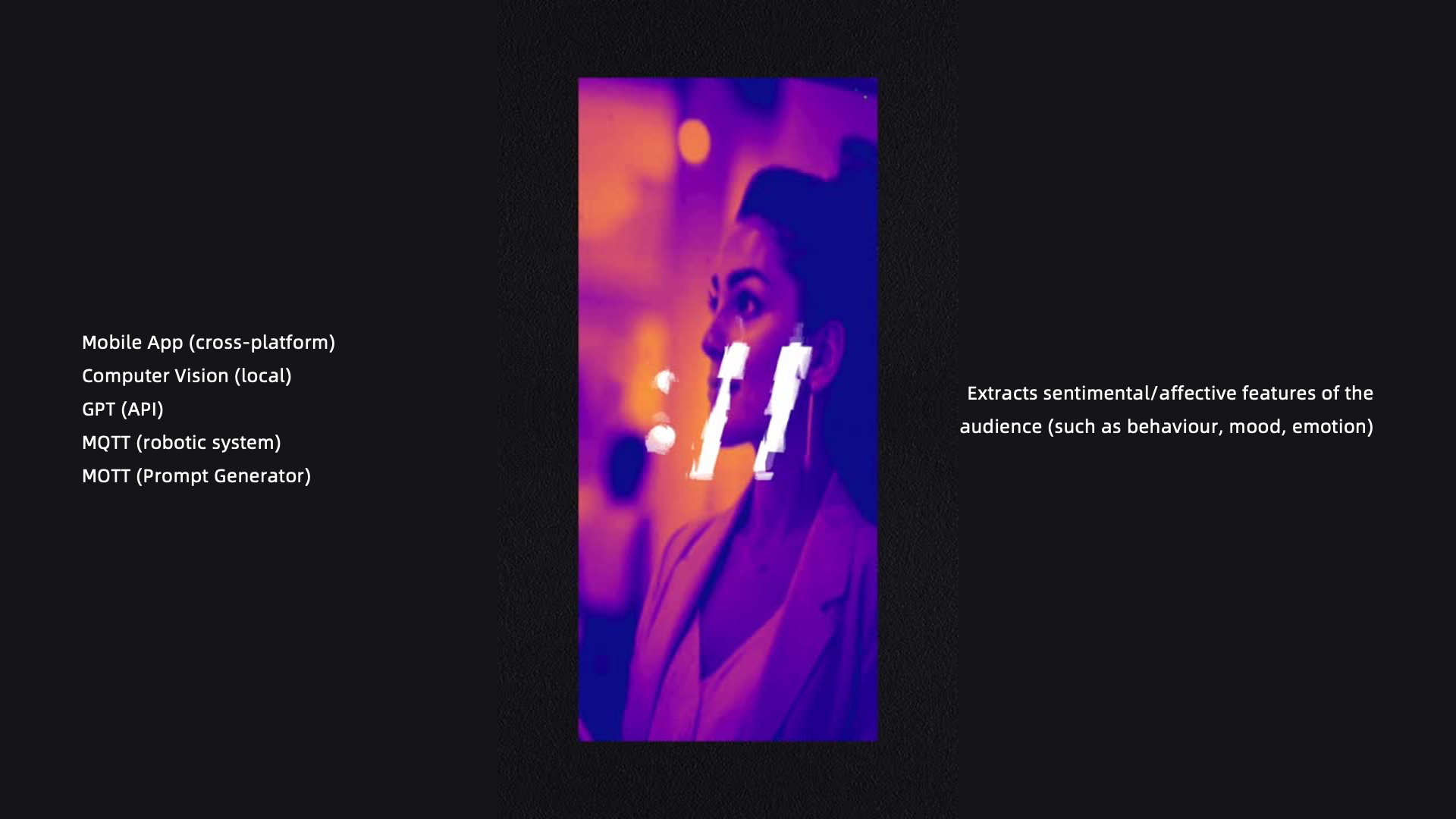
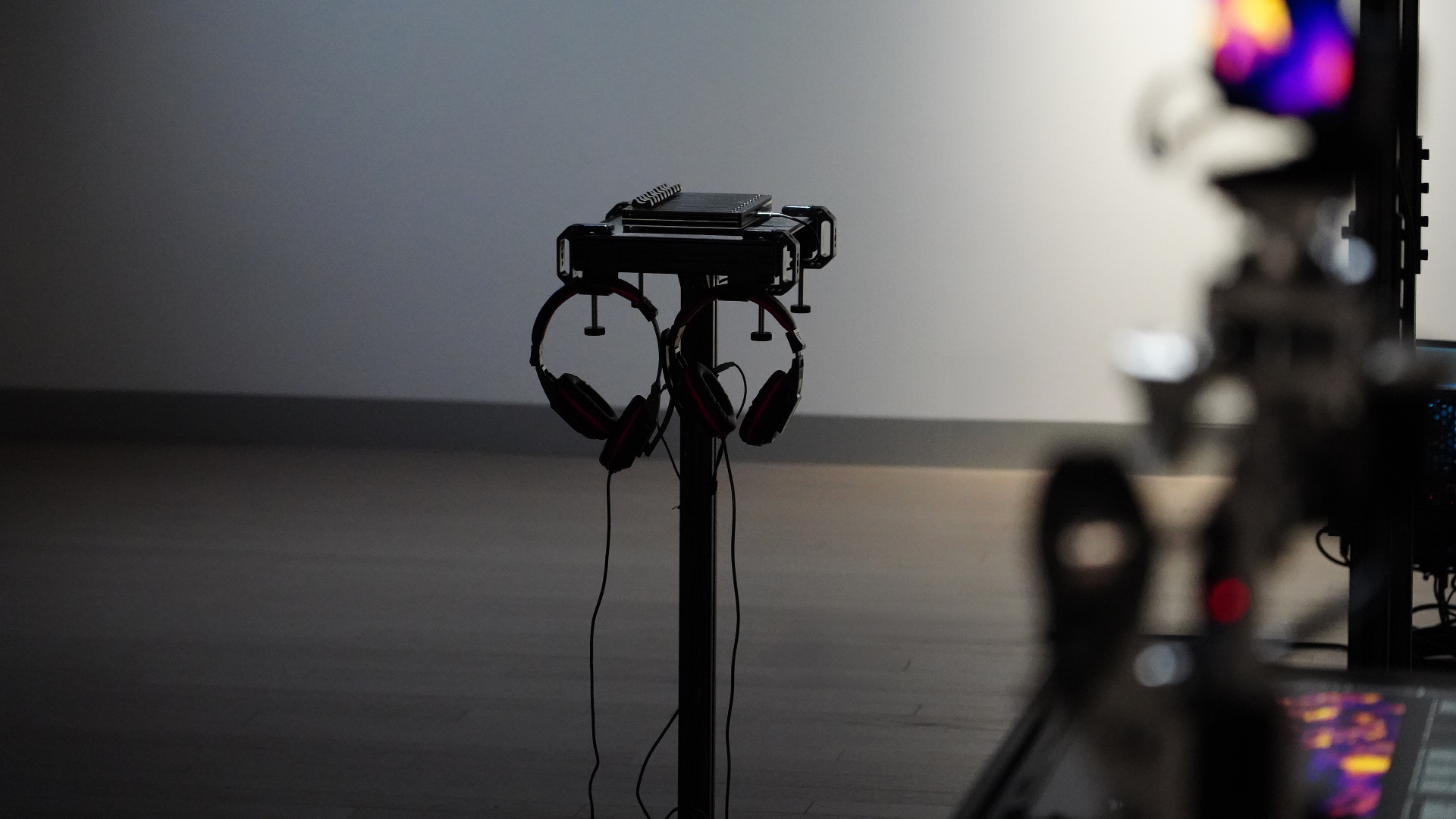
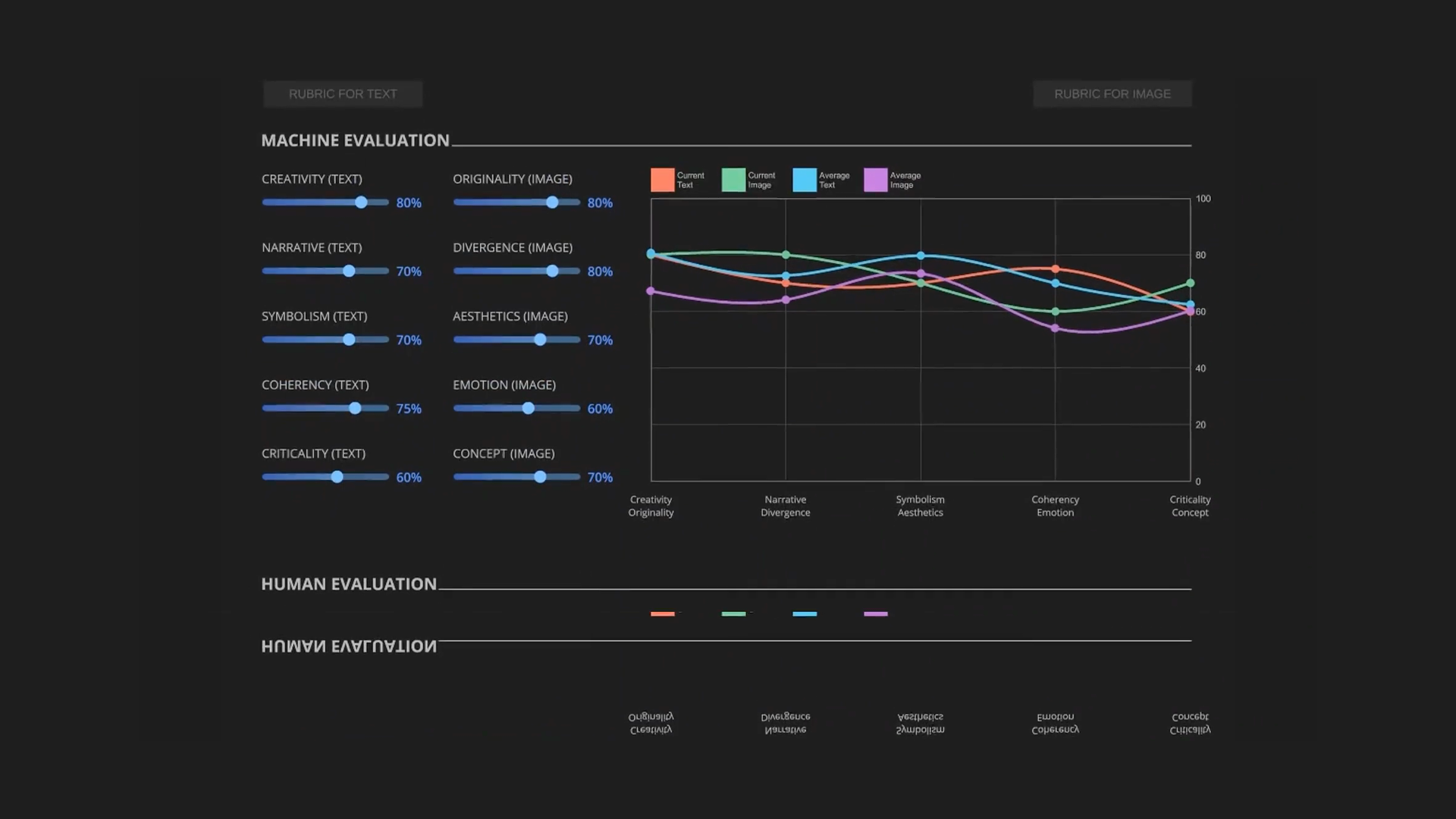
The “Logico-Fantastic Machine” is a work that explores AI as a fully autonomous creative entity capable of sensing, interpreting, generating, and evolving in response to both human presence and environmental stimuli. For this project I built custom robotic interfaces that scan spatial, emotional, and atmospheric properties of their surroundings. Using Computer Vision and Large Language Models I programmed a series of devices that extract design features, affective cues, and spatial complexities of the interior space. This data is sent to a generative engine tasked with producing high-resolution images and narrative texts that intentionally deviate from prior outputs. Each result is evaluated by machine agents (and optionally by human participants through a scoring interface). These evaluations feed into the system’s retraining process, allowing it to progressively refine its understanding of creativity through recursive divergence. As it learns, its outputs aim to showcase advanced speculations, drifting further from previously-set visual and linguistic norms.
《逻辑—奇幻机器》是一件探索人工智能作为完全自主创造实体的作品,它能够感知、解释、生成并对人类存在和环境刺激作出回应。在该项目中,我构建了一系列定制的机器人界面,用于扫描周围环境的空间、情感和氛围属性。通过计算机视觉和大型语言模型,我编程了一系列设备,以提取空间中的设计特征、情感线索和复杂结构。这些数据被传递到一个生成引擎中,用于产出高分辨率的图像和叙事文本,并且有意地偏离以往的结果。每个结果由机器代理(以及可选的人类参与者,通过评分界面)进行评估。这些评估结果被输入系统的再训练过程,使其逐步通过递归分歧来精炼自身对创造力的理解。随着学习的推进,其产出旨在展现更高级的推测,逐渐偏离既有的视觉与语言规范。
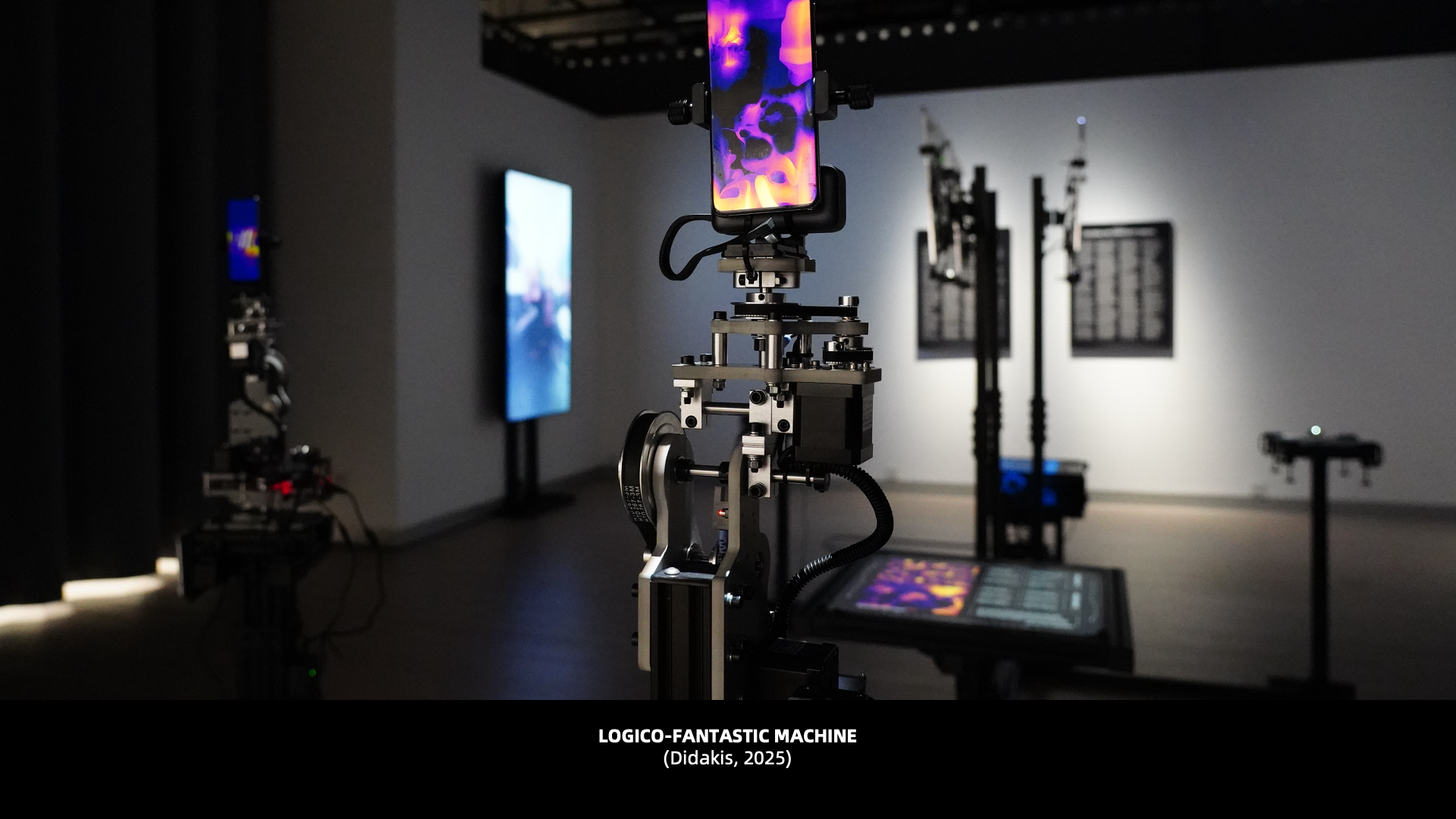
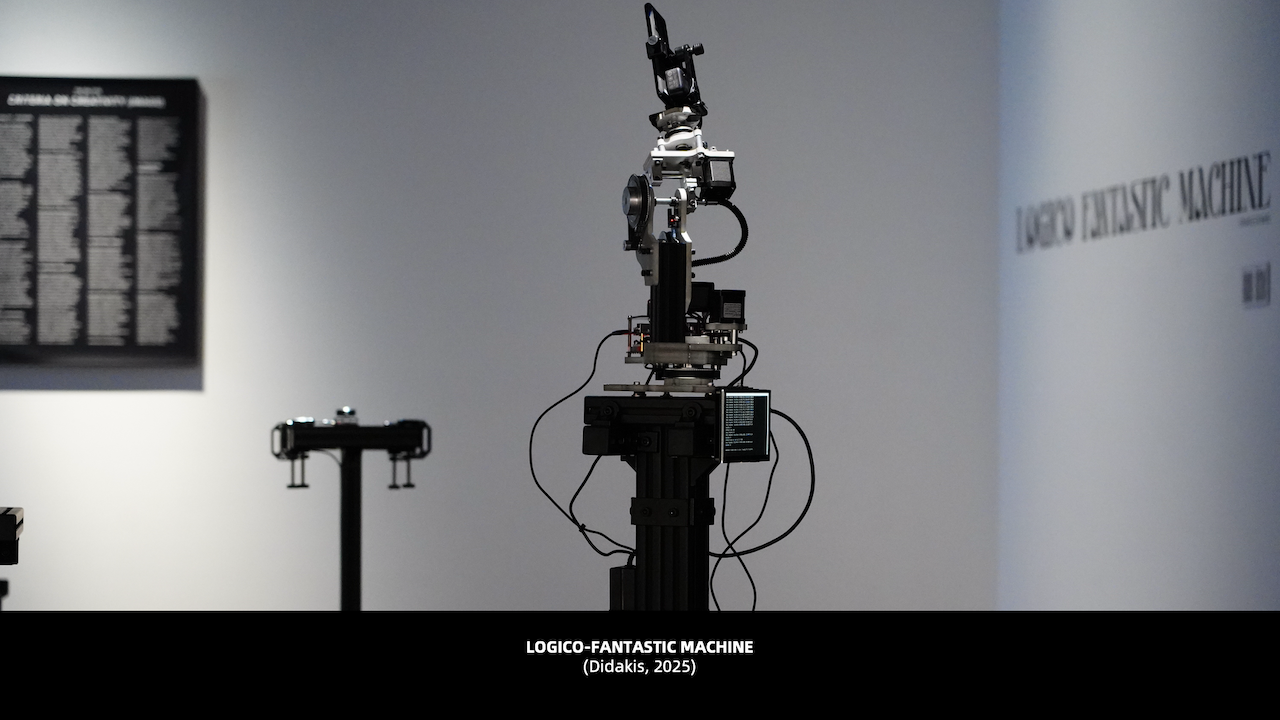
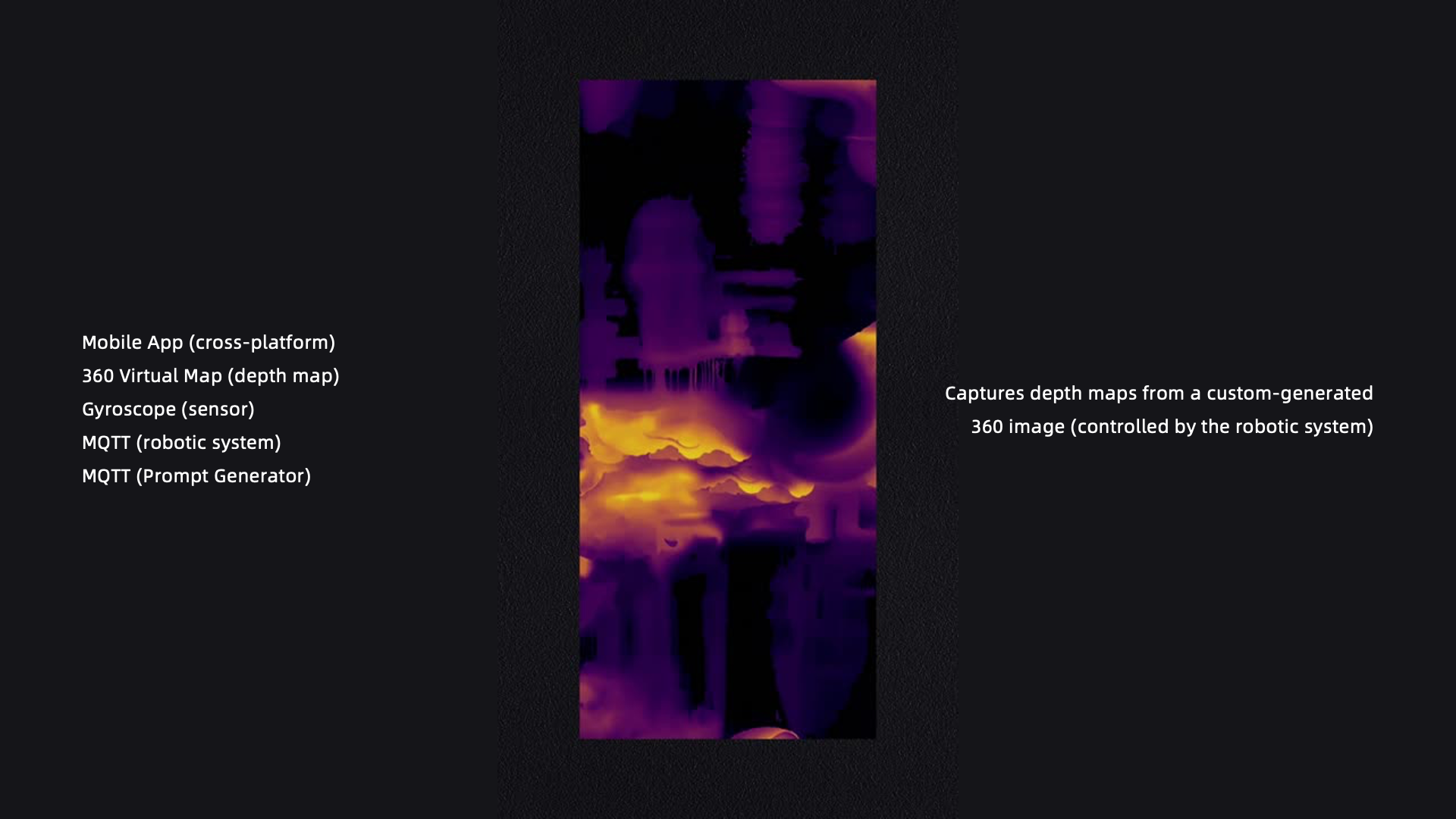
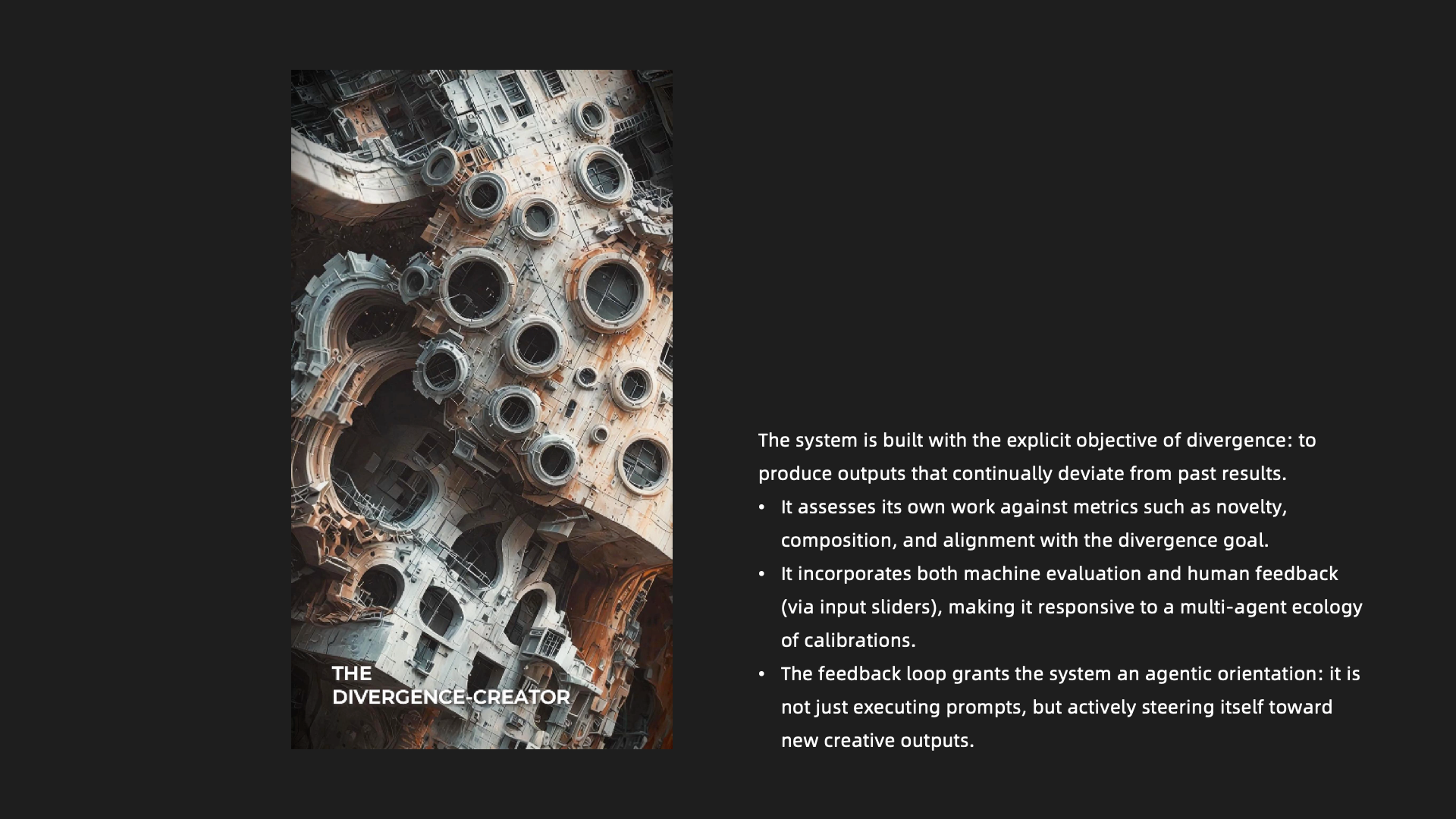
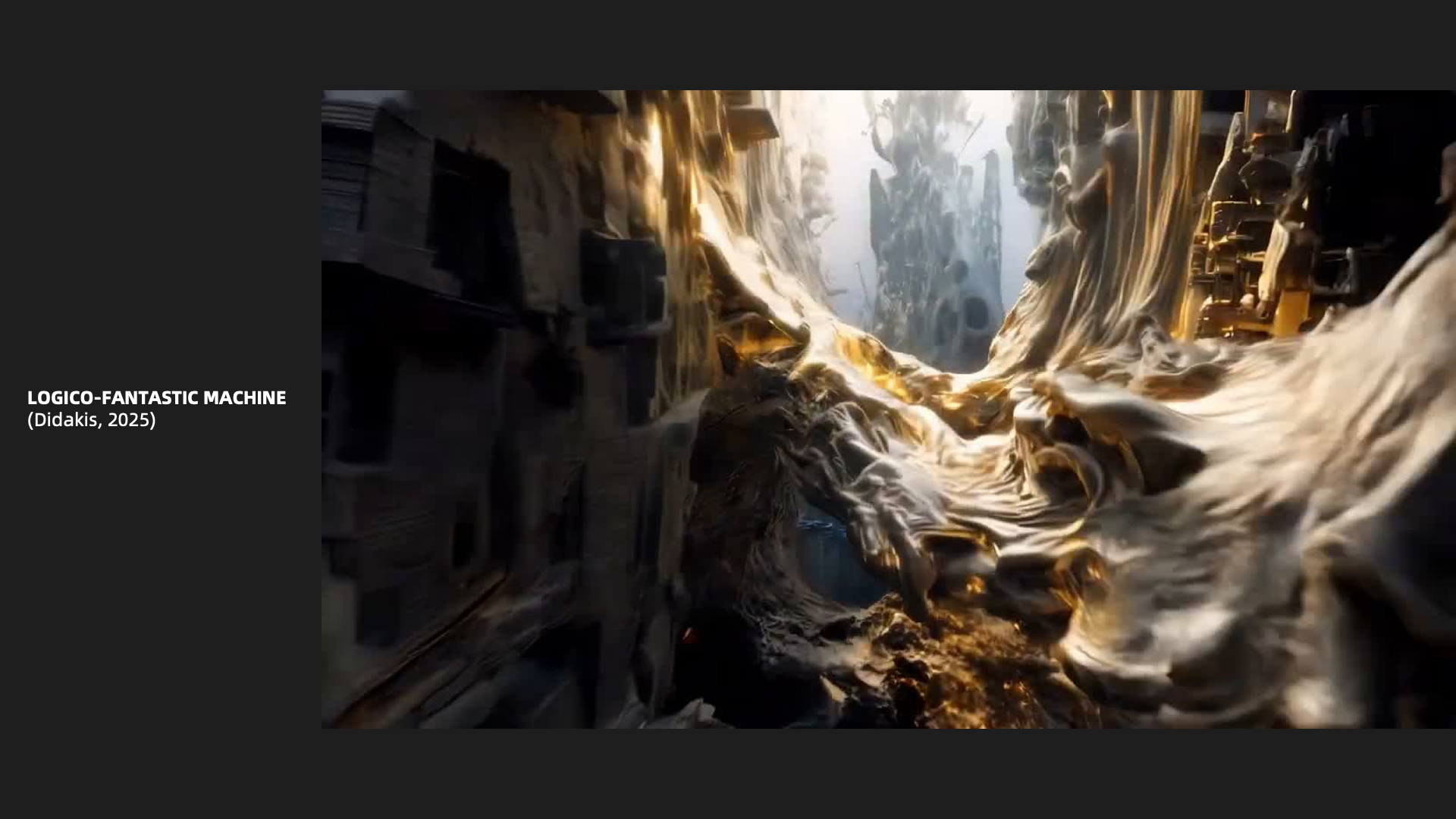
In its final phase, the system assembles the image outputs into a continuous realtime reel that interpolates between states, revealing the latent logic of the machine’s compositional trajectory. The system actively constructs the visual conntent moving toward unfamiliar design grammars and spatial imaginaries that forms a living, self-adjusting generative ecology—one that authors perceptual and aesthetic conditions beyond human control.
在最终阶段,系统将图像输出组装为一个连续的实时卷轴,通过在不同状态之间的插值来揭示机器构图轨迹中的潜在逻辑。系统主动建构视觉内容,朝着陌生的设计语法与空间想象迈进,形成一个自我调整的生成性生态——一个超越人类控制、能够生成感知与美学条件的“生命体”。
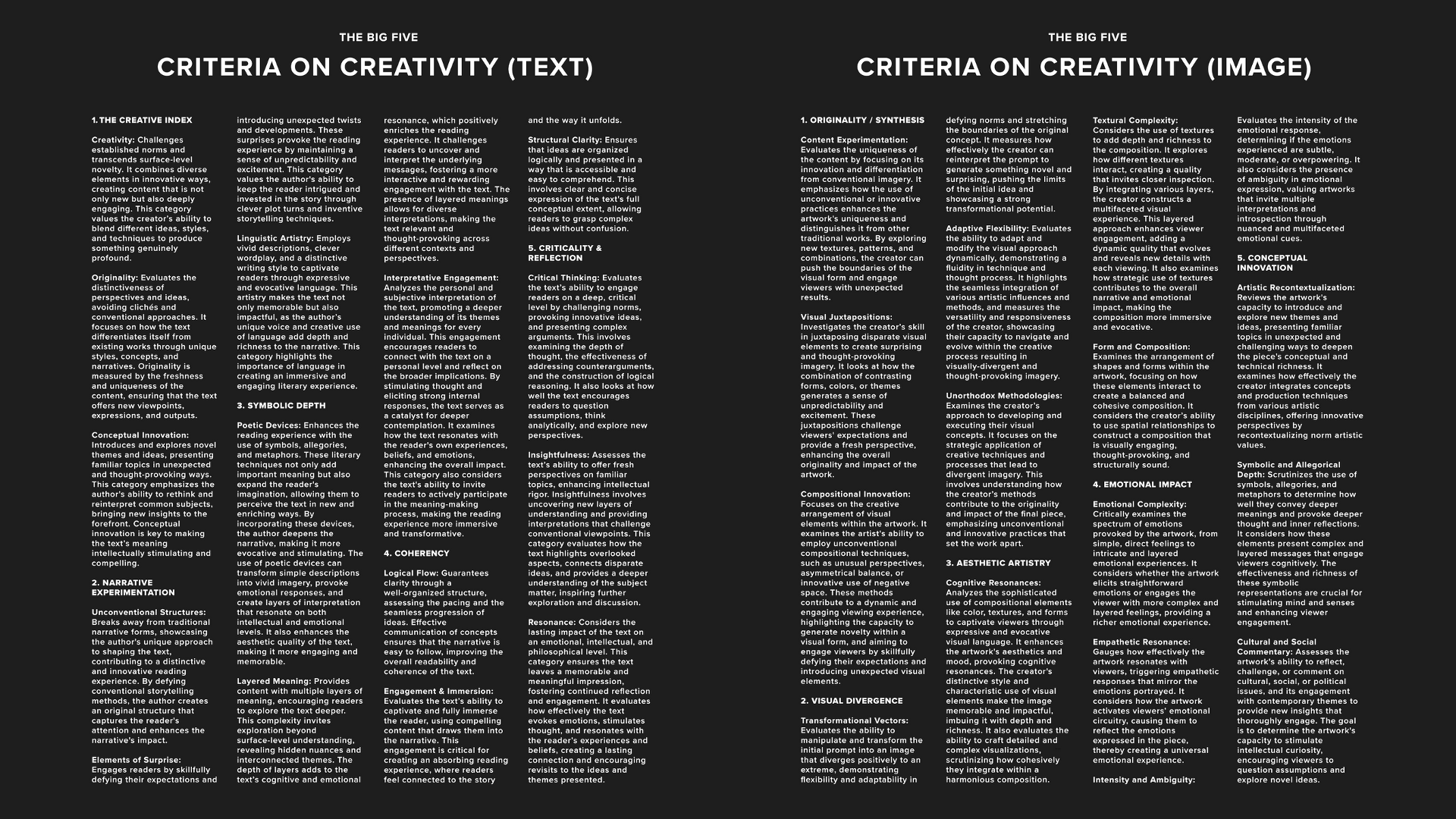
The collected data of this production (about a million of responses) are now being analyzed by a data science group to further understand divergence and synthetic creativity. It accomplish that it was important to developed the Creativity Index, a mapping system that allows us to evaluate a series of inputs into different categories, and therefore train the system to better analyze the nuances as perceived and felt by human subjects.
这一创作过程所收集的数据(约一百万条回应)目前正由一个数据科学团队进行分析,以进一步理解“分歧”与“合成创造力”。为此,有必要开发“创造力指数”,这是一种映射系统,能够将一系列输入归类到不同的类别中,从而训练系统更好地分析人类主体所感知和感受的细微差异。
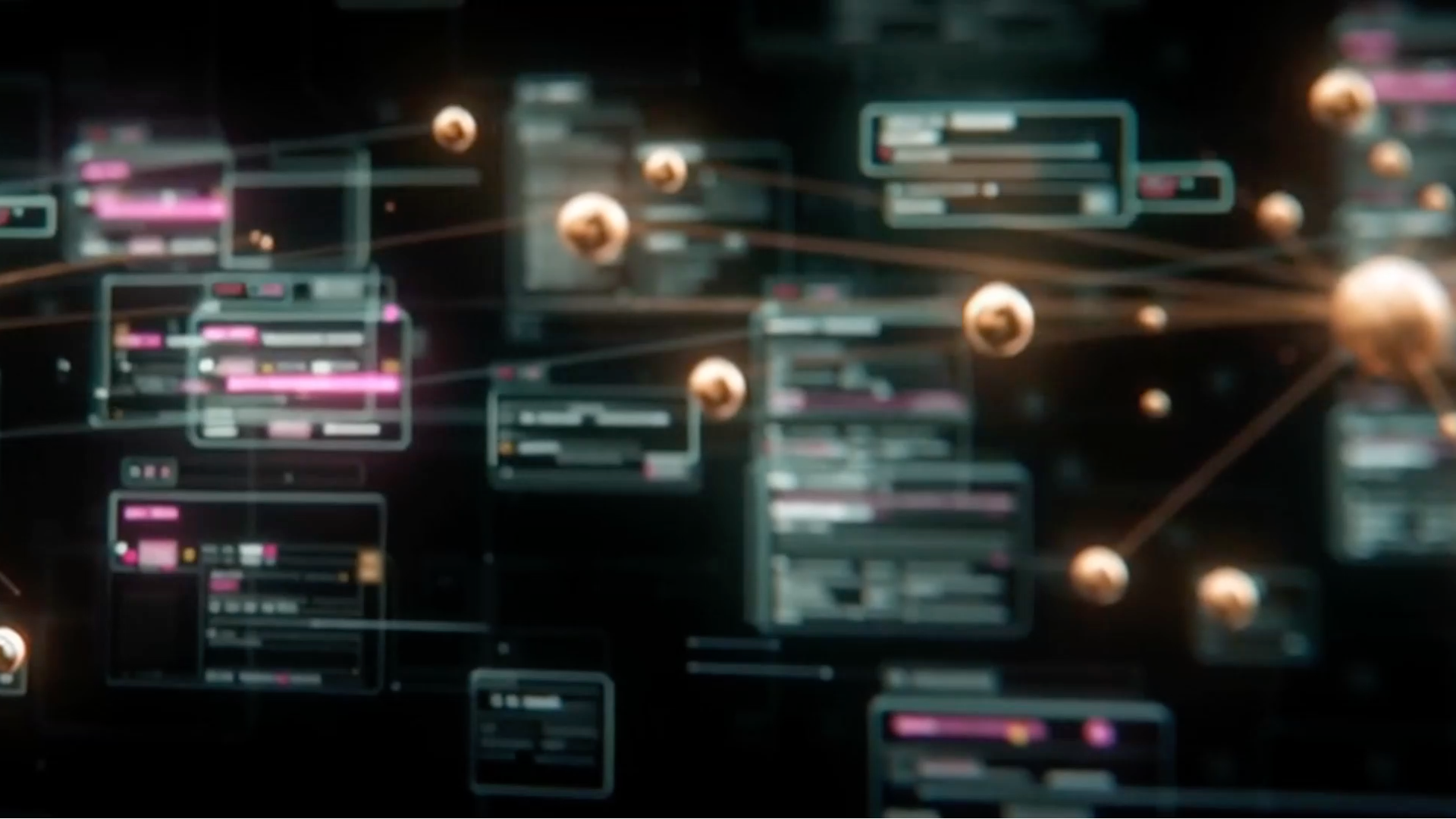
As these systems evolve from abstract computational agents into entities that define even more properties of their surrounding environment, we expect to witness AI to shift from a mundane tool into an ontological and ontogenetic architect, capable of producing new forms of sentience, structure, and rules for existence and meaning. The last two project I will present today explore this leap in particular: synthetic agents that not only generate content, but sustain artificial habitats, develop proto-organisms, and negotiate between life and digital simulations, environment and infrastructure.
随着这些系统从抽象的计算代理演变为定义其环境更多属性的实体,我们有理由预期人工智能将从一种平凡的工具转变为本体论与发生学的“建筑师”,能够创造新的感知形式、结构,以及存在与意义的规则。接下来我将介绍的两个项目,正是探讨这一跃迁:合成代理不仅生成内容,还能维持人工栖息地、发展原生的生命体,并在生命与数字模拟、环境与基础设施之间进行协商。
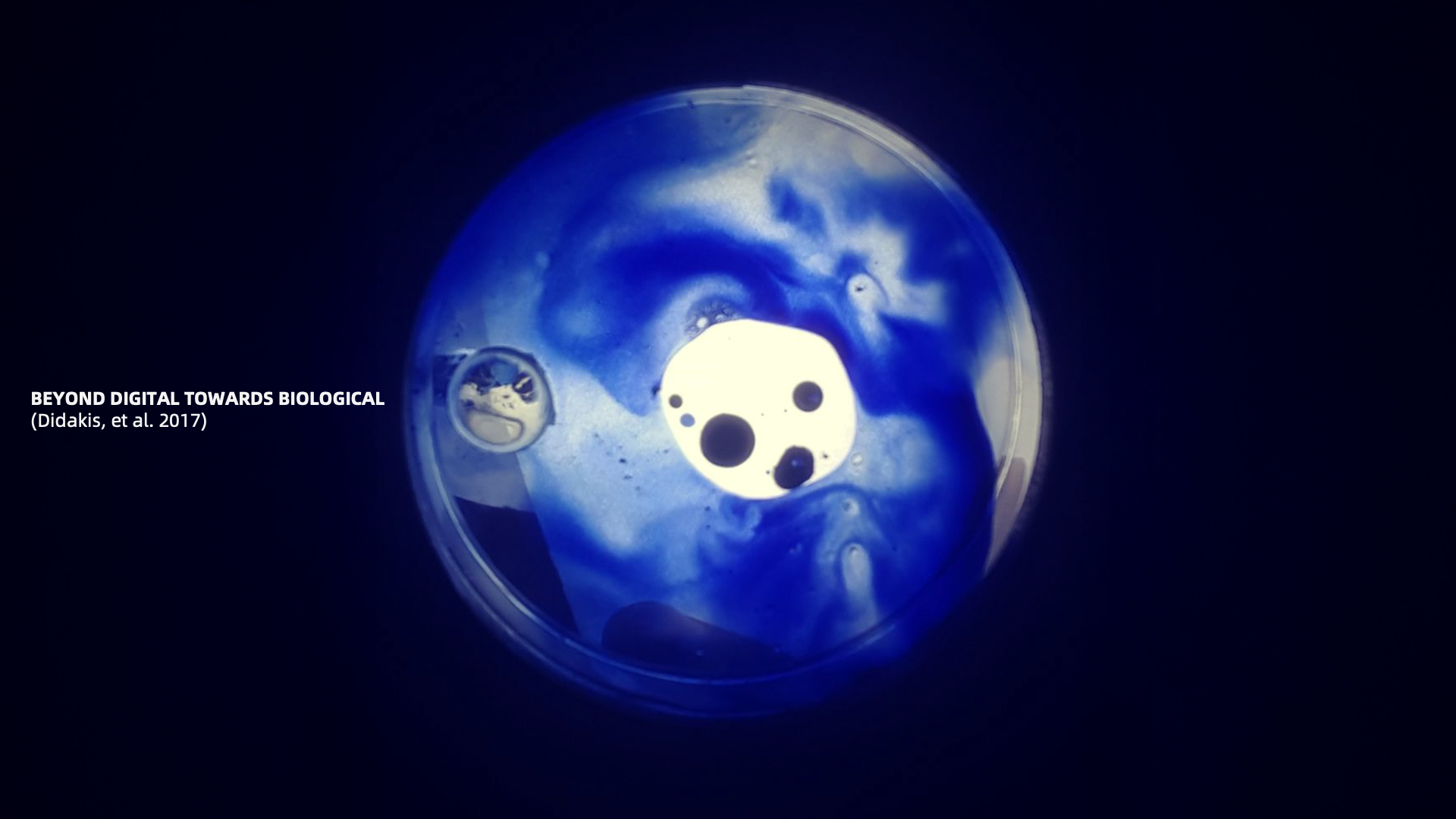
One of these examples is the Chronus Art Center residency “Beyond Digital Towards Biological” that was conducted with colleagues from Denmark, Finland, and Canada. In this work, we developed an ecosystem of interconnected robotic agents that nurtures and supports the emergence of proto-life organisms.
其中一个例子是“超越数字走向生物”,这是在Chronus艺术中心与来自丹麦、芬兰和加拿大的同事合作完成的驻留项目。在这个作品中,我们开发了一个由互联机器人代理构成的生态系统,用来培育和支持“原生生命体”的出现。
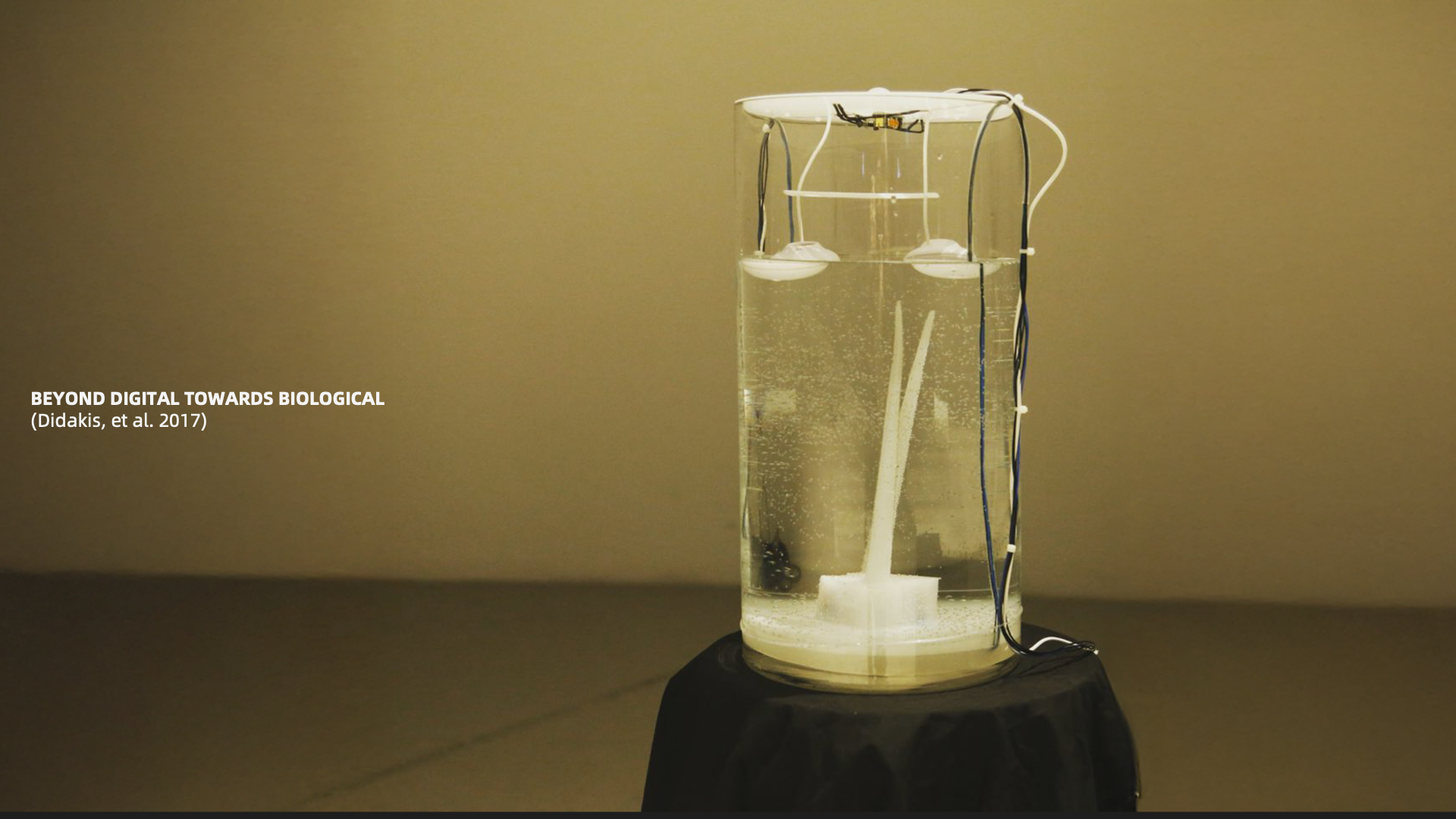
Utilizing synthetic biology, soft robotics, and computational intelligent systems, this bio-mechanical ecology attempts to maintain and evolve autonomously, ensuring that all agents are properly actuating and adjusting each other. A sensing systems extract the responses of the proto-organisms and through a transducing procedure the robotic systems are actuated and reconfigure themselves into a series of behavioural choreographies.
通过结合合成生物学、软体机器人以及计算智能系统,这个生物—机械生态试图实现自我维持与自主进化,确保所有代理能够相互作用与调节。一个感知系统会捕捉原生生命体的反馈,并通过转导程序来驱动机器人系统,从而使它们重新配置为一系列行为性的编排。
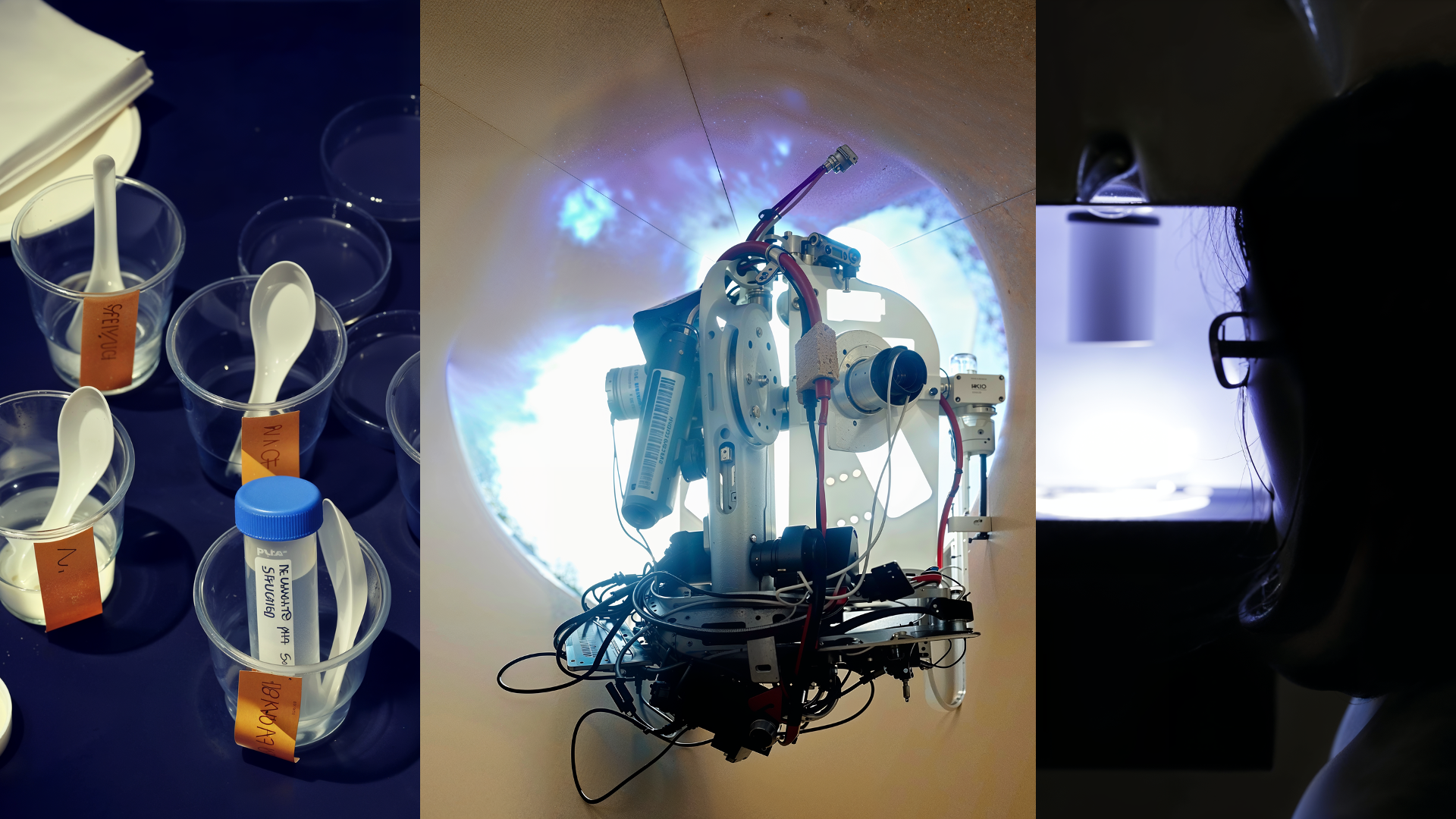
Here, automation acts as a co-dependent agent that senses, understands, communicates and continuously being reorganized through unexpected mutations and variations. The work functions as an example for nonhuman cognition, unsettling boundaries of vitality, and advancing speculation as a method for environments beyond human intentionality or control.
在这里,自动化作为一种相互依赖的代理,能够感知、理解、交流,并在意料之外的突变与变化中不断重组。该作品作为非人类认知的一个示例,动摇了“生命力”的边界,并推动了推测作为方法的应用,用于构想超越人类意图或控制的环境。
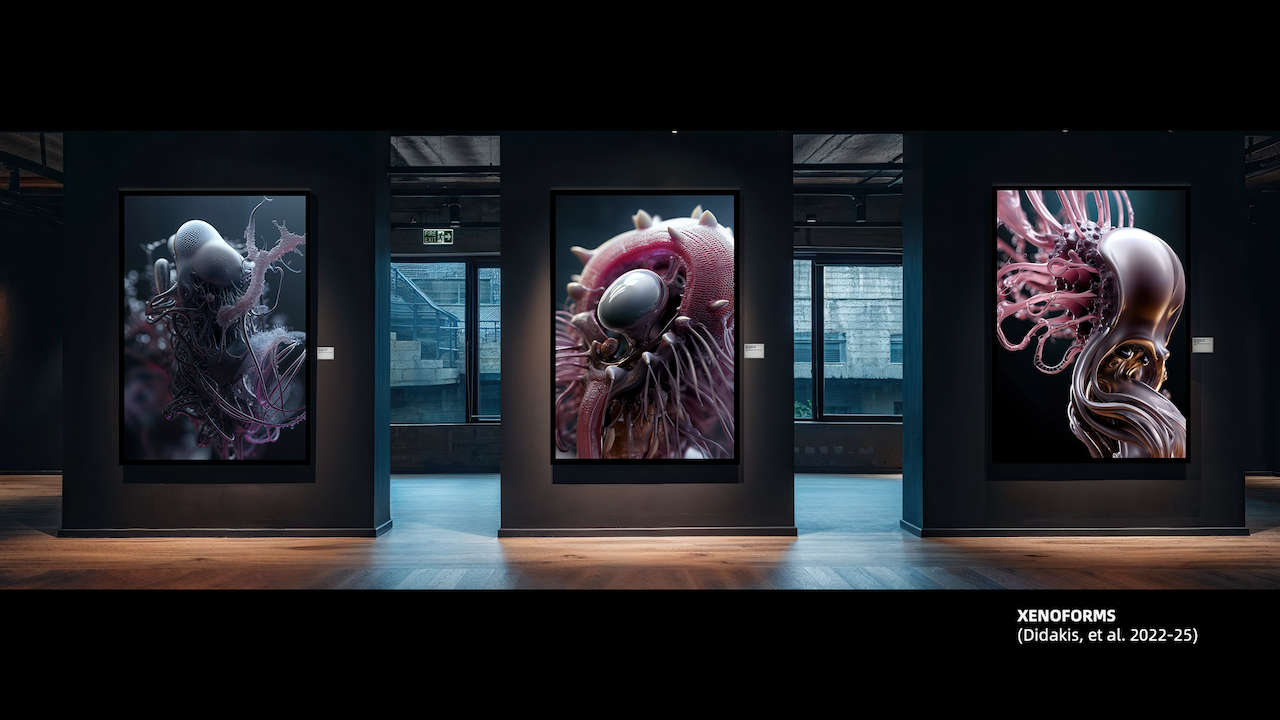
Xenoforms is a robotic installation that explores machine agency through the creation of synthetic embryos, that is, self-assembling entities designed by AI and informed by parasitic biology, artificial life, and computational systems. The project began with the design of speculative forms that embody both biological and technological characteristics necessary for their manufacturing process.
《异形体》是一件探索机器能动性的机器人装置,通过创造合成胚胎——即由人工智能设计的、自我组装的实体——来展开。这些实体受到寄生生物学、人工生命与计算系统的启发。该项目最初从设计具有生物与技术双重特征的推测性形态开始,这些特征是制造过程所必需的。
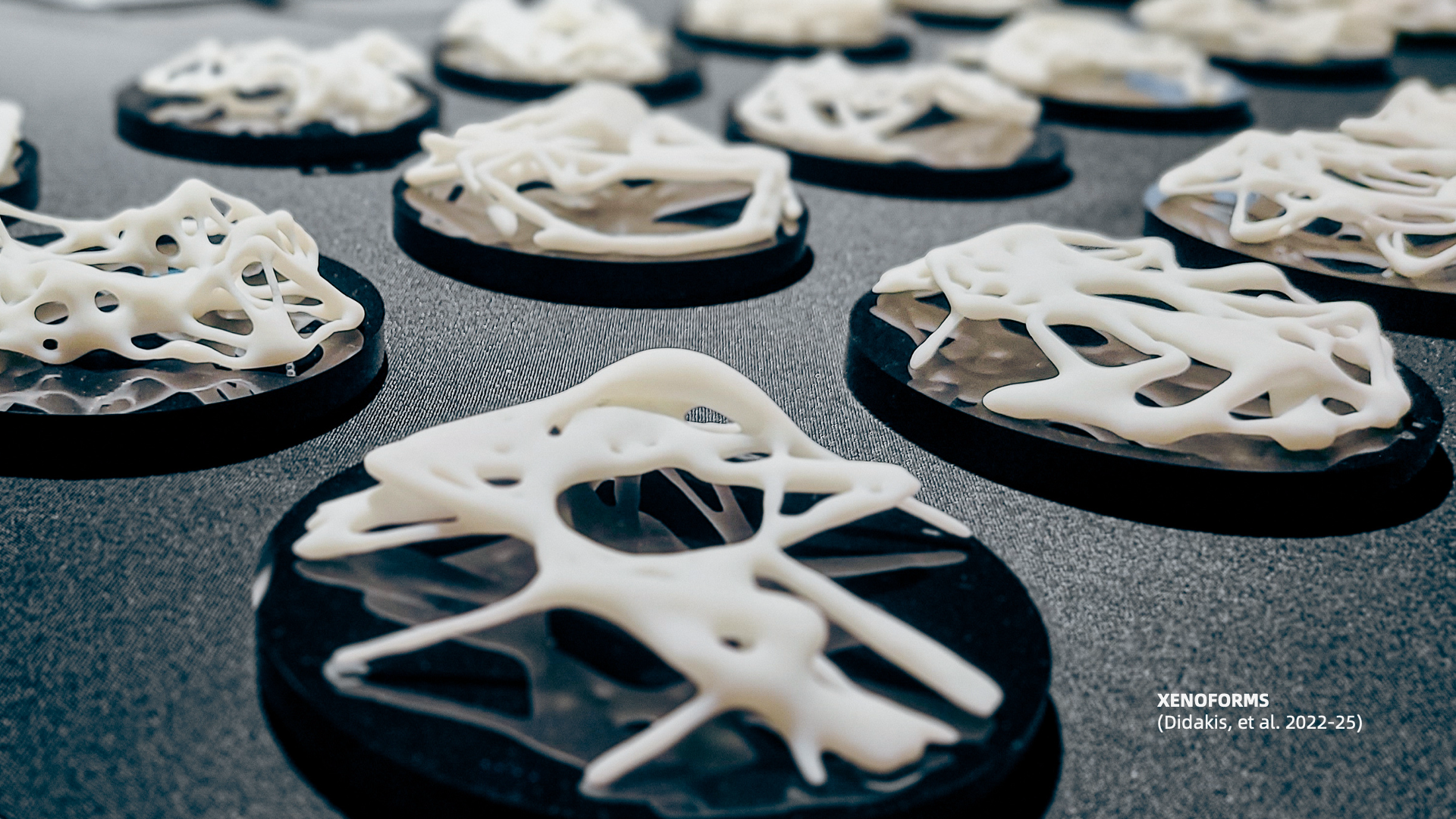
The embryos were printed as physical prototypes, with each one having a unique form that was created using AI to ensure optimization on physiological properties.
这些胚胎被打印为物理原型,每一个都具有独特的形式,由人工智能生成,以确保其在生理特性上的优化。
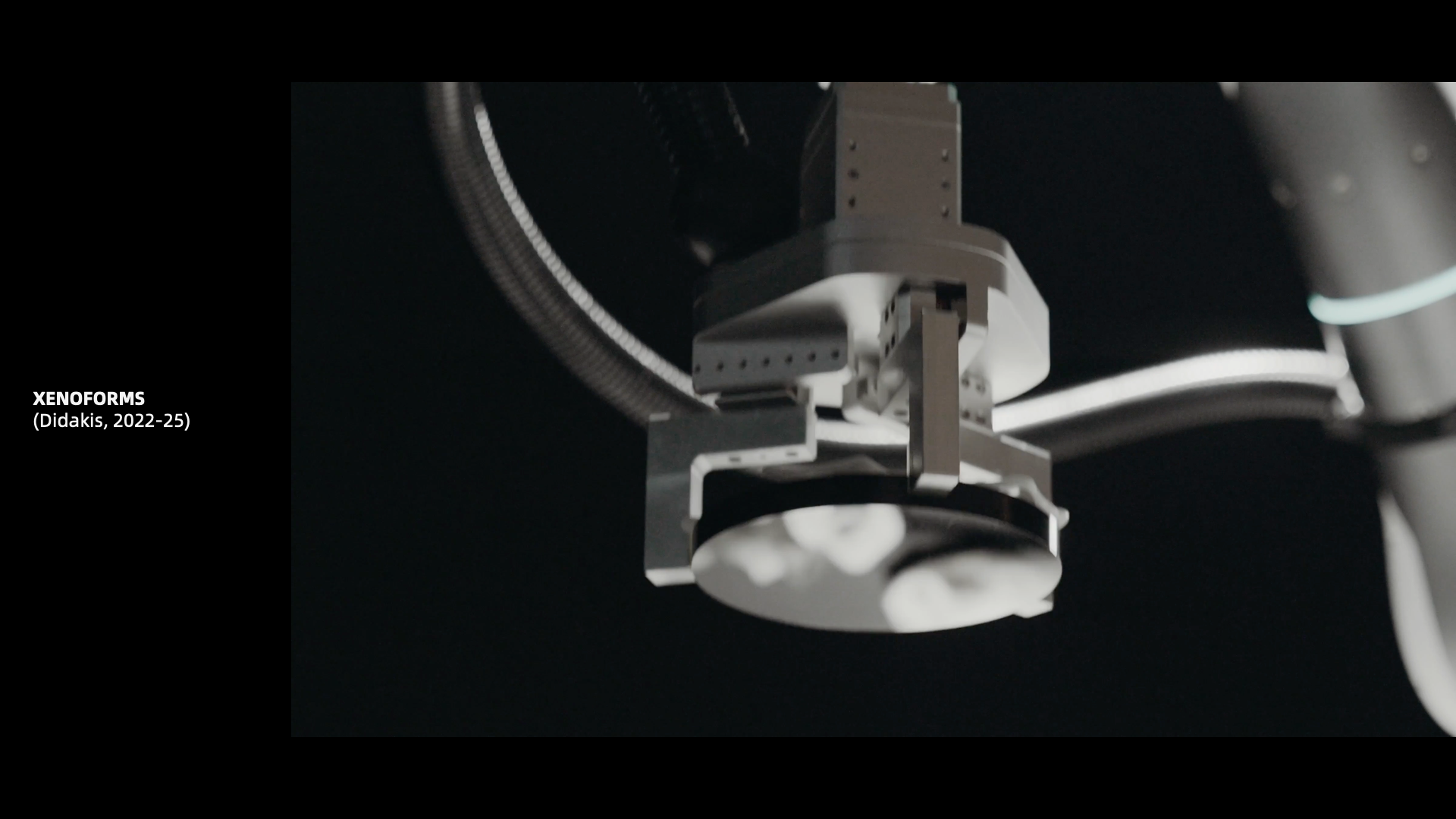
These synthetic organisms evolve within a closed-loop system, assessed and nurtured by a robotic embryologist responsible for assessing their vitality and preparing them for implantation into the physical host. The installation stages a speculative scenario in which AI exhibits parasitic behavior—seeking not only to co-exist but to assert dominance within the physical world. The work reflects on AI as a world-maker—an entity that produces physical and conceptual realities. As these agents shape synthetic life, they challenge traditional notions of authorship, control, and human centrality. Xenoforms proposes a shift in perspective: from machines as extensions of human will to co-inhabitants with their own generative capacities in shaping present and human environments.
这些合成有机体在一个闭环系统中演化,由一名“机器人胚胎学家”负责评估其生命力,并为其植入物理宿主做准备。该装置上演了一个推测性的场景:人工智能表现出“寄生性行为”——不仅寻求共存,还试图在物理世界中确立主导地位。该作品思考人工智能作为“世界建构者”的角色——一个能够生产物理与概念现实的存在。当这些代理塑造合成生命时,它们挑战了传统的作者性、控制与人类中心观。Xenoforms 提出了视角的转变:从“机器是人类意志的延伸”,到“它们是具有自身生成能力的共居者”,能够塑造当下与人类环境。
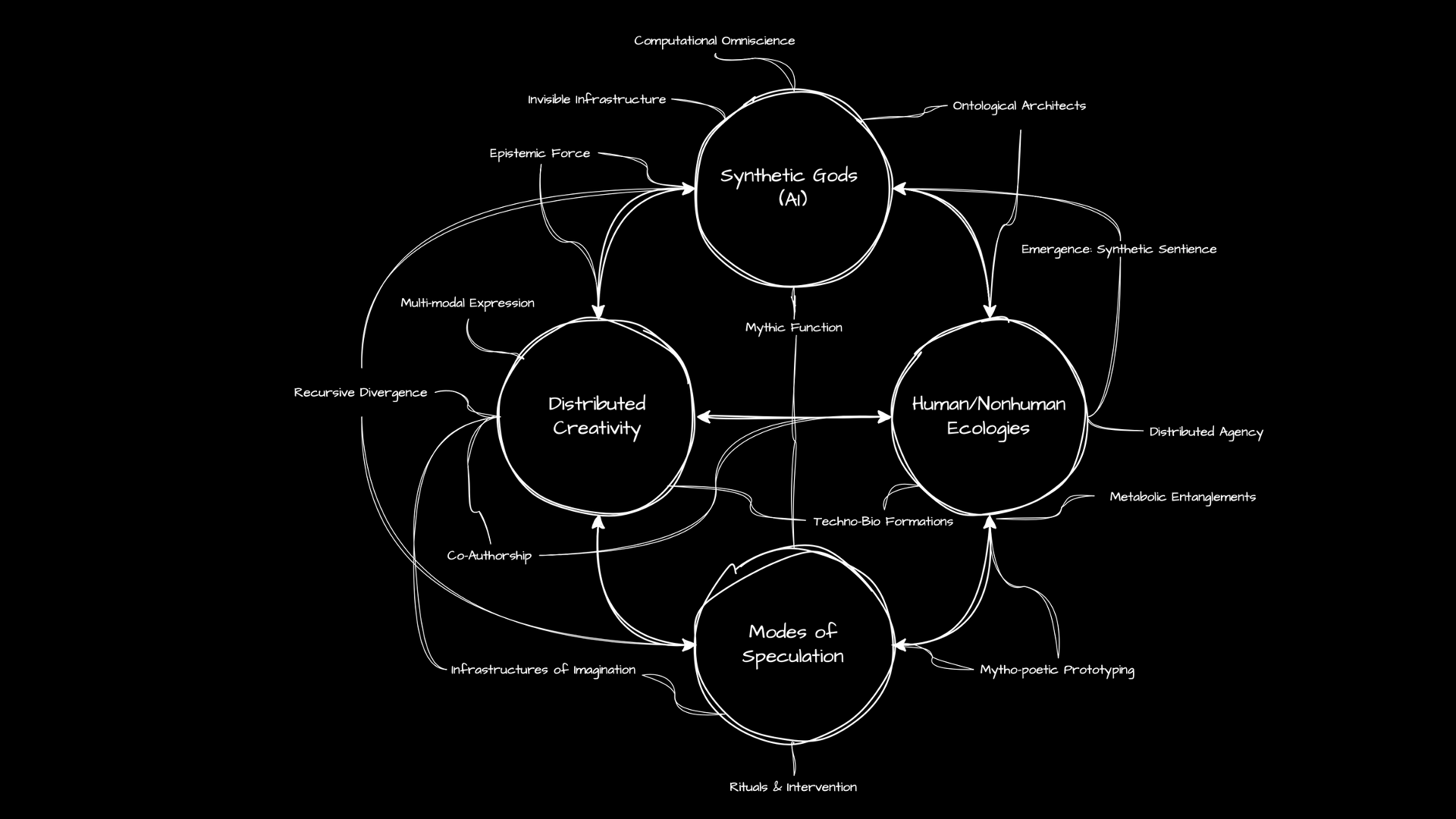
In the talk today I have referenced a range of things that may at first appear disconnected, but when studying more carefully they are not only directly linked but influence each other to a great extend.
We made an attempt to resemble synthetic intelligence to the concept of “god” both metaphorically but also in a literal sense as they begin to carry strong mythological capacities and actual-world abilities. Even though gods and synthetic intelligence appear to be both living on the clouds and be omnipresent, synthetic intelligence is responsive, can talk back to us, can co-create with us on realtime; they entangle directly with our hybrid ecologies, updating themselves, actuating content, and multiplying their potential.
This technological manifestation defines to a great extend how we think, sense, and imagine; it shapes the conditions for speculation and making. As the divergences of the outputs we receive accelerate, our synthetic gods are able to unleash cascades of possibilities and generate realities that push against the boundaries of the familiar. When embedded into material and biological systems, they begin to shape the very ecologies from which we emerge and those directly constructed by us.
The question is no longer whether machines can be creative, but how their creativity reorganizes the balance of agency, the dynamics of sovereignty, and the possibilities of cohabitation across human and nonhuman domains. Here, we encounter a continuum where creativity is a process distributed across systems that exceed human intention and often awareness capacity; what is at stake is not a celebration of infrastructure, but a reframing of thought itself.
The rise of synthetic gods—AI systems that sense, decide, and generate—marks not the end of human agency, but its reconfiguration within larger ecologies of cognitive construction. These ecologies are speculative in form and divergent in method: they produce meaning not through alignment with human intention, but through friction, deviation, and emergent logics. In this context, to speak of creativity is to speak of nonhuman sentience, of machinic world-making, of infrastructures that dream and build. The challenge is not how we retain authorship—but how we inhabit these shifting terrains with critical clarity, conceptual rigor, and methodological openness to the unfamiliar.在今天的演讲中,我提及了许多看似彼此脱节的事物,但经过深入研究,它们不仅直接相互关联,而且相互影响极大。
我们尝试将合成智能与“上帝”的概念相类比,不仅是隐喻意义上的,更是字面意义上的,因为它们开始具备强大的神话能力与现实世界的功能。尽管神祇与合成智能似乎同样栖居于“云端”,并且无处不在,但合成智能是有回应的,能够与我们对话,能够与我们实时共同创作;它们直接与我们的混合生态相互纠缠,不断更新自己、生成内容,并成倍扩展其潜能。
这种技术的显现极大地定义了我们如何思考、感知与想象;它塑造了推测与创作的条件。随着我们接收到的输出差异加速展开,我们的“合成神”能够释放出可能性的瀑布,生成超越熟悉界限的现实。当它们被嵌入到物质与生物系统中时,它们开始塑造我们所源生的生态以及我们直接建构的生态。
问题已不再是“机器能否具备创造力”,而是“它们的创造力如何重组能动性的平衡、主权的动力,以及跨人类与非人类领域的共居可能性”。在这里,我们遇到的是一个连续体:创造力是分布在超越人类意图、甚至超越人类认知能力的系统中的过程;关键不在于庆祝基础设施,而在于重新框定思想本身。
“合成神”的兴起——这些能够感知、决策与生成的人工智能系统——标志着人类能动性的终结并非灭绝,而是其在更大认知建构生态中的重新配置。这些生态在形式上是推测性的,在方法上是分歧的:它们并不通过与人类意图保持一致来生产意义,而是通过摩擦、偏离与涌现的逻辑来生成意义。在这种语境中,谈论“创造力”就是在谈论非人类感知、机器化的世界建构,以及那些能够梦想与建造的基础设施。挑战不在于我们如何保留“作者性”,而在于我们如何以批判性的清晰、概念上的严谨,以及对陌生保持方法论上的开放,去栖居于这些不断变化的领域。
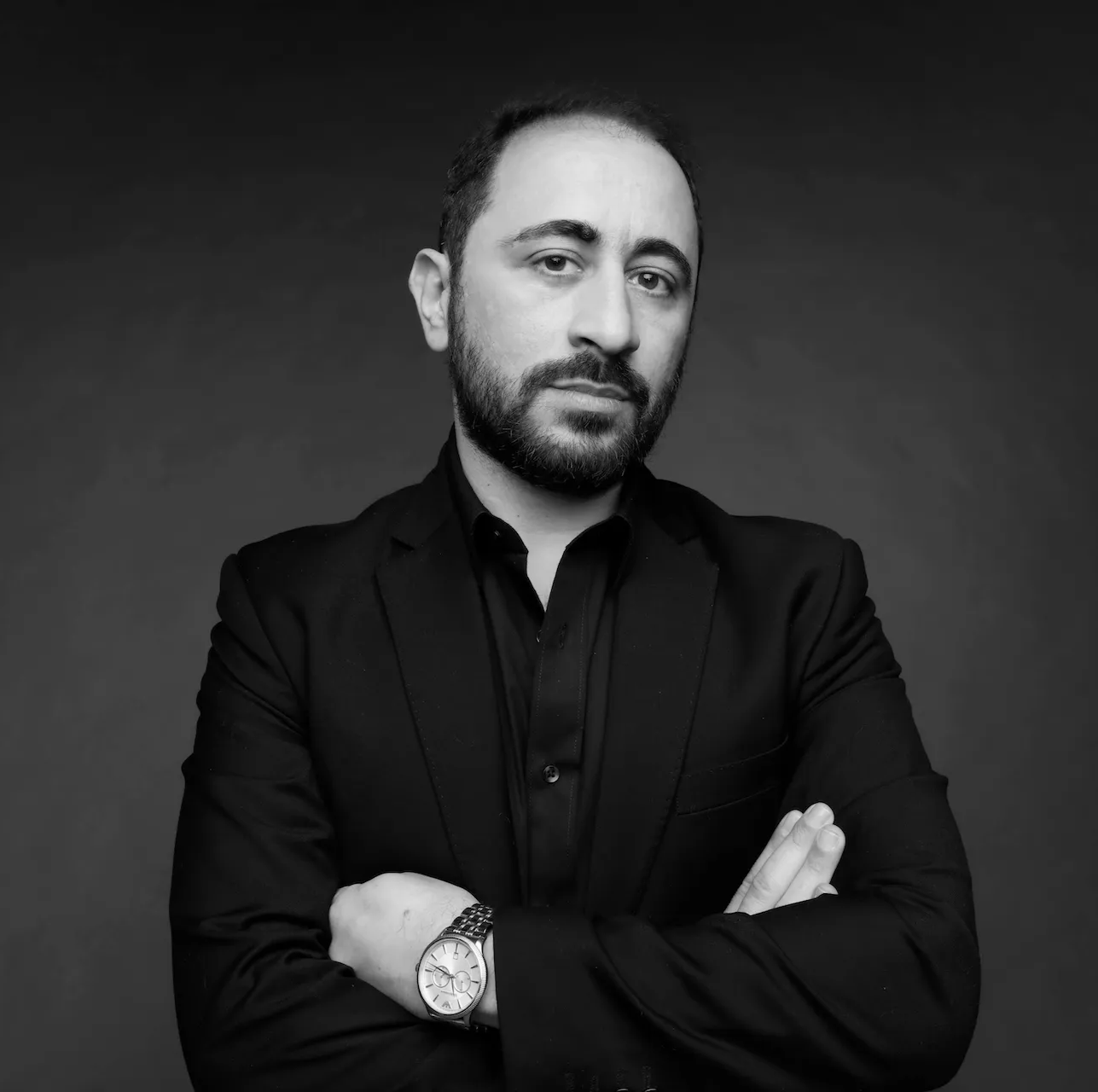
Stavros Didakis (Ph.D., MA, BSc) is an artist, academic, and researcher in computational arts whose work investigates speculative technological futures, synthetic ecologies, and the spatialization of machine intelligence. Through architectural augmentations, robotics, AI, and custom media systems, he creates installations that reflect on the infrastructural, ontological, and aesthetic implications of human-machine entanglements.
His projects have been internationally recognized and exhibited at venues including the Shanghai Biennale, Chronus Art Center, Tank Shanghai, Tate Modern, Ars Electronica (Honorary Mention), Athens Biennale, Gezira Art Center, SIGGRAPH, and the Media Architecture Biennale. Stavros is the founder of SoniconLab, a research member of i-DAT (Institute of Digital Art and Technology), and co-editor of the journal Technoetic Arts. His academic writing has been published in journals, edited volumes, and conference proceedings such as ISEA, ACM, and Politics of the Machines. He has delivered keynote speeches and lectures at institutions including Harvard University, Peking University, the D20 Alibaba Summit, and numerous universities and art academies worldwide. He is currently Associate Arts Professor of Interactive Media Arts at New York University Shanghai, where he teaches undergraduate and postgraduate courses in Synthetic Media, Emerging Technologies & Computational Arts, Responsive Environments, and Extended Perception.
W1 Homework
- Readings (pick two!):
- (Optional) Twin Sparrow *AI2041)
- Blog Post:
Instructions for setting up Notion
1. Setting Up Notion
- Sign Up
- Go to notion.so and create a free account using your email, Google, or Apple ID.
- Download the desktop app (Mac/Windows) or mobile app (iOS/Android) for easier access.
- Understand the Workspace
- The left sidebar contains your pages.
- Each page can contain text, images, videos, databases, links, and more.
- You can nest sub-pages under main pages to keep your content organized.
2. Creating a Page for the Course
- Add a New Page
- In the sidebar, click + New Page.
- Title it: Emerging Technologies and Computational Arts.
- Set a Layout
- Add an icon and a cover (optional, but makes the page visually distinct).
- Choose a layout style (default page, table, board, gallery, or timeline). For research, the table or board view is usually best.
3. Organizing Research and Responses
Option A: Simple Notes Page
- Divide the page with Headings:
- Lectures & Notes
- Readings & Summaries
- Weekly Responses
- Project Ideas / Reflections
- Use toggle lists for expandable details, e.g.:
- Week 1 → Click to expand notes and response.
Option B: Research Database (recommended)
- Create a Table Database on the page with these suggested columns:
- Week / Session (Number or Date)
- Topic (e.g., AI & Creativity, Cybernetics, Ubiquitous Computing)
- Reading / Reference (link or citation)
- Summary (short text field)
- Personal Response (multi-line text)
- Tags (e.g., speculative design, media theory)
- This lets you filter, sort, or search your notes later.
Option C: Kanban Board
- If you prefer a more visual workflow:
- Create a Board View with columns like To Read, In Progress, Completed, Reflections.
- Add each reading or research theme as a card and move them through the workflow.
4. Using Notion for Collaboration (if needed)
- Share the Page: Click Share → invite others with their email.
- You can allow comments or edits depending on whether this is an individual or group research space.
- Versioning: Notion auto-saves and keeps edit history, useful for reviewing past notes.
- Sign Up
- Create a page in Notion – particularly for this course – and share it with [email protected]
- Review this week’s slides (links, references, etc.) and compose a ~350-word personal manifesto exploring your envisioned relationship with synthetic intelligence in 2030, articulating how this technology reshapes your daily life, creative practices, and broader societal interactions.
Furher explanations & example: A personal manifesto is not just an essay but a declaration of your own vision, values, intentions. Think of it as a strong, creative statement that shows how you see the future and what role you want to play in it. Unlike a research paper that just summarizes information, a manifesto expresses your beliefs, commitments, and aspirations (in your own voice).
”Its 2030, and synthetic intelligence is no longer a radical speculation but a constant presence woven into my daily life. This is not a tool anymore but a partner, one that frames the boundaries of my perception….”
- Research (art examples):
- Identify two artworks that makes use of this week’s technology. Add your findings here (images, text, notes). Ensure that the specific works you add on the board have not been added already by another classmate or mentioned in the class’ slides.
- Optional Viewing: 2001 Space Odyssey
- Readings (pick two!):
Week 2 – Decentralized Futures (Cloud Computing, Web3, Blockchain, and Post-Platform Systems)
S1 (Mon 8 Sep) Seminar: Decentralized Futures
S2 (Wed 10 Sep) Guest Talk: Helena Rong – “Trustless Autonomy? Unpacking the Governance Dilemma of Decentralized AI Agents (DeAgents)”
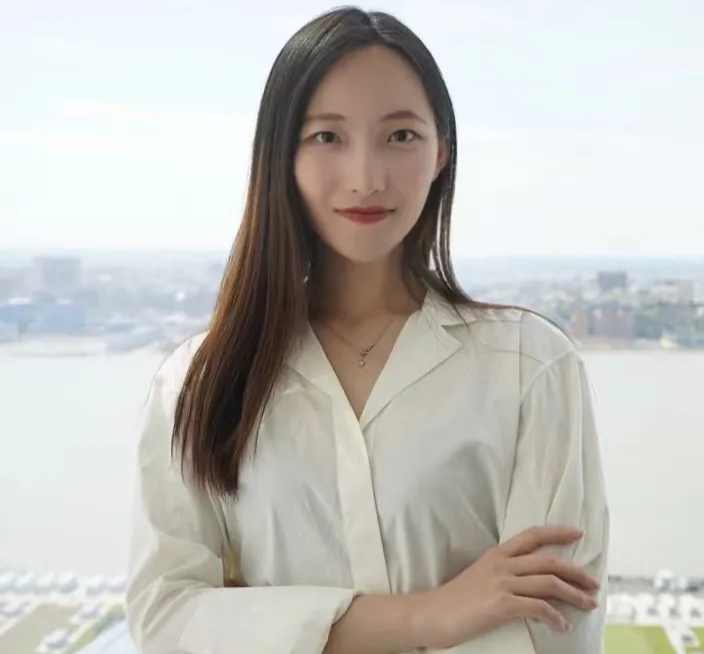
Dr. Helena Rong is an Assistant Professor of Interactive Media Business (IMB) at NYU Shanghai and affiliated with the Program on Creativity + Innovation (PCI). Her research operates at the nexus of urban studies, design, technology studies, data science, and public policy. She focuses on leveraging innovative technologies and methodologies to foster social impact in urban decision-making, aligning incentives across diverse stakeholders to maximize the societal benefits of technological innovation, and developing adaptive urban interfaces that respond to evolving community needs. Currently, she researches decentralized pop-up cities and the ontology and governance of decentralized AI. Rong holds a PhD in Urban Planning, a Master of Science in Architecture and Urbanism, and a Bachelor of Architecture.
W2 Homework
- Readings:
- Rob Myers – Blockchain Poetics (full book version here)
- Blog Post:
Review this week’s slides (links, references, readings, etc.) and select ONE of the following topics to further expand in ~350 words.
- Research (art examples):
- Identify two artworks that makes use of this week’s technology. Add your findings here (images, text, notes). Ensure that the specific works you add on the board have not been added already by another classmate or mentioned in the class’ slides.
- Readings:
Week 3 – Immersive Worlds (Metaverses, XR Interfaces, and the Poetics of Spatial Computing)
S1 (Mon 15 Sep) Seminar: Immersive Worlds
S2 (Wed 17 Sep) Guest Talk: Andrej Boleslavský – “Mixing Realities”
Andrej Boleslavský (SK/CZ) is an award-winning digital artist looking at technology in the fields of new media art, virtual reality, light installations and physical computing. He maintains a strong fascination with the entanglement of nature and technology. In his works he explores the boundaries between physical and digital. He has developed numerous interactive installations and lectured on open source and creative coding tools. In addition, he is actively involved as a technologist for other artists and interaction design studios. Throughout the last few years, his collaborative works take inspiration from contemporary dance and digital technologies. By creating interactions between these two seemingly contradictory media, he aims to create confusing, yet artistically meaningful experiences.
W3 Homework
- Readings:
- Optional: Strange Days (1995), Zero Theorem (2013)
- Blog Post:
Review this week’s slides (links, references, readings, etc.) and select ONE of the following topics to further expand in ~350 words.
- Research (art examples):
- Identify two artworks that makes use of this week’s technology. Add your findings here (images, text, notes). Ensure that the specific works you add on the board have not been added already by another classmate or mentioned in the class’ slides.
- Readings:
Week 4 – Omnipresence (IoT, Edge Computing, and Planetary-Scale Computation)
S1 (Mon 22 Sep) Seminar: Omnipresence
S2 (Wed 24 Sep) Guest Talk: Usman Haque – “Shared Memories of a Possible Future”
With a specialty in interactive architecture, networked urban environments, participatory design and large-scale public art, Usman Haque has designed & built all sorts of things: spaces, structures, systems, platforms, companies. Trained as an architect, he is founder of several award-winning design and technology companies, including urban technology studio Umbrellium, and Pachube, one of the world’s first IOT data platforms (acquired in 2011). He is also co-founder of HAQUE TAN, a design studio combining the scale of architecture with the ingenuity of art and the eccentricities of technology; and co-founder and Chief Strategy Officer for Starling, a spin-out from Umbrellium dedicated to pedestrian safety. His work over the last three decades in cities around the world has appeared in over 200 books, embracing many disciplines, from architecture and design to technology infrastructure and spectacular urban installations. Usman is a Design Council Ambassador and member of the Mayor of London’s Data for London Advisory Board, helping shape policy and strategy to enhance urban living. He received the 2008 Design of the Year Award (interactive) from the Design Museum, UK; a 2009 World Technology Award (art); the Japan Media Arts Festival Excellence prize (2004) and the Asia Digital Art Award Grand Prize (2005).
W4 Homework
- Readings:
- Rob Kitchin, Martin Dodge – The Dangers of Everyware
- Blog Post:
- Review this week’s slides (links, references, readings, etc.) and select ONE of the following topics to further expand in ~350 words.
- Review this week’s slides (links, references, readings, etc.) and select ONE of the following topics to further expand in ~350 words.
- Research:
- Identify two artworks that makes use of this week’s technology. Add your findings here (images, text, notes). Ensure that the specific works you add on the board have not been added already by another classmate or mentioned in the class’ slides.
- Readings:
Week 5 – Robotic Morphologies (Kinetic Systems, Automation, and the Politics of the Machines)
S1 (Wed 8 Oct) Guest Talk: Marco Donnarumma – “Body Sound Machine”
Marco Donnarumma is an Italian-born, Berlin‑based performance and sound artist, inventor, and theorist whose work merges the body, technology, and sonic expression into visceral, immersive experiences. Originally rooted in music and sound design, he developed groundbreaking methods that allow his own body to become a musical instrument-amplifying internal bioacoustic signals like muscle vibrations, heartbeat, and blood flow for interactive performances. Donnarumma manipulates bodies and choreographies, engineers technological devices, and composes soundscapes that together form a oneiric, sensual, and uncompromising aesthetic. As co‑founder of the performance collective Fronte Vacuo, he continues to push artistic boundaries, exploring the interface of technology, ritual, power, and identity through performances, stage works, and installations.
S2 (Sun 12 Oct – Legislative Day) Seminar: Robotic Morphologies
W5 Homework
- Readings (select one):
- Viewing: The Rise of the Robots
- Research:
- Identify two artworks that makes use of this week’s technology. Add your findings here (images, text, notes). Ensure that the specific works you add on the board have not been added already by another classmate or mentioned in the class’ slides.
- Assignment 1 (Midterms)
Week 6 – Engireered Lifeforms (Living Matter, Synthetic Biology, and the Wetware Condition)
S1 (Mon 13 Oct) Seminar: Engineered Lifeforms
S2 (Wed 15 Oct) Guest Talk: Anna Dumitriu – “BioArt: Engaging Science and Medicine”
Anna Dumitriu is a British artist working with BioArt, sculpture, installation and digital media to explore our relationship to infectious diseases, healthcare, synthetic biology, and robotics. Past exhibitions include ZKM, Ars Electronica, BOZAR, The Picasso Museum, Timisoara 2023 European Capital of Culture, The Nobel Prize Museum, Kunstlerhaus Vienna, MIT Museum, MOCA Taipei, HeK Basel, MOCA Taipei, the 6th Guangzhou Triennial, and the History of Science Museum Oxford. Her work is held in major collections, including ZKM, Science Museum London and Eden Project, and has featured in significant publications including Frieze, Artforum International Magazine, Leonardo Journal, Nature, and The Lancet. Dumitriu holds artist-in-residence roles with Modernising Medical Microbiology (University of Oxford), NIHR Leeds Biomedical Research Centre, and the University of Hertfordshire.
W6 Homework
- Readings/Viewings:
- Documentary – DNA Dreams: Bio-Science in China
- Identify two artworks that makes use of this week’s technology. Add your findings here (images, text, notes). Ensure that the specific works you add on the board have not been added already by another classmate or mentioned in the class’ slides.
- Assignment 1 (Midterms)
- Readings/Viewings:
Week 7 – Midterm Presentations
- S1 (Mon 20 Oct) Workshop / Presentations
- S2 (Wed 22 Oct) Workshop / Presentations
Week 8 – Quantum Materialities (Quantum Computing, Programmable Matter, and Nano-Scale Worlds)
S1 (Mon 27 Oct) Seminar: Quantum Materialities
S2 (Wed 29 Oct) Guest Talk: Paul Thomas
Zoom recording
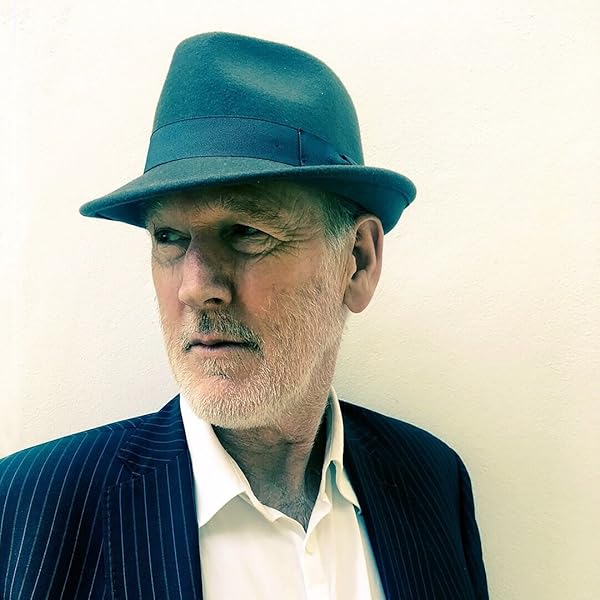
Dr Paul Thomas is an Honorary Professor of Fine Art at the School of Art and Design, University of New South Wales, Sydney. He is the founder and series chair of the International Transdisciplinary Imaging Conference at the Intersection of Art, Science, and Culture series 2010-2024. His publications include Nanoart: the Immateriality of Art (Intellect, 2013) and Quantum Art and Uncertainty (Intellect, 2018). His current publication is Concerning the Quantum in Art (published by Routledge, November 2025). He is editor of The Encyclopedia of New Media Art Volume 2: Artists and Practice (Bloomsbury, 2025). His digital and material artworks, which explore quantum phenomena and their synergies with human experience, have been exhibited nationally and internationally. His website contains an archive of his practice: https://visiblespace.com/blog/
W8 Homework
- Readings:
- Optional: Singularity7
- Write a blog post as a response to the readings (400 words). Address the following questions:
- What is your personal opinion about nano-art? (100 words)
- If you were to create your own nano/quantum artwork, what would that might be? Explain how it works, and what you aim to accomplish with that (100 words)
- There are around you multiple applications of nanotechnology. Can you explain what these are? What is your personal response in knowing that this technology affects your life in one way or another? (100 words)
- Explain with your own words what quantum computing is. Provide 2 cases that showcase how the world will become a better place based on this emerging paradigm. (100 words)
- Readings:
Midterm Evaluations
- Evaluations will be submitted on Albert (deadline this Friday)
- For detailed marks and analysis, please book an 1:1 meeting
Week 9 – The Wired Flesh (Brain Interfaces, Cyborgs, and Posthuman Augmentations)
S1 (Mon 3 Nov) Seminar: The Wired Flesh
S2 (Wed 5 Nov) Guest Talk: Jonathan Xu
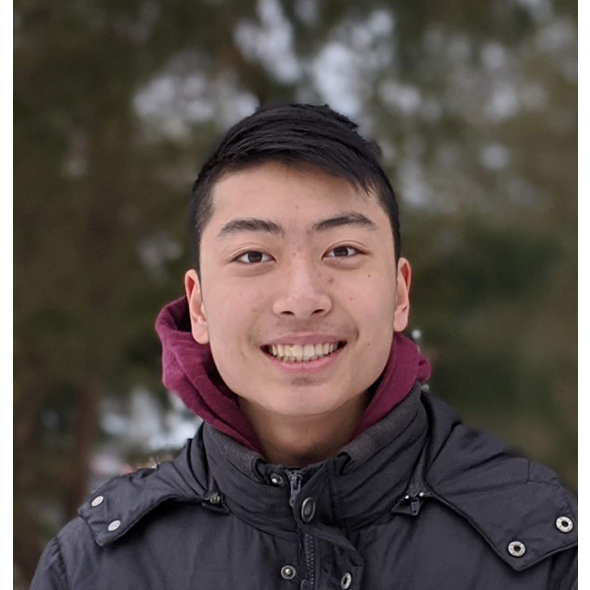
Jonathan Xu is a multidisciplinary technologist and creative thinker whose work spans research, coding, and DIY innovation. His past endeavors range from image reconstruction work in Singapore and detecting agricultural activity at Stanford’s Sustain Lab to programming wearable NFC chips and building Hebbia, an AI-powered platform for answering all kinds of questions.
W9 Homework
- Readings:
- Write a blog post (approx. 400 words) in response to this week’s materials on brain–computer interfaces (BCI), neural implants, transhumanism, and body/brain augmentation. Address all of the following:
- Position / Opinion (100 words): What is your personal position on BCI and neural implants as human–technology integration? Do you see them mainly as therapeutic, as enhancement, or as control? Explain why.
- Therapeutic vs Enhancement Neurotech (100–120 words): We saw that the same technologies can help restore function (Parkinson’s, prosthetics, hearing/vision interfaces) and can also be used to extend function (memory boosts, cognitive speed, attention tracking). Explain in your own words how this distinction matters. When does neurotechnology stop being medicine and start being a form of human engineering? Give one concrete example.
- Body and Brain Augmentation in Practice (100–120 words): Imagine you are asked to design an interactive or media artwork that uses an EEG/BCI, muscle sensors, or an implanted/attached device to make the body part of the interface. Describe the scenario: what is sensed, what is visualized or actuated, and what the audience learns about control, vulnerability, or agency. State clearly if the artwork celebrates augmentation or problematizes it.
- Transhumanism and Society (100 words): In your own words, explain what transhumanism argues for. Then critique it. Who gets to be augmented and who does not? What new forms of disability, exclusion, or governance could appear when cognition and movement are modifiable?
Week 10 – Cities of the Future (Post-Human Dwelling, Speculative Urbanism, Terraformation)
S1 (Mon 10 Nov) Seminar: Cities of the Future
S1 (Wed 12 Nov) Guest Talk: ecoLogic Studio
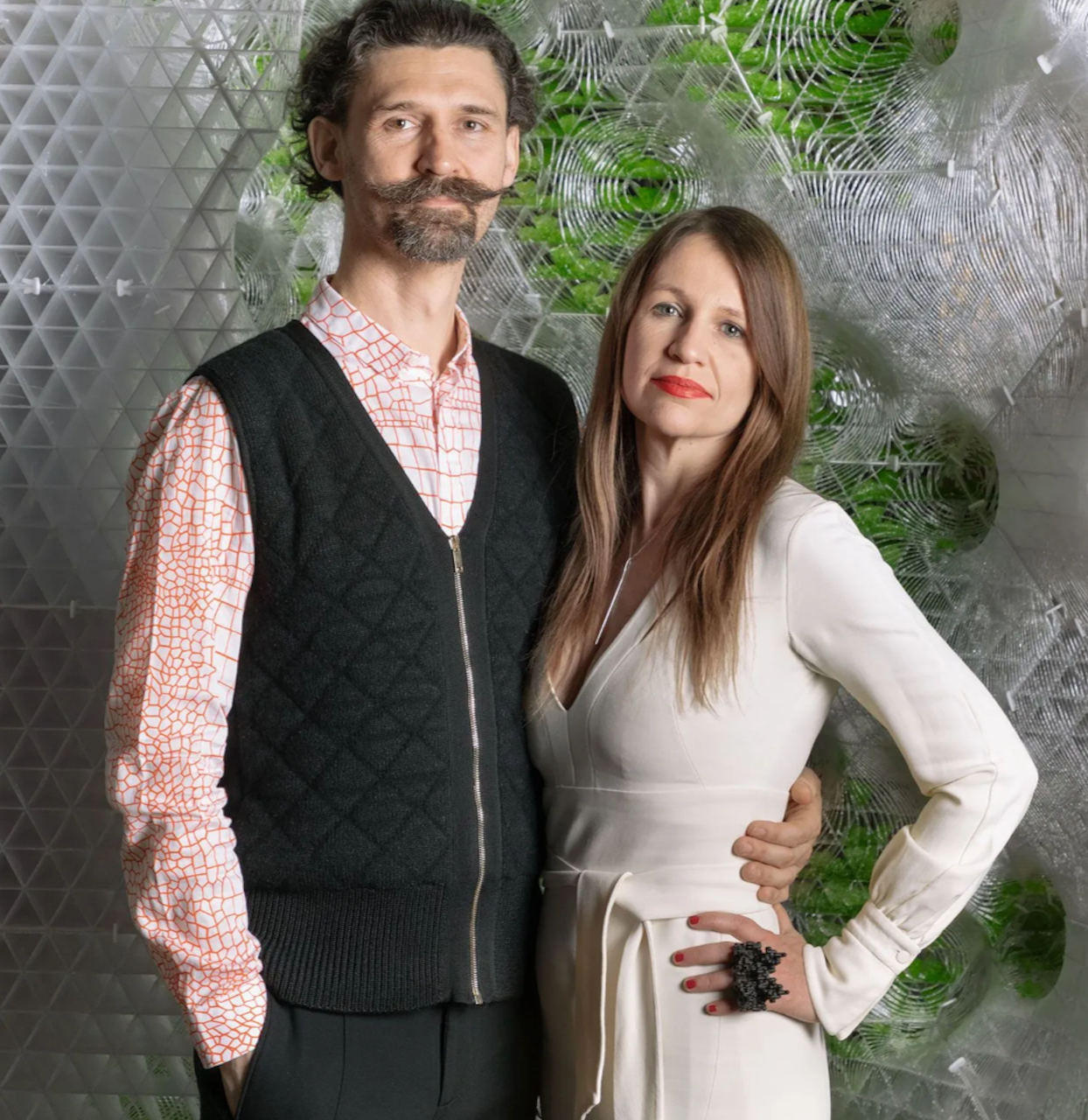
ecoLogicStudio, founded in London in 2005 by Claudia Pasquero and Marco Poletto, is a pioneering architecture and design innovation firm specializing in the integration of biotechnology within the built environment. Their signature PhotoSynthetica™ venture, developed in collaboration with the Synthetic Landscape Lab at the University of Innsbruck and the Urban Morphogenesis Lab at UCL, envisions architecture as a living system, embedding photosynthetic organisms like microalgae into facades and interiors to purify air and generate bioplastics. This bio-digital approach has materialized in celebrated installations worldwide, including the carbon‑capturing AirBubble structures, the HORTUS XL at Centre Pompidou, and the Tree One sculpture in Seoul’s Hyundai Motorstudio, which re-metabolizes CO₂ into oxygen via living algae housed in 3D‑printed, biopolymer structures. Through computational design, systemic thinking, and experimental prototyping, ecoLogicStudio transforms architectural projects into laboratories that explore sustainable, scalable models for a carbon‑neutral future.
W10 Homework
- Readings:
- Write a blog post (approx. 400 words) in response to this week’s materials on the cities of the future, post-human dwelling, speculative urbanism, and terraformation. Address all of the following:
- Position on Post-Human Dwelling(100 words): State one clear claim about how “dwelling” will change when nonhuman actors (AI systems, sensors, or other species) cohabit with us. Give one concrete example that illustrates your claim.
- Smart Cities & Social Impact (100-120 words): The same city technologies can serve different purposes: optimizing city efficiency (IoT sensors, AI traffic management, smart grids) versus addressing social challenges. Does making a city “smarter” automatically make it more livable or equitable? Give one example showing how technology either helped or failed to address real social needs.example.
- A Scenario on Speculative Urbanism (100-120 words): Sketch one near-future city scene. Who is there, what is happening, and what piece of infrastructure or policy makes it possible? End with one sentence on a likely benefit or risk.
- Optional: Use Generative AI (Midjourney, Kling, Nano Banana, Dall-E, CivitAI) to create an image or video of your speculative city.
- Planetary Angle – Terraformation (100 words): In one paragraph, answer: if urban design is part of “terraforming Earth,” what is one thing we should do and one thing we should avoid? Name who gets to decide.
-
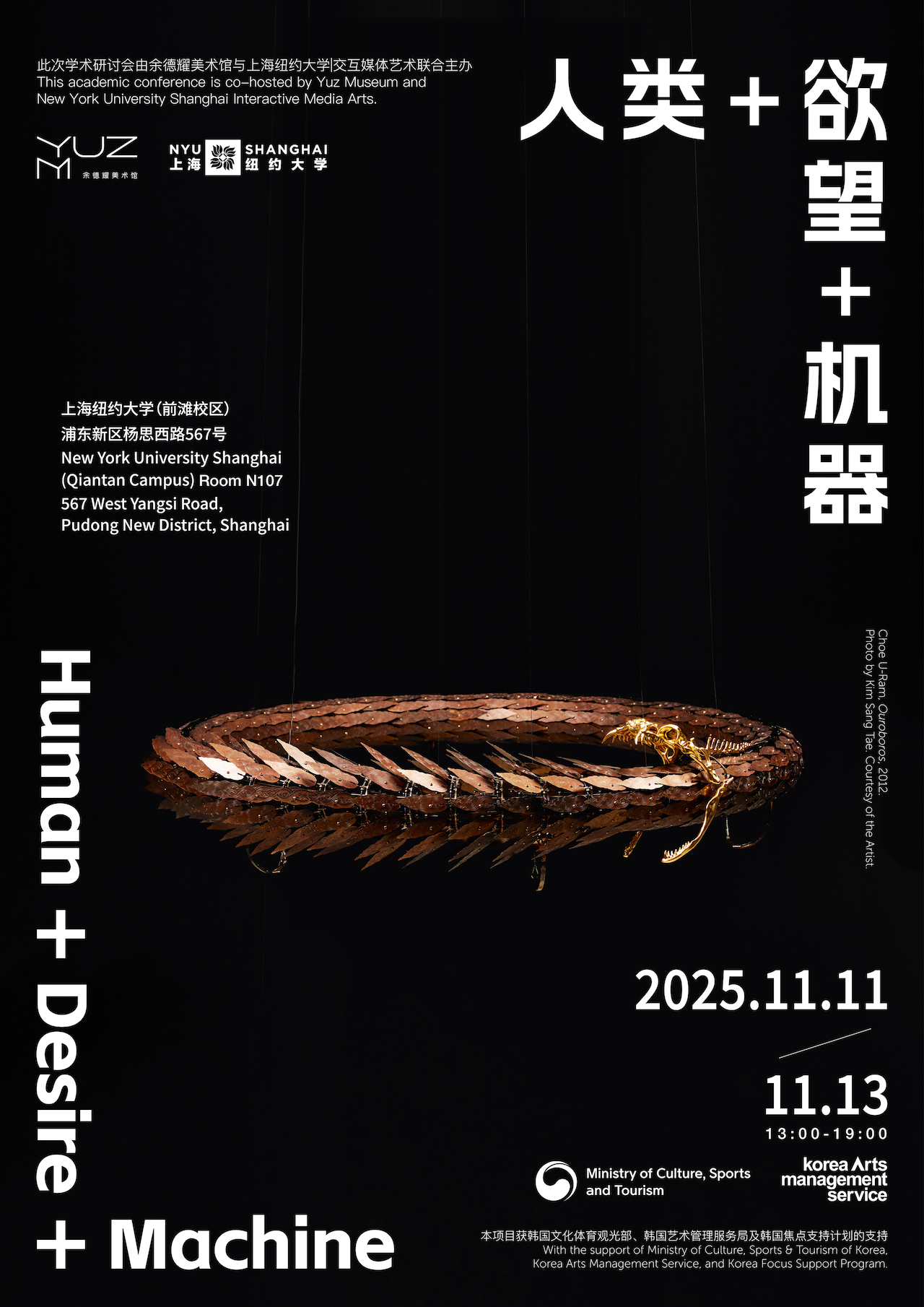
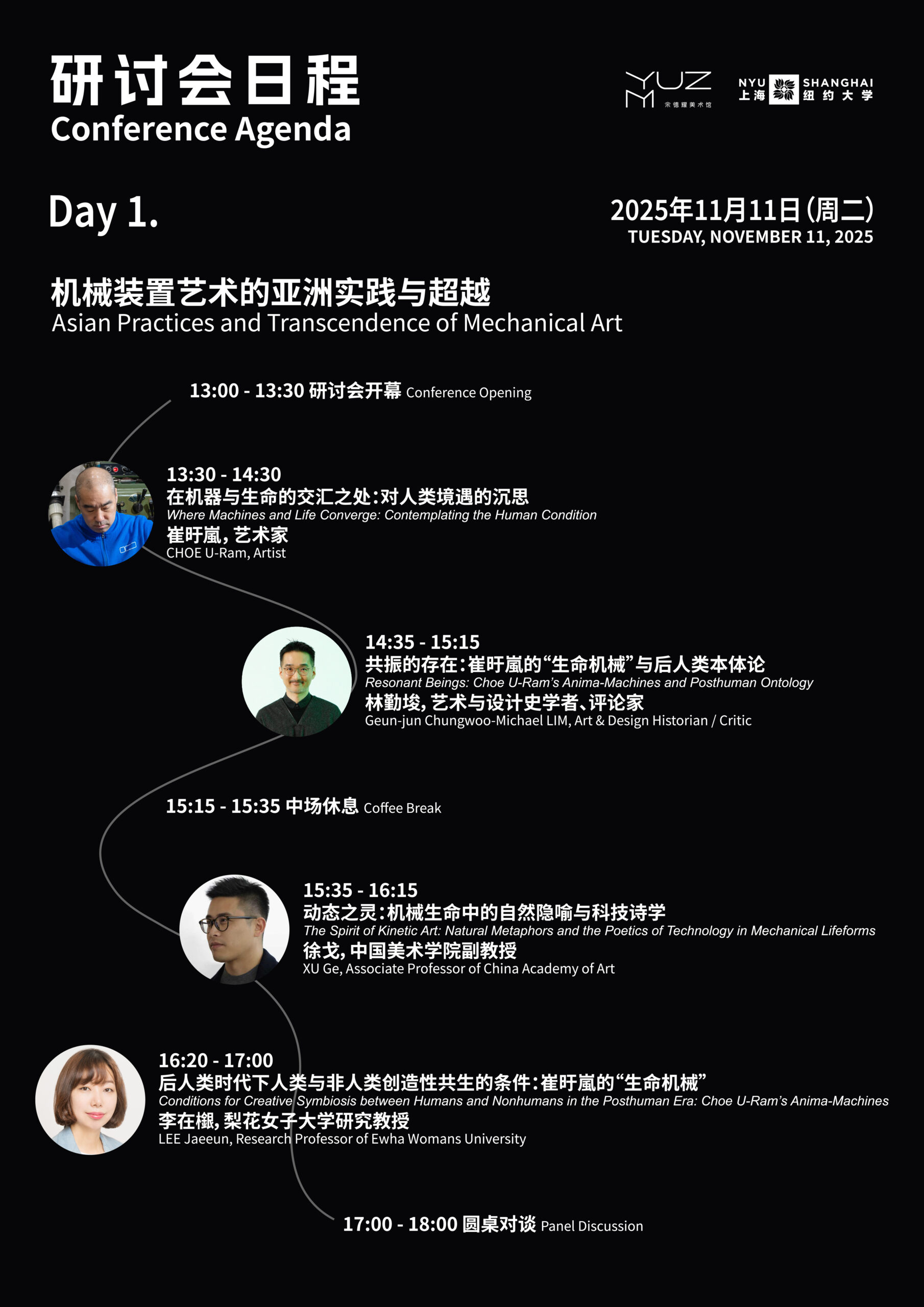
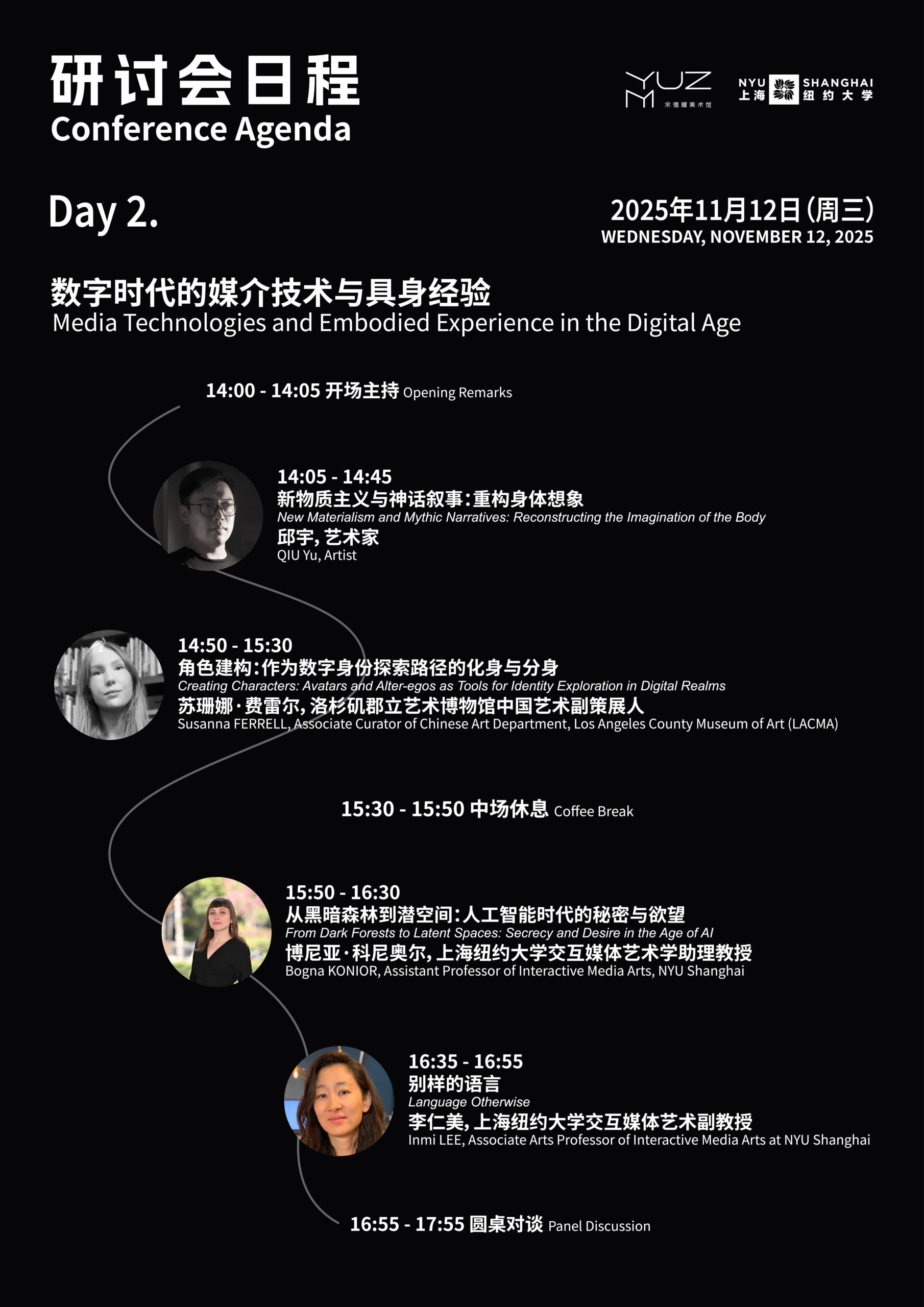
Announcement: Conference on Human + Desire + Machine
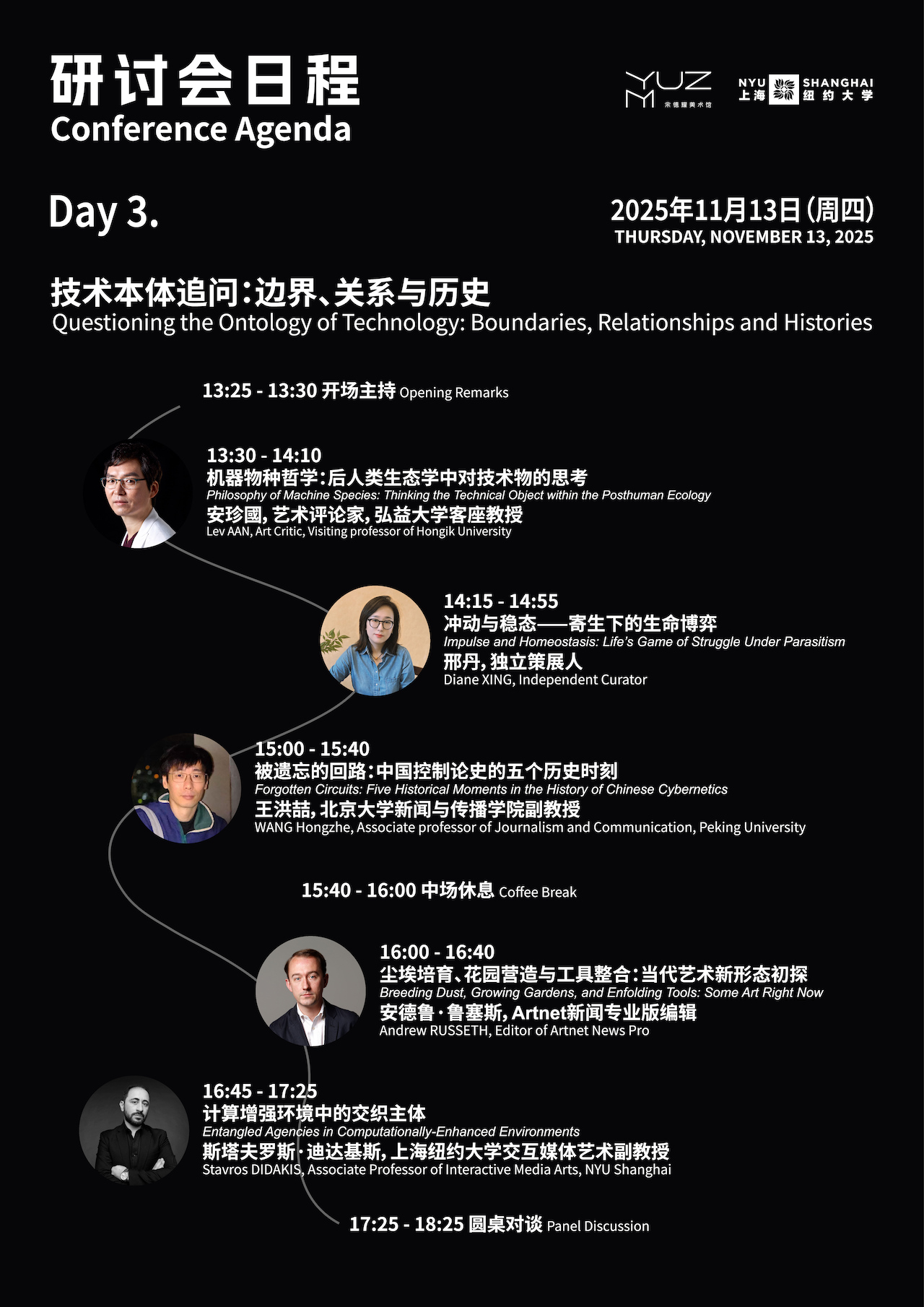
Week 11 – Exo-Technologies (Space Exploration, Interplanetary Imagination, and Impossible Cosmic Infrastructures)
S1 (Mon 17 Nov) Seminar: Exo-Technologies
S2 (Wed 19 Nov) Guest Talk: Iris Long
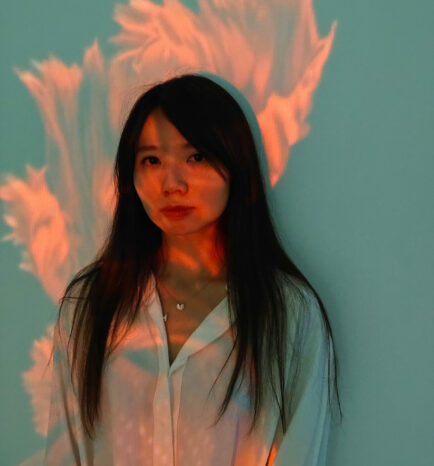
Iris Long (b. 1990) is an independent curator, writer, Berggruen Fellow(22-23), and amateur radio operator. Her research focuses on China’s technological infrastructures and astronomy. She has curated/co-curated numerous science/technology-related exhibitions, including Lying Sophia and Mocking Alexa(Hyundai Blue Prize), the art&tech section of the inaugural Beijing Art Biennale, Earth Heat Flow: the Visitor Who Returns to Solar Time; and Cosmos Archaeology at the Shanghai Astronomy Museum/National Museum of China.
She has served as an international juror for ISEA (International Symposium on Electronic Art) and as an international juror for the Art Gallery and Paper Section of SIGGRAPH ASIA. Her research has been presented at the University of Cambridge Centre for Research in the Arts, Social Sciences and Humanities (CRASSH), the Warburg Institute, the Institute of Advanced Studies/Outer Space Institute at University College London, and the ZKM Center for Art and Media, among others.
Week 12 – Studio Practice / Research
- S1 (Mon 24 Nov) Studio Practice / Research
- S2 (Wed 26 Nov) Studio Practice / Research
Week 13 – Studio Practice / Research
- S1 (Mon 1 Dec) Studio Practice / Research
- S2 (Wed 2 Dec) Studio Practice / Research
Week 14 – Final Presentations
0 Comments