Media Architecture: Overview of Practices
Written by Stavros Didakis
A. Media Facades
Description
Media façades refer to architectural exteriors that incorporate media technologies to display dynamic visual or audiovisual content. These systems transform the building envelope from a static surface into an active interface capable of communication, expression, and interaction. Common technologies include LED matrices, projection systems, and integrated lighting infrastructures, each offering different levels of resolution, permanence, and architectural integration.
While media façades are frequently associated with commercial applications such as advertising and public information displays, they also serve as platforms for artistic and cultural expression. In such cases, the façade operates not only as a surface for display but as a time-based medium that redefines the perceptual and symbolic role of architecture in the urban environment. The integration of media introduces temporality, variability, and responsiveness into the built form, allowing architecture to participate in evolving narratives rather than remaining fixed.
Communication Skin
The notion of the architectural façade as a communicative surface is not new. Historically, building exteriors have conveyed cultural, religious, and political meanings through material ornamentation and symbolic representation. Medieval cathedrals, for example, employed intricate carvings and sculptural compositions to narrate theological stories and encode collective values.
Media façades extend this tradition by introducing dynamic and programmable content. Rather than being fixed in material form, the architectural skin becomes a mutable layer capable of displaying changing information, emotions, and narratives over time. This shift allows the façade to engage audiences in more immediate and participatory ways, expanding its communicative capacity beyond static representation.
A notable example is BIX, the media façade of the Kunsthaus Graz designed by Peter Cook and realized by realities:united. The system consists of hundreds of circular fluorescent elements embedded within the building’s surface, each functioning as a low-resolution pixel. These elements can be individually controlled to display animations and abstract visual content, aligning the building’s exterior with the curatorial program of the institution. In this case, the façade operates as an extension of the museum itself, bridging architecture and media art.
More info about this work:
“The idea of the media installation BIX arose out of considerations on how to equip the interior of tahe Kunsthaus in Graz with media. BIX was created as an additional feature at a time when overall planning of the building had already reached an advanced stage. In addition to the late date and technical complexity of the project, it was also a challenge to integrate an architectural concept of foreign authorship into the expressive building design. After all, BIX was a new element designed to entirely dominate the building’s riverside frontage, thereby radically redefining the architectural concept of the building’s skin. It received approval from the client and the architects because it was based on the architect’s original ideas for the sleek, blue, shimmering façade: Constructed from about 1,300 individually shaped, translucent Plexiglas panels covering the biomorphic building, the so-called skin was intended to feature different nuances of transparency, which would have created varying communicative relationships between interior and exterior. For both technical and budgetary reasons, the skin’s physical transparency had to be abandoned, degrading the material’s transparency into mere decoration.
The introduction of BIX revived the communicative conception of the façade, even if in a mediated way, at the same time delivering the required political arguments for the use of Plexiglas for the final construction of the skin. BIX consists of a matrix of 930 conventional circular fluorescent light tubes integrated into 900 square meters of the Plexiglas façade on the east side of the Kunsthaus. The individual, continuous adjustability of the lamps’ brightness with a frequency of 18 frames per second makes it possible to display images, films, and animations. During the development of BIX, key performance features of conventional large-scale displays were radically abandoned in exchange for a number of substantial advantages. The resolution of the matrix is extremely low. There are only 930 pixels—a mere 0.2% of the pixels found in a conventional TV screen—and they are monochrome. Although such a low image resolution imposes strong limitations, it enables both the modular structure and the large size of BIX to become part of the architecture instead of an additional gadget like so many other media displays. Reduction and intensity are well-established strategies of contemporary art to advance toward the inner essentials. In this way, BIX not only extends the Kunsthaus Graz’s communication range; the installation also replenishes the overall program of the Kunsthaus.
The architecture and the media installation form a strong symbiosis projecting the internal artistic processes of the Kunsthaus in an abstract and mediated form onto the façade and to the public. BIX constitutes an amorphous light matrix tailored to the complex shape of the building and gradually fading away toward the edges, instead of offering straight and clearly visible borders. The installation’s edges are hardly perceptible, as if the light patterns could dance freely on the building’s outer skin, and the 930 lights seem to be rather “tattooed” into the skin of the building like individual spots of pigment. In regard to the themes of size and resolution, integration in the façade and dissolution of the visible boundaries of the monitor screen, BIX is the starting point for investigations that were continued in later projects.
With the choice of an “old” technology, BIX addresses the issue of “technological sustainability.“ Due to the industry’s rapid innovation cycles, technologies for large screens become outdated at a very fast rate. However, by using as pixels industrial fluorescent tubes—known since the 1960s as kitchen lamps that are almost a design classic today—the question of being technologically up-to-date does not arise and BIX meets the architectural demand of constancy. Nevertheless, BIX is not a “low-tech” project. The capability of each lamp to adopt a brightness level between 0% and 100% in 1⁄18 of a second is the result of a groundbreaking tuning process that required the development of special hard- and software.
The BIX screen matrix acts as an architectural “enabler” enhancing the building’s communicative possibilities considerably and offers significantly more than just a spectacular presentational touch. The media façade extends the communication range of the Kunsthaus Graz, complementing its programmatically formulated communicative purpose and becomes an important factor for the identity and image of the Kunsthaus. BIX remains an experimental laboratory until today. As the content producer, the Kunsthaus has the chance to continuously explore and develop methods for a dynamic communication between building and surroundings. In 2010 BIX was selected for inclusion in the permanent collection of the Museum of Modern Art in New York City”.
BIX (realities:united, 2003)
Projection Mapping
Projection mapping is a technique that uses projectors to cast images onto complex, non-planar surfaces, effectively transforming architectural forms into dynamic visual displays. Unlike conventional projection onto flat screens, projection mapping requires precise spatial calibration, often using 3D models of the target structure to ensure accurate alignment between digital content and physical geometry. This approach allows designers to reinterpret architectural elements by augmenting them with light, creating illusions of transformation, movement, or structural alteration. Projection mapping is widely used in festivals, public events, and artistic interventions, where buildings temporarily become immersive visual experiences.
🔗 The Illustrated History of Projection Mapping
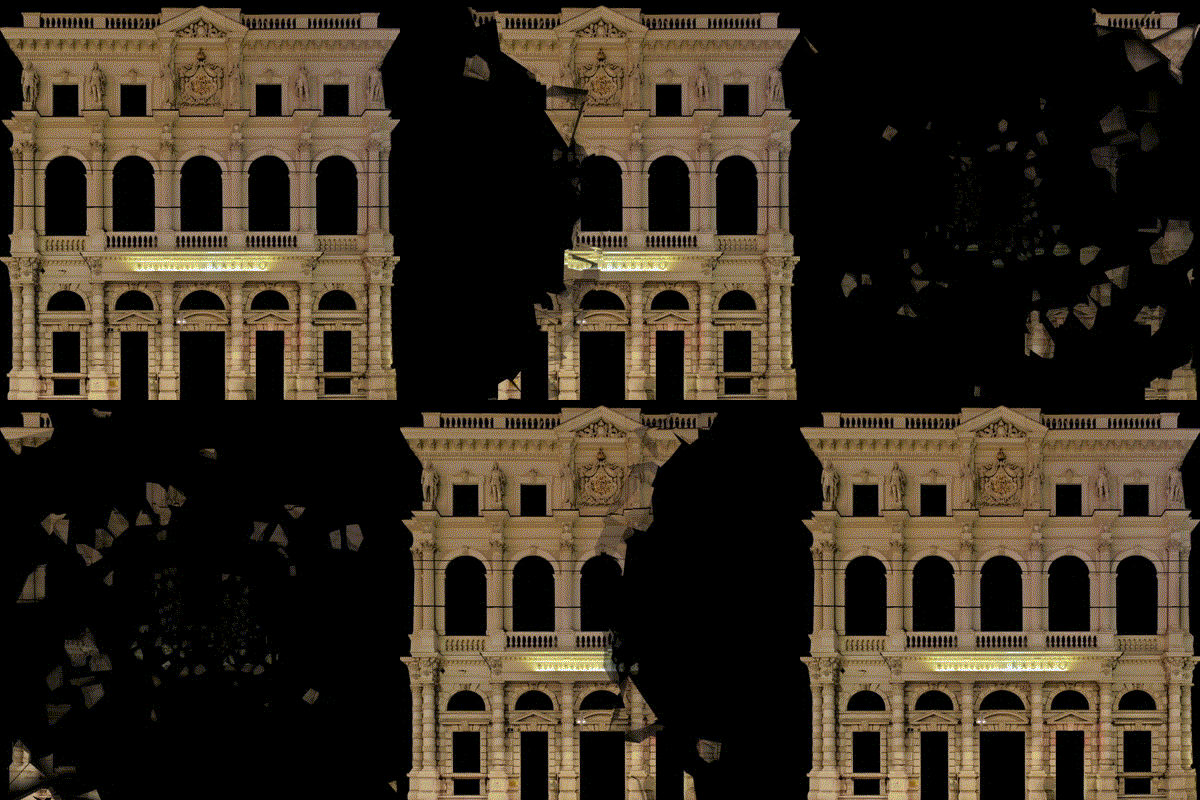
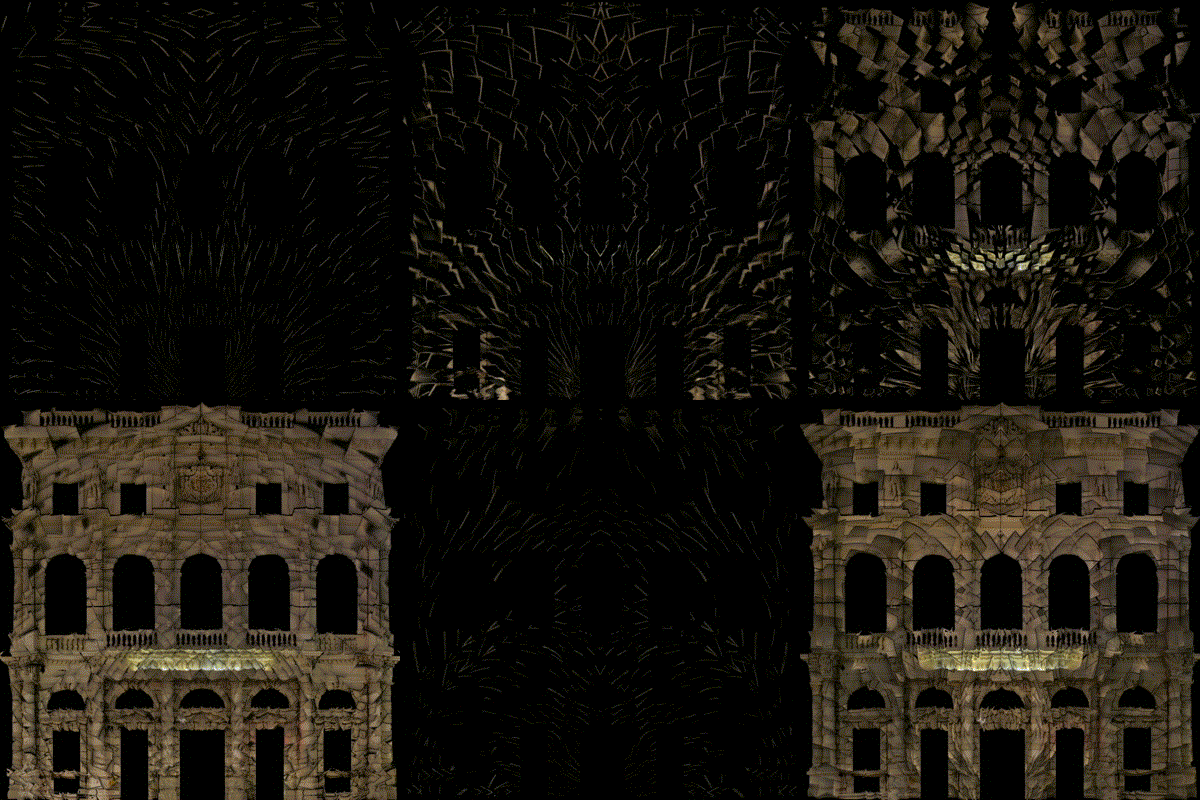
AntiVJ is a visual label initiated by a group of European artists whose work is focused on the use of projected light and its influence on our perception. Clearly stepping away from standard setups & techniques, AntiVJ present live performances and installations, providing to the audience a senses challenging experience, as it is demonstrated in the following audiovisual work at the Bains Numériques festival, Enghien-les-Bains, France.
Enghien (AntiVJ, 2009)
At a larger scale, studios such as Obscura Digital have developed highly complex projection mapping projects, such as the illumination of the Sheikh Zayed Grand Mosque in Abu Dhabi. Utilizing dozens of high-powered projectors, the project required meticulous alignment across intricate architectural details, including domes, columns, and carved surfaces. The result is a temporally orchestrated transformation of architecture, where light becomes a medium for cultural storytelling.
More info about this work:
Interactive developer and artist Mary Franck who worked on the project had this to say: “It was certainly a dream projection-mapping job: incredible architecture, all white marble, completely artistic and cultural content. It was absolutely an honor to be a part of it”.
The first step in the pipeline was to get the model of the structure involved. In this instance, the team used a laser scanner to output a 3d point cloud of the building. This point cloud then was to turned into a mesh, which was then re-topologized into a simpler mesh that can be easily handled in realtime.
At the same time, the physical projector locations had to be decided upon. This depended upon the actual map of the building and surrounding area, where the production team could get access to, and what kind of structures they are allowed to build. According to Mary Franck, this particular job was easy in terms of obstructions of the surrounding area, but difficult because of the sacred nature of the site. All of our projector towers had to be well designed with facades to match the mosque architecture. The projector placement and physical production aspects are a behemoth tasks in themselves; number and placement of projectors has many variables, but in general, maximum brightness, full area coverage and optimal resolution are the major ones.
After the 3d model and general projector spec’ing was completed, a template was made to render the content, which was previously put through an extensive creative process. This was output as video, in this case using a currently-proprietary codec called FireFrame, which were then textured onto the 3d model.
TouchDesigner was utilized for this work.

(Obscura Digital, 2012)
🔗 OBSCURA DIGITAL Shines 940,000 Lumens in the Desert
The following media projection was created by Alexander Klein in 2017. It has a surface of approximately 2,500 square meters of video capable LED-RGB pixels. The content for the media façade was chosen by Yumasheva, granddaughter of Boris Yeltsin, who requested 20 separate pieces based on five topics: architecture, nature, urban spaces, culture, and art. Visuals like perpendicular lines, buildings, clouds, handicrafts and Russian tea are featured as well as the work of established Russian artists. The production of the digital media content was a combined effort using analog techniques, from photographing gold pigment in oil to building complex scale models to get the shot before the post-production digital editing began. The result manages to reposition the role of the architectural facade as a time-based three-dimensional canvas that can utilize a range of alternative methods for the engagement of the public.
🔗 Media Façade Design for the Boris Yeltsin Presidential Center
Illusionary Practices
Recent developments in media façades have explored illusion-based techniques, particularly anamorphic imagery, to create the perception of three-dimensional forms on flat or curved surfaces. These illusions depend on specific viewing angles, establishing a spatial relationship between the observer and the media content.
The project WAVE by d’strict demonstrates this approach. Installed on the large-scale LED display at COEX K-POP Square in Seoul, the work simulates a massive ocean wave contained within the architectural frame of the screen. The illusion is achieved through careful manipulation of perspective, making the wave appear volumetric and physically present. This strategy introduces a conditional form of spectatorship, where the experience is optimized from particular vantage points.
WAVE (d’strict, 2019)
Impossible Skylines
Media façades can extend beyond individual buildings to construct coordinated visual systems at the scale of the city. In these cases, architecture is no longer treated as a singular object but as part of a distributed media network, where multiple structures operate in synchronization to produce a unified audiovisual experience.
A notable example is a large-scale media event in Shenzhen, organized to celebrate the city’s 40th anniversary as a Special Economic Zone. During this event, numerous high-rise buildings in the urban core were transformed into a collective display surface, with synchronized light and media content spanning the skyline. Rather than functioning independently, each façade contributed to a larger compositional system, effectively dissolving the boundaries between individual buildings.
This type of intervention constructs what can be described as an “impossible skyline,” where the city itself becomes a programmable image. The urban environment is temporarily reconfigured into a coherent visual field, capable of expressing cultural narratives at a scale that exceeds traditional architectural limits. Such practices foreground questions of coordination, authorship, and infrastructure, as well as the implications of transforming the city into a unified media apparatus.
B. Fluid Interiors
Description
While media façades primarily address the exterior of architecture, interior spaces radically transformed as well through the integration of computational media technologies. Media and interactive systems enable the continuous manipulation of audiovisual content, allowing environments to adapt, respond, and evolve over time. Media interiors operate across both pre-rendered and real-time modes, often incorporating interactive elements that respond to user input, environmental conditions, or external data streams. As a result, interior space is no longer defined solely by material composition but by dynamic processes that shape occupants’ perception and experience.
Surrealscapes
Media technologies allow interior environments to move beyond representational constraints, enabling the creation of immersive and often surreal spatial experiences. Through the combination of animation, sound, real-time rendering, and computational control, interiors can become fluid environments that shift between different aesthetic and perceptual states.
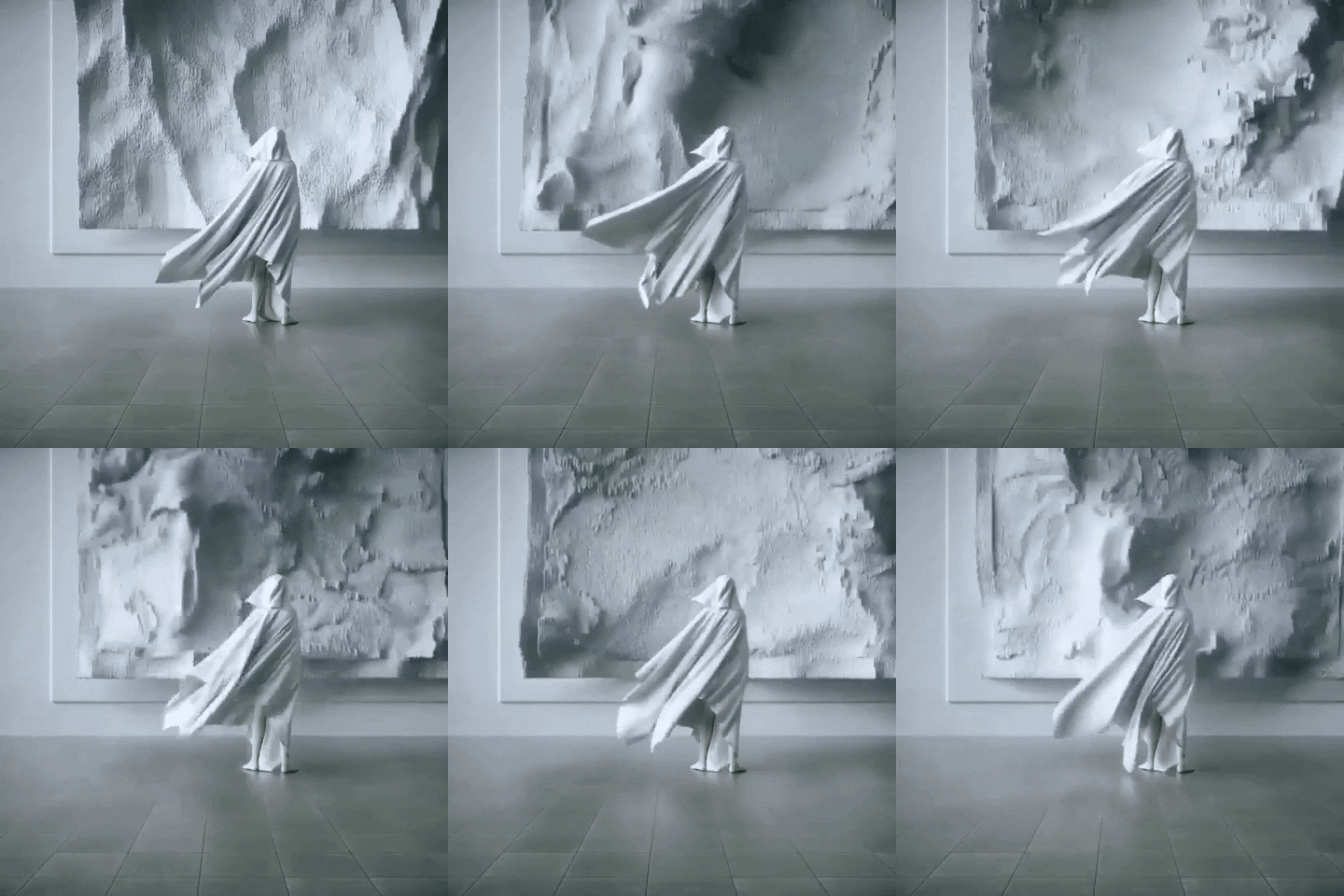
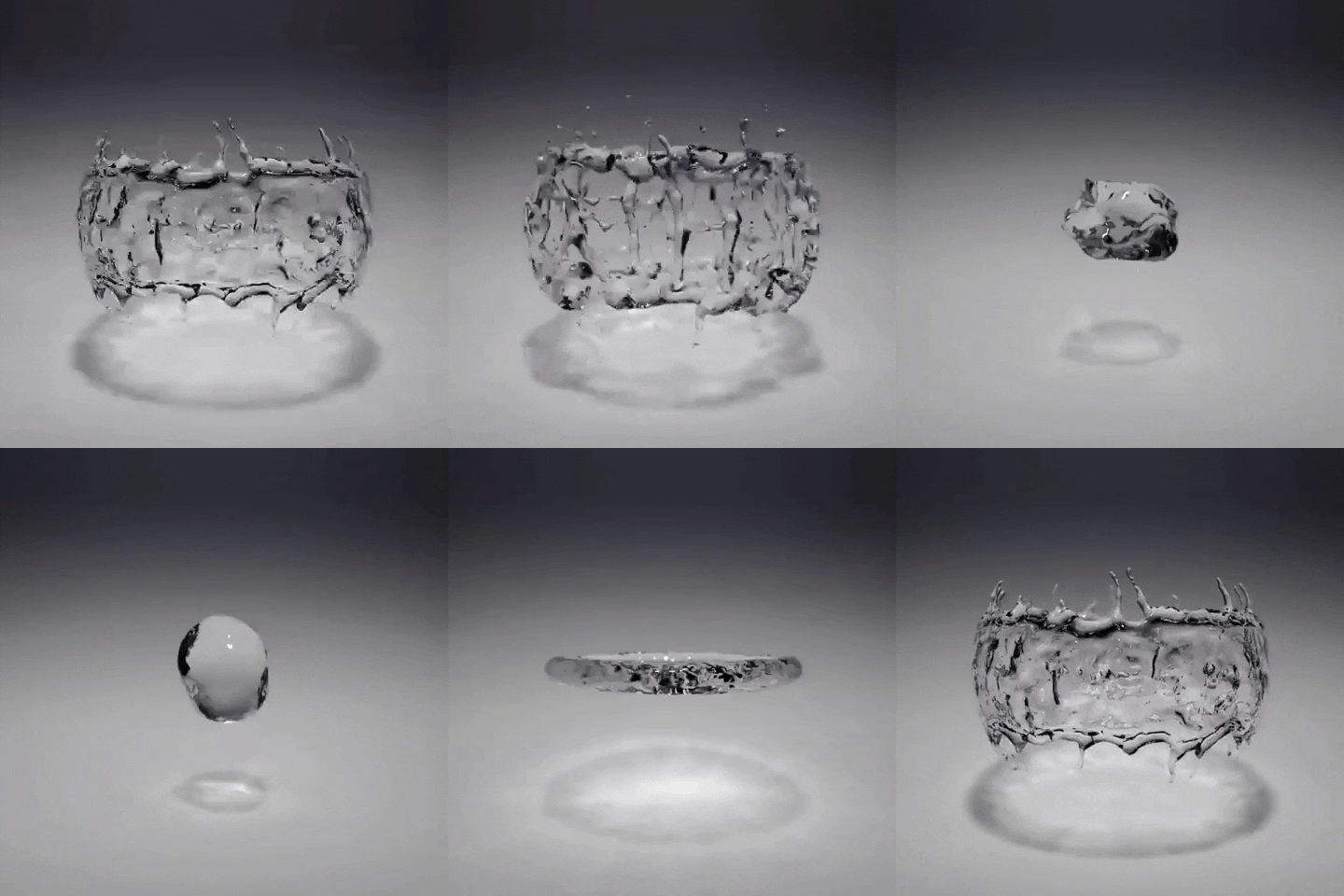
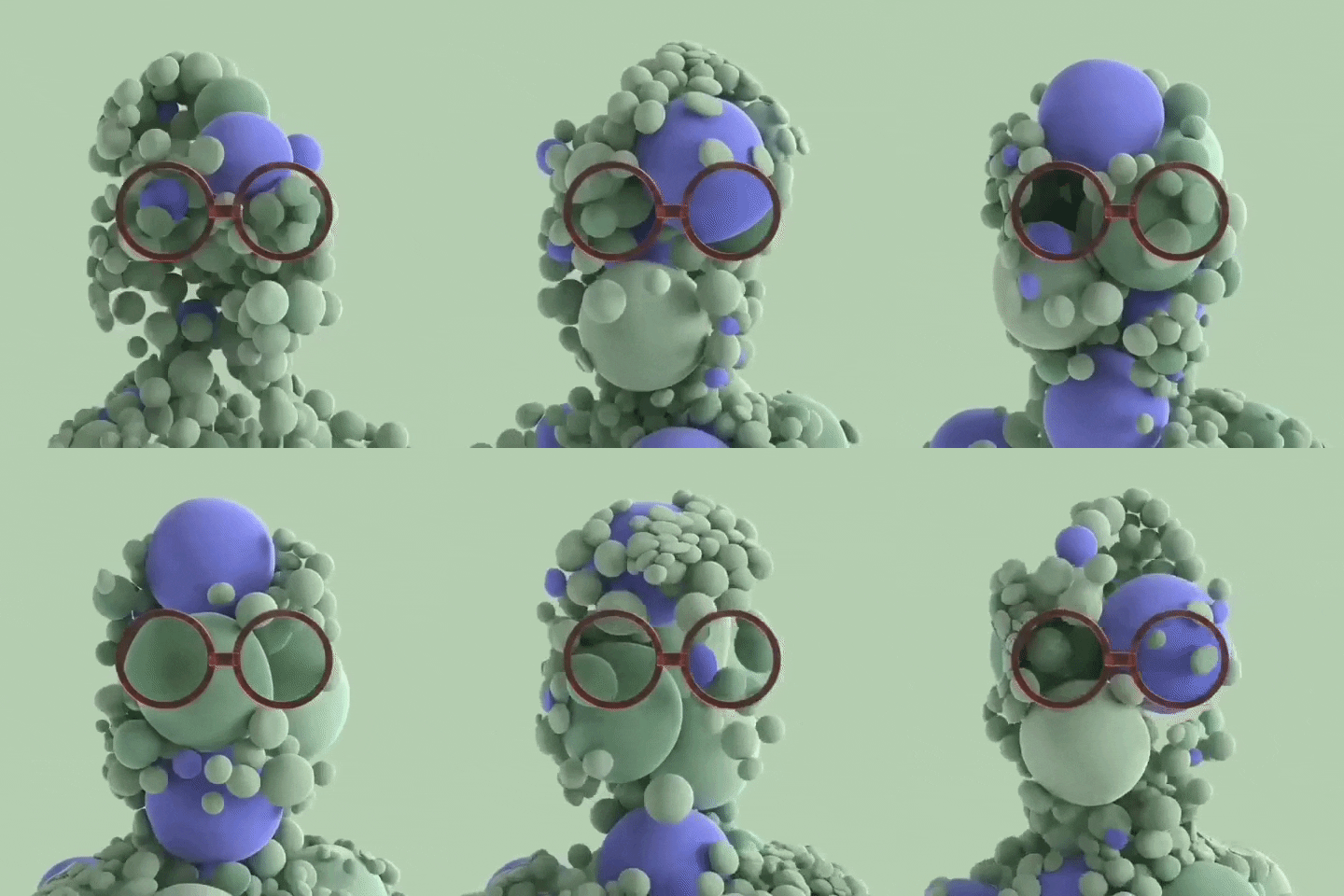
An example is Theatre of Experience by the Moment Factory at Changi Airport. Here, large-scale media installations are integrated into the architectural fabric of the terminal, transforming transitional spaces into narrative environments. The content ranges from cinematic landscapes to subtle animated reliefs, creating a layered experience that enhances the identity of the space while engaging travelers.
Theatre of Experience (Moment Factory, 2018)
Similarly, Universe of Water Particles by teamLab presents a continuously evolving digital waterfall generated through real-time simulation. The system calculates the behavior of thousands of virtual particles, producing a dynamic representation of water that responds to environmental data. This approach exemplifies how computational processes can generate spatial phenomena that are both visually compelling and systemically driven.
Universe of Water Particles (teamLab, 2018)
🔗 Universe of Water Particles on the Living Wall | teamLab / チームラボ — teamLab, 2017, Digital Installation, LED, Endless, H: 11810 mm W: 1920 mm
Responsiveness
A key characteristic of contemporary media interiors is their capacity for responsiveness. Through the use of sensors, cameras, and input devices, these environments can detect and react to human presence and behavior in real time. This establishes a feedback loop between users and the system, where actions and responses continuously influence one another. Software platforms such as TouchDesigner, Unity, Unreal and Max/MSP are commonly used to develop such interactive systems.
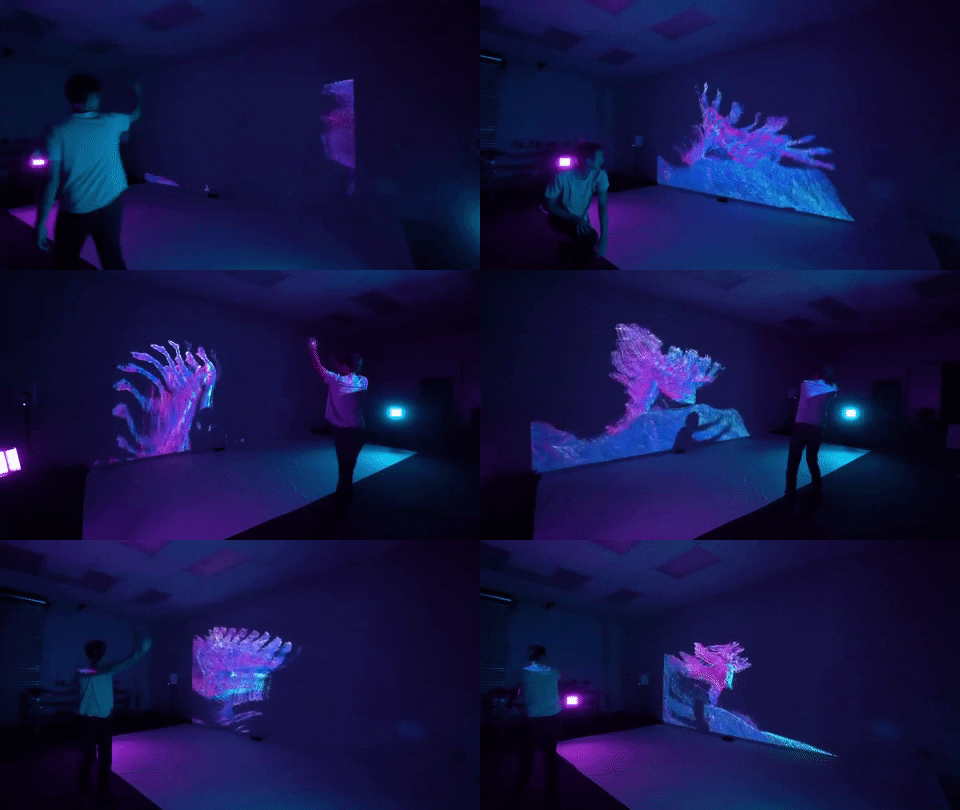
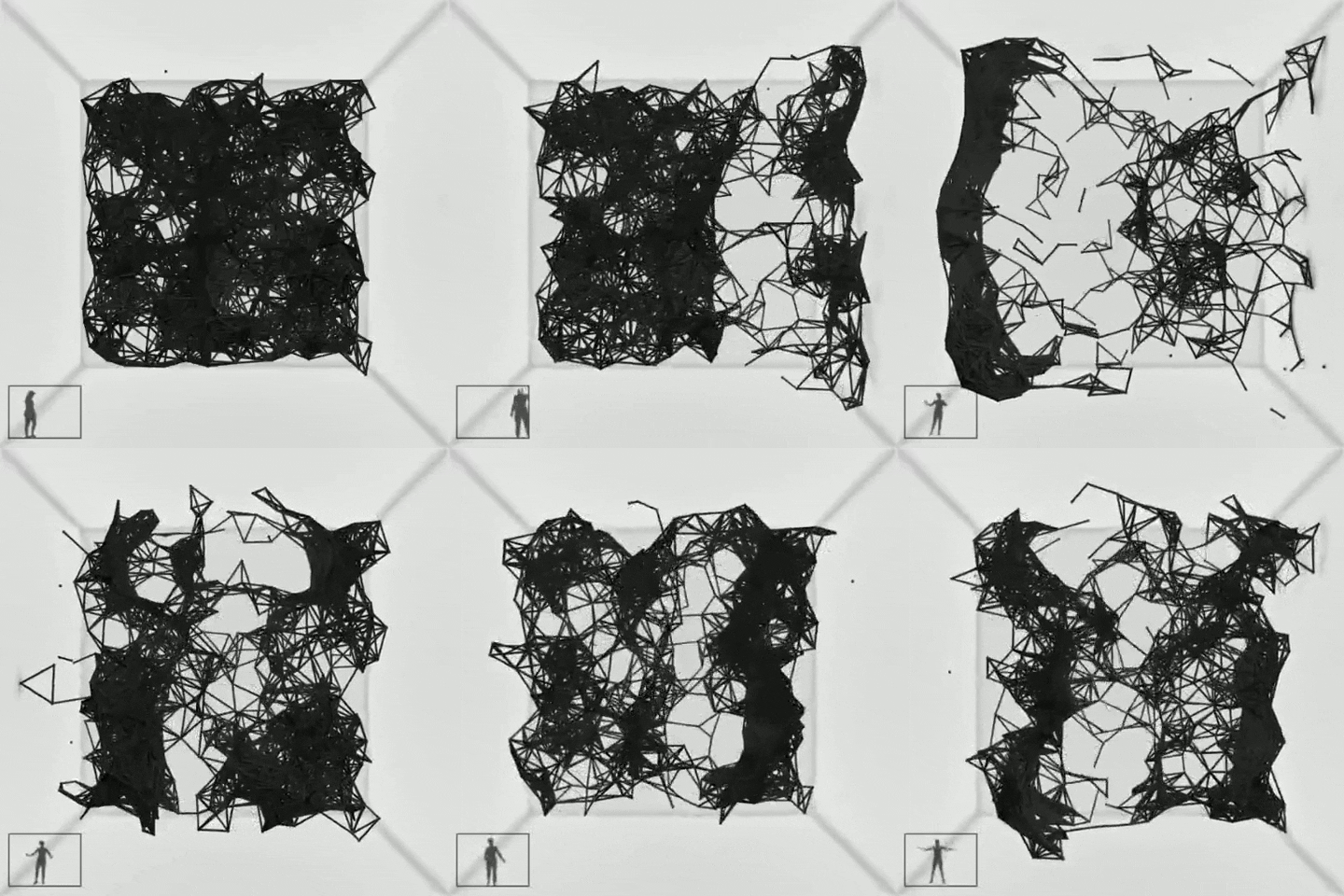
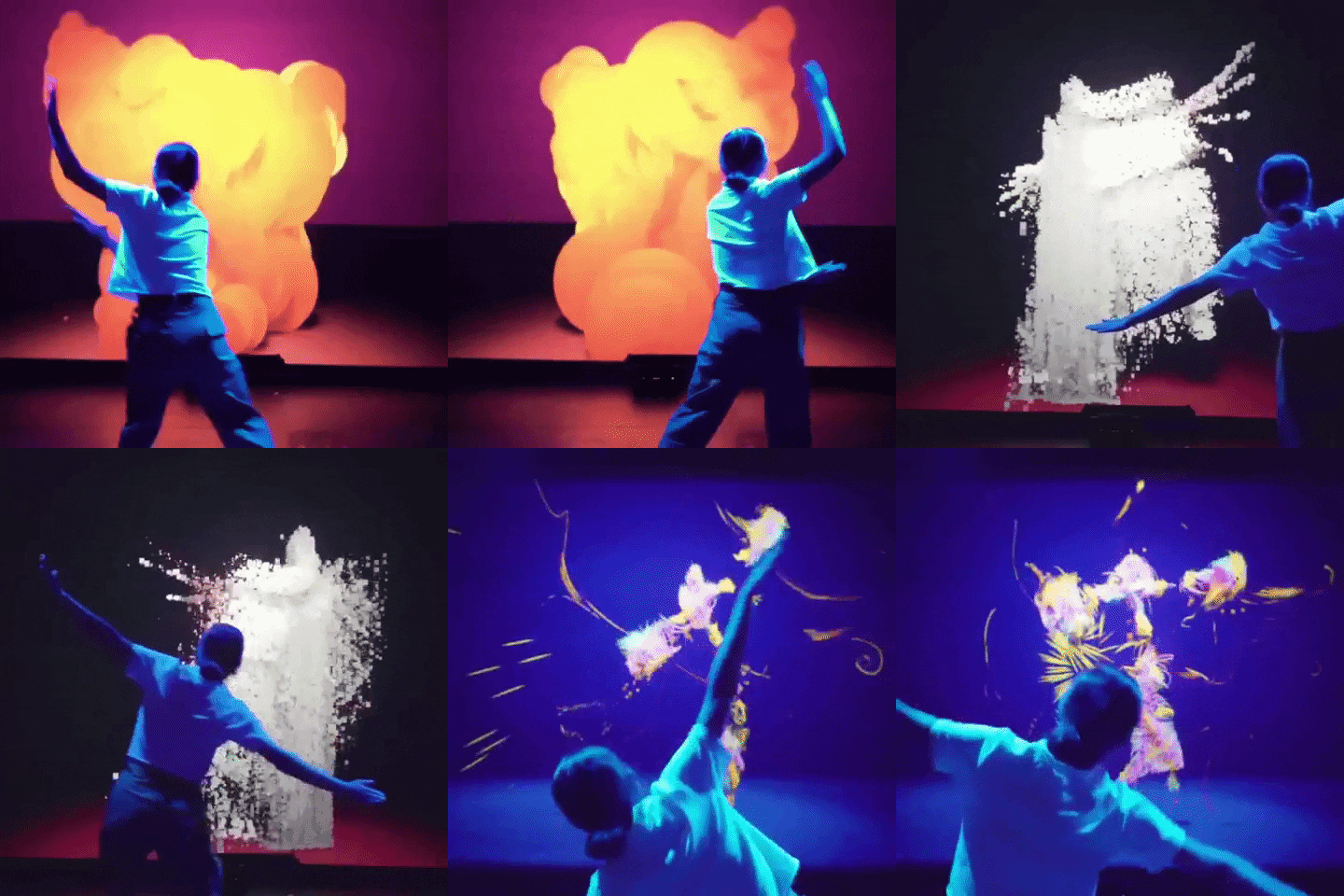
In the main lobby of the Terrell Place in Washington DC, the media company ESI transformed its lobby with the use of a 1,700-square-feet of motion-activated media. Here, technology and media are seamlessly integrated into the architectural surfaces, creating an ever-evolving artwork that captures the pulse of the building. ESI’s designers unified the expansive first floor lobby space by treating it as a single media canvas. By installing large-scale, reactive media on lobby walls and corridor portals, they created a sense of connection across the building’s common areas. At 80 feet wide x 13 feet high, the large media wall is capturing the attention and curiosity of passersby, who can see it from outside through oversize windows.
More info about this work:
The media installation includes a range of practices involved; some of its highlights include the following:
• Diffused LED wall displays in the main lobbies and corridor are activated by passersby via an infrared camera system, creating beautiful scenes that ebb and flow with the morning rush and the afternoon lull.
• The displays include three content modes – ‘Seasons,’ ‘Color Play,’ and ‘Cityscape’ – offering a selection of scenes that can be programmed with varying durations and sequences, ensuring that tenants never see the same scene even if they arrive and leave at the same time every day.
• The ‘Season’ mode shows the lifecycle of the iconic Washington, DC cherry trees. In the ‘Spring’ phase, as people pass by the screens, their movement causes the trees to blossom until eventually their petals fall off; when people pause in the lobby, they trigger butterflies to flutter.
• ‘Color Play’ shows algorithmically-generated patterns of multi-color threads which spread across the walls, weaving a tapestry that reflects the activity of Terrell Place.
• ‘City Scape’ pays homage to the city of Washington, DC with iconic architecture, statuary and transportation scenes that are brought to life by people passing by.
Terrell Place (ESI Design, 2016)
🔗 Terrell Place, Washington, DC | Interactive Architecture
Immersive Space
In some cases, media systems dominate the interior environment entirely, creating fully immersive spaces where digital content surrounds the viewer. These environments often use large-scale projections or LED surfaces to envelop users in audiovisual narratives.
The following example created by Tamschick Media+Space has been installed in the Wuxi City Relics Museum, with content that has been specifically designed to introduce visitors to the story of the Kingdom Wu, which, in a sense, becomes a time machine to transport “passengers” to the 5th century BC.
Click for further details:
The completely projected 400 sqm space interactively tells the story of the Kingdom Wu. Visitors are immersed in a 15-minute story about the rise of the Kingdom of Wu during the Spring and Autumn Period between 514–496 BC. In this project, the creators have developed a unique visual style as a mix of cinematic martial arts scenes shot in Shanghai combined with paint-style animations. The linear storytelling is enhanced with interactive elements that reinforces the visitors’ feeling of being transported back in time, away to king HelV’s coming into power, his fight for hegemony, the victory at the battle of Boju and other great legends of that period.
Client: Wu Kingdom HelV Relics Museum Wuxi, Peoples Republic of China
TAMSCHICK MEDIA+SPACE GmbH has developed the following content: Overall Management, Planning and Production of the Spatial Media Design, Conception, Story Development, Creative Direction, Direction, Art Direction, Production of Shooting, Motion Design, Animation, Postproduction, VVVV Programming, Music Composition and Sound Design, Implementation
Media Technology, Hardware: Kraftwerk Living Technologies GmbH, Brainsalt Media GmbH
Hardware used: 22 WUXGA projectors, 14 IR cameras, 36 synchronized computers, 34 audio channels
Floor: with projection and interactive video & audio, size approx. 400sqm, resolution 3600×8500 pixels
Wall: projected and interactive, size approx. 240sqm, resolution: 1900x8500pixel
Program Runtime: 15min
Data-Actuated
As digital information has become a ubiquitous necessity (being everywhere at all times) any dataset can be utilized to create new interactions and creative interior spaces. The works below utilize information extracted from databases, APIs (Application Programming Interfaces), Open Data, or cloud applications and machine learning algorithms.
Here, the combination of computer science, telecommunication systems, and audiovisual design, become integrated, fused together.
‘Virtual Depictions: San Francisco’ is a public art project by media artist Refik Anadol that consists of a series of parametric data sculptures that tell the story of the city and people around it. The main idea of the project is to bring 21st century approaches to public art and define new poetics of space through media arts and architecture. The media wall displays parametric data sculptures that have an intelligence, and are linked to memory and culture.
Through architectural transformations of the media wall located in 350 Mission’ lobby, home of Salesforce, the main motivation was to frame an experience with a meticulously abstract and cinematic site-specific data-driven narration. As a result, the wall turns into a spectacular event making direct and phantasmagorical connections to its surroundings through simultaneous juxtapositions. The project also intends to contribute to contemporary discourse of media art by proposing a hybrid blend of art, technology and architecture. As the artist says, “when creating this artwork my goal was to make the invisible visible by embedding media arts into architecture and create a new way to experience a living urban space”.
Virtual Depictions (Refik Anadol, 2016)
The installation DATAGATE by Ouchhh consists of 3 parts; Form, Light, and Space. Light is the world’s first artwork based upon the idea of utilization of Machine Learning in the context of space discovery and astronomical research through NASA’s Kepler AI Data Sets. By using the Kepler data from NASA, the public will be able to observe the exoplanets [planets that orbit around other stars] which human life can exist in. Ouchhh aims for this artwork to be considered as a gate between our planet and other habitable planets around the universe.
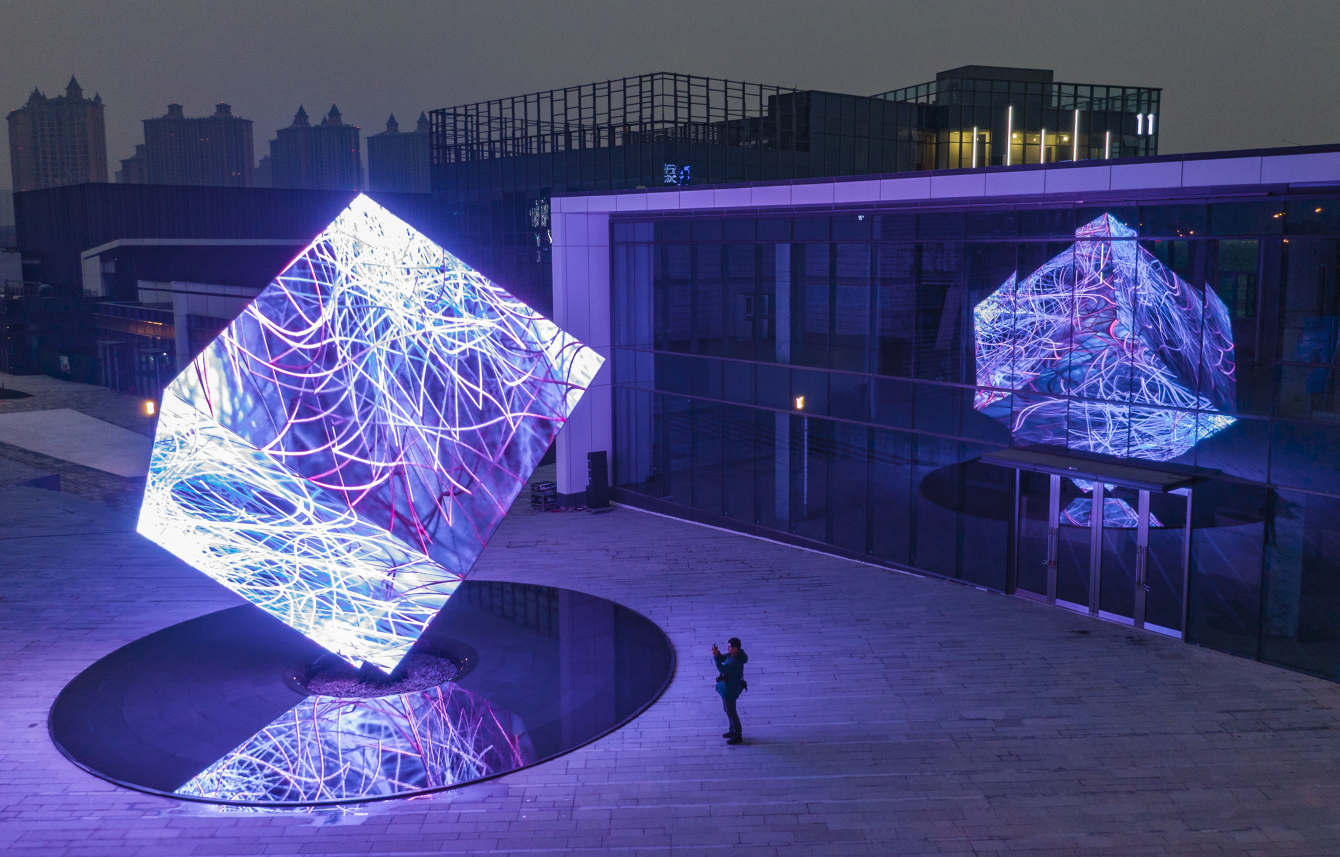
DATA GATE (Ouchhh, 2019)
Symulakra (2019), by panGenerator, is an interactive media installation that explores the relationship between perception, simulation, and collective behavior through a responsive audiovisual environment. The project employs a system of sensors and real-time processing to translate the presence and movement of participants into evolving fields of light and sound, generating a space in which digital phenomena appear to acquire a form of autonomous agency. As users navigate the installation, their actions are continuously captured, transformed, and reintroduced into the system, creating layered feedback loops between the physical and the simulated. In this way, Symulakra operates as a media-architectural construct that interrogates how contemporary environments are increasingly shaped by computational processes, where representation and reality become entangled within dynamic, perceptual infrastructures.
Symulakra (PanGenerator, 2019)
The Shimmering Pulse (2020), by panGenerator, is an interactive media installation that transforms biological signals into a distributed spatial experience of light and rhythm. Centered on the real-time capture of participants’ heartbeats, the project translates individual pulses into synchronized patterns of illumination that propagate across a networked architectural system. As multiple users engage simultaneously, their physiological data interweave to produce a collective, pulsating environment, where the boundaries between individual bodies and shared space become fluid. Through this convergence of biometric sensing and responsive media, the installation foregrounds the body as both a generator and modulator of spatial atmosphere, articulating a form of media architecture in which intimate signals are externalized and amplified into a communal, dynamic field.
The Shimmering Pulse (PanGenerator, 2020)
This interactive installation has been developed by i-DAT an Open Research Lab for playful experimentation with creative technologies that is hosted by the University of Plymouth, School of Art, Design, and Architecture. A fundamental consideration in this work is to use data as manifestations that emerge through multiple digital interactions. This dynamic data-driven artwork analyses content generated through social media, as well as information tracked in the real space, and attempts to represent the identified interactions using realtime visualizations, questioning how behaviour is actuated through algorithmic technologies.
Click for further details:
The intelligence of the system is driven by Quorum, a computational initiative in cultural computation, ludic data and playful experimentation, which focuses on analyzing audience behaviour that emerges from physical and digital interactions. The system incorporates bio-inspired algorithmic swarm decentralized decision-making processes to generate a dynamic and evolving collective behaviour. Its computational infrastructure integrates subjective and objective data, considering its temporal and predictive aspects, variety and quality and correlations through the use of Artificial Neural Networks, Deep Learning and Self-Organising Maps.
TIWWA utilizes a range of data inputs that are collected and distributed to its processing units, in order to comprehend the complexity of the surrounding space, which is not limited to a physical, but also the digital realm. Behavioural data such as individual and collective movement and touch are extracted through the use of sensors that are installed on the physical space. The process provokes audience to engage on an instant temporality according to the reactions of the media sculpture, challenging the communication patterns exchanged between humans and the computational machine. Social media data are used through the extraction of specific keywords that collect content and sentiment from present and distant audiences. Natural language processing and Artificial Intelligence is used to analyse the content that is identified as relevant to the system’s performance, allowing it to build its own subjectivity and sentiment intensity. Finally, the last parameter that is used for the system input is environmental data such as CO2, temperature, humidity, and energy consumption captured by Tate Modern’s Energy Management System. This information becomes important as it represents vital aspects of the architectural space, and how the environment affects inhabitants’ lives collectively.
TIWWA challenges us to realise the complexity of our surrounding and immersive spaces and the possibilities that materialize through computational intelligence, transforming our apprehension and appreciation of the hybridization that occurs. By fusing a range of parameters to the system’s input and processing the content with the use of the aforementioned computational processes, a range of meta-cognitive elements begin to emerge, allowing us to perceive an extended map of agents and relationships that form between them. This experience becomes critical in the way our environments are conceived, materialized, and used, pushing us forward into theorizing and speculating on the additional dimensions and possibilities that computational media may offer into our contemporary development practices.
TIWWA (i-DAT, 2016)
Kinetics
Kinetic media architecture extends the logic of the responsive interior beyond screens and projected light, introducing physical movement as a primary channel of expression. Rather than rendering change through illumination or pixels, kinetic systems reconfigure architectural elements — panels, shutters, tiles, mirrored units — through motorized actuation, so that the surface itself becomes a site of transformation. In this approach, the boundary between building component and display dissolves: walls, facades, and partitions acquire temporal behavior, shifting between states of opacity, reflection, texture, and porosity according to computational control and environmental input.
A representative example is Brixel Mirror by the Brooklyn-based studio BREAKFAST. The installation comprises 540 modular rotating bricks — Brixels — each mirrored on one side and matte-black on the other, individually actuated and controlled through custom software. When a visitor approaches, computer-vision sensing triggers the bricks in front of them to rotate, generating a silhouetted reflection that tracks the body in real time; in the absence of a viewer, the array composes kinetic animations, typographic sequences, and abstract patterns across its surface. BREAKFAST frames these modular units as “mechanical pixels,” where visual resolution is a function of actuated physical elements rather than light emission. In doing so, Brixel Mirror — and the broader Brixels platform — positions kinetic tiling as an architectural medium in its own right, capable of operating simultaneously as wall, artwork, display, and sensor-responsive interface, and pointing toward an architecture in which structural surfaces are themselves programmable and behaviorally alive.
Public Installations
Description
Public installations refer to art works that are exhibited to open public spaces and their form, function and meaning are created for the general public usually in outdoor spaces. Public art embodies public or universal concepts rather than commercial, partisan or personal interests, and it has clear aesthetic qualities in form or theme. In many cases, the works are interactive and collaborative, allowing the public to enjoy playful and engaging content. The case studies below explore selected examples of such projects.
Playful Interactions
Chris O’ Shea‘s “Hand from Above” is by far one of the most exciting urban screens project to date. The work encourages us to experience and question our normal routines and behaviors, especially in the public space. “Inspired by Land of the Giants and Goliath, we are reminded of mythical stories by mischievously unleashing a giant hand from the BBC Big Screen. Passers by will be playfully transformed. What if humans were not on top of the food chain? Unsuspecting pedestrians will be tickled, stretched, flicked or removed entirely in real-time by a giant deity”.
The “Hand from Above” was built using openFrameworks and openCV.

Hand from Above (Chris O’ Shea, 2009)
Loop is a public installation that consists of 13 giant zoetropes – an optical toy that was a forerunner of animated film. When a zoetrope is activate, images are shown in rapid succession, creating the illusion of motion. This illuminated musical installation, featuring a distinctive retro-futuristic look, uses cylinders two metres in diameter. Members of the public are invited to sit down inside and activate the mechanism, causing beautiful images inspired by 13 fairy tales to come to life. It’s magical! Loop is sure to spark children’s imagination and revive their parents’ childhood memories.
Loop is a cross between a music box, a zoetrope and a railway handcar – the pump-powered vehicles familiar from Bugs Bunny cartoons. The retro-futuristic machine plays animated fairy-tale loops set in motion when visitors work the lever together. When the cylinder starts spinning, it lights up, making the series of still images appear to move. A flickering strobe effect accompanies the black and white images, like in the very first movies. The animation is visible from inside or outside the cylinder and can be viewed from up close or far away. The speed at which the images move, the frequency of the flickering and the tempo of the music are determined by how fast the participants move the lever.
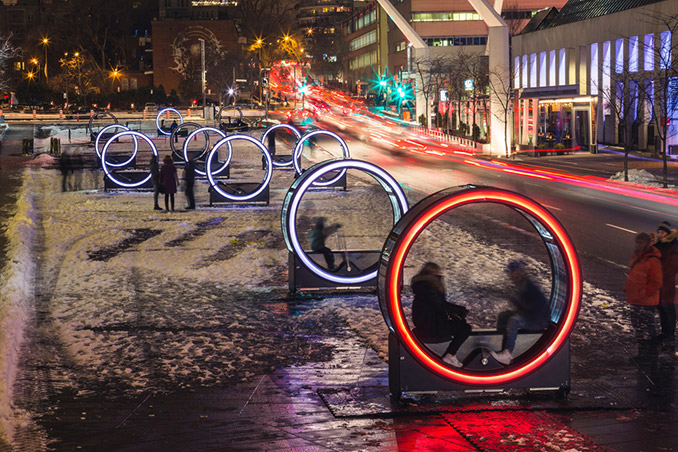
Loop (Ekumen, 2016)
The Lightwaves (2019), is a large-scale interactive media installation that transforms collective human input into a dynamic spatial light environment. Developed for the Męskie Granie music festival, the project consists of a network of drums connected through addressable LED systems to a central floating sphere, where each percussive interaction generates waves of light that propagate through space in real time. As participants engage simultaneously, the intensity and rhythm of their actions directly shape the evolving audiovisual composition, establishing a feedback loop between human activity and architectural illumination. In this way, the installation operates as a responsive media system that materializes sound, participation, and social synchronization into a shared luminous experience, foregrounding the role of collective agency in shaping emergent spatial atmospheres.
The Lightwaves (PanGenerator, 2019)
Immersive Landscapes
WATERLICHT, developed by Studio Roosegaarde, is an immersive light installation that simulates the presence of rising water levels within the built environment, transforming public space into a dynamic, atmospheric landscape. Using layers of light and motion, the project renders an ephemeral “virtual flood” that allows audiences to physically experience the potential impact of climate change and sea-level rise. Rather than representing water as a static visualization, WATERLICHT operates as a spatial and perceptual intervention, where shifting waves of illumination envelop participants and reframe their relationship to the surrounding architecture. In doing so, the installation functions as a form of environmental media architecture that merges poetic expression with data-driven awareness, foregrounding the urgency of water management and collective ecological responsibility.
Waterlicht (Studio Roosegarde, 2016-2020)
🔗 Waterlicht | Studio Roosegaarde
Transitional
Transitional works foreground transformation as their central condition, employing mechanical, optical, or computational means to render architectural and sculptural forms in perpetual flux. Rather than presenting a fixed image or stable object, these installations operate through sequences of states, where identity, representation, and appearance are continuously reassembled over time. In this register, public sculpture becomes a temporal event: its coherence emerges not from a singular form but from the choreographed passage between configurations, inviting viewers to engage with instability, metamorphosis, and the slow unfolding of image as a defining aesthetic register.
David Černý is a renowned artist who creates provocative sculptures for public spaces. In the following work, he has created a kinetic piece that displays Franz Kafka’s head in a state of constant metamorphosis. The kinetic sculpture is 11 metres tall and made of 42 rotating panels. Each layer is mechanized and rotates individually.
Head of Franz Kafka (David Černý, 2014)
MegaFaces Pavilion is a structure incorporating the world’s first large scale actuated LED screen & kinetic facade. Facial impressions are created once every minute and are relayed to the kinetic facade from multi-camera 3D scans made in proprietary instant 3D photo booths installed within the building and in locations across 30 Russian towns and cities. This fully automated process utilised a tablet-based registration app in the queue line to give each visitor a personalised QR code card, and therefore a personalised language experience within the photo booths. Each visitor received a SMS message with the time they would appear on the facade. Everyone received a live webcam link before their face was shown and recorded video was archived so that visitors, or people who participated but were unable to attend the games, could share their moment across social media.
Megafaces (iart, 2014)
Collectivity
Collectivity-driven works shift the locus of artistic expression from the singular object to the distributed social body, employing media-architectural systems to aggregate, visualize, and materialize shared states of the public. Through networked interfaces, crowd-sourced inputs, and collective sensing, these installations render the moods, behaviors, and rhythms of a community as perceptible spatial phenomena. In doing so, they reconfigure the relationship between citizen and urban form, positioning the installation as a civic organ through which the invisible dynamics of collective life acquire material presence and continuous public visibility.
D-Tower is a media sculpture made by NOX Architects, which explores the way that public art can be connected with each individual citizen. In this example, a web application was developed that provides visitors a selection interface for their current mood (sad, angry, happy, and so on). All the entries are automatically calculated every day, and the sculpture will light with a specific color that displays the average mood of the city. Here, therefore, the installation becomes an important living organ of the city.

D-Tower (NOX Architects, 2007)
🔗 D-tower
Sustainable Structures
Sustainable structures extend the field of media architecture toward ecological and environmental concerns, reframing the built surface as an active participant in planetary systems rather than a passive envelope. Drawing on biomimicry, biotechnological integration, and atmospheric sensing, these works propose architectures that absorb carbon, host living organisms, regulate microclimates, or metabolize waste streams as part of their operational logic. Here, the computational and the biological converge: sensors, actuators, and digital control systems are combined with photosynthetic, chemical, and material processes to produce hybrid infrastructures in which performance is measured not only in aesthetic or communicative terms, but in ecological contribution and environmental responsiveness.
Humidity swing technology, developed by Dr Klaus Lackner (Lenfest Center at Columbia University), allows the energy-efficient capture of CO2 from air, closing the carbon cycle and creating a valuable product. Inspired by him, the Boston’s TREEPODS INIATIVE, lead by Influx_Studio and ShiftBoston, looks to help towards the achievement of Boston’s goals in carbon reduction programs.
Embodying and artificially enhancing the capacity of natural trees to clean the air. Treepods are not designed to replace natural trees, but to act like small air cleaning infrastructures, increasing in many times CO2 absorption. Biomimicry of the most unique trees in the world: taking inspiration from the Dragon Blood Tree, the TREEPOD imitates its umbrella shaped crown to optimize a canopy that provides a maximum of shading surface and that allows the wind flow.

Treepods (Influx Studio, 2011)
🔗 Boston Treepods | Influx Studio | Archello
The Urban Algae Folly, designed by ecoLogicStudio and located at the District’s entrance, is an interactive pavilion integrating living micro-algal cultures, a built example of architecture’s bio-digital future. Microalgae, in this instance Spirulina, are exceptional photosynthetic machines; they contain nutrients that are fundamental to the human body, such as minerals and vegetable proteins; microalgae also oxygenate the air and can absorb CO2 from the urban atmosphere ten times more effectively than large trees. The innovative architecture of the Alge Folly originates from the evolution of the well known ETFE architectural skin system; in this instance it has the ability to provide the ideal habitat both to stimulate Spirulina’s growth and to guarantee visitors’ comfort.
On sunny summer days the microalgae will grow rapidly thus increasing the shading potential of the architectural skin and improving human comfort; visitors, with their presence, will in turn activate the digital regulation system which will stimulate algal oxygenation, solar insolation and growth. In any given moment the effective translucency, the color, the reflectivity, the sound and productivity of the Urban Algae Folly are the result of the symbiotic relationship of climate, microalgae, humans and digital control systems. The Future Food District, designed by Carlo Ratti Associati for Italian supermarket chain COOP, is one of the thematic areas of EXPO 2015 “Feeding the Planet, Energy for Life”. FFD is composed of a 2,500 square meter pavilion (supermarket) and of a 4,500 square meter public square. The project explores new forms of interactions between people and products to re-imagine the supermarket of the future as a place for free exchange where everyone can be both producer and consumer.

Urban Algae Folly (ecoLogic, 2015)
🔗 :: Algae Folly – EcoLogicStudio ::
Screen-Based
Screen-based media architecture employs large-scale digital displays as integral components of the built environment, embedding moving image, dynamic content, and synchronized audiovisual sequences directly into the spatial and operational fabric of a site. Unlike projection-based approaches, these works rely on dedicated display infrastructures — LED walls, high-resolution panels, and modular screen arrays — that function continuously as part of the architecture itself. In such configurations, the screen ceases to be a discrete object and becomes an infrastructural layer, shaping orientation, atmosphere, narrative, and identity across transit terminals, civic buildings, and cultural venues. The result is an environment in which storytelling, real-time data, and curated content are woven into the everyday experience of moving through space.
The multimedia installations at the Tom Bradley International Terminal (TBIT) at Los Angeles International Airport (LAX), developed by Moment Factory in collaboration with Los Angeles World Airports, Sardi Design, and MRA International, constitute one of the largest immersive media environments integrated within an airport infrastructure. Conceived as a dynamic system of large-scale digital displays, responsive content, and synchronized audiovisual sequences, the project transforms the terminal into a continuously evolving narrative space that reflects the cultural identity and diversity of Los Angeles. Rather than functioning as static signage, the installation operates as an infrastructural media layer, adapting its visual content across time, events, and passenger flows. In doing so, it redefines the airport as an experiential environment where media architecture enhances orientation, atmosphere, and engagement, embedding storytelling and real-time data within the spatial and operational fabric of transit.
Light Art & Design
Lighting is an important part of the functional and aesthetic part of buildings. By using light (illumination, color, or shadows) as an artistic medium, a wide range of compositions can be created. Lighting is a fundamental medium for architectural and interior design, as it is able to communicate content with its inhabitants, and, in addition, it strongly defines how the space can be utilized. The profound effects of lighting within architectural spaces are non-arguable, as everyone can instantly sense the conveyed mood. As light plays a significant role in the psychological state of inhabitants – such as provoking mood and cognition levels (Knez, 1995), (Baron et al. 1992), influence performance through the intervening variable of positive affect (Baron et al., 1992), trigger serotonin levels in the body, changing a person’s mood and social behaviour (aan het Rot et al., 2008), and assist interpersonal communication, stimulate more general communication, or encourage intimacy (Gifford 1988: 177) – it is a considerable parameter to the development of media extensions of an interior space and to the emotional
states that it can affect.
🔗 The Importance of Architectural Lighting – TCP Lighting
Light as Space
For over half a century, the American artist James Turrell has worked directly with light and space to create artworks that engage viewers with the limits and wonder of human perception. Turrell has innovated photographic techniques that allow light to have a physical presence. Using holography to make the light itself the subject rather than the medium, Turrell creates colored light installations that appear to possess mass and take up space as planes, cubes, pyramids, and tunnels. Turrell’s series “Skyspace,” (begun in the 1970s), which he has constructed around the world, are enclosed spaces open to the sky through an aperture in the roof that enable viewers to observe changes in light from minute to minute and season to season, what has been described as a religious experience.

🔗 Type — A hologram is a recording of light waves on a thin layer of transparent gelatin emulsion. In the emulsion is an image that has full parallax. In other words, it appears to have depth from every vantage point. Unlike traditional holograms that depict objects, the Turrell holograms aim to make a hologram of light itself.
Artist Olafur Eliasson is another renowned artist that uses often light and architecture to create provocative works. One of his most known artworks is the Weather Project for the Turbine Hall of Tate Modern, London, which is a site-specific installation that employed a semi-circular screen, a ceiling of mirrors, and artificial mist to create the illusion of a sun. Aluminium frames lined with mirror foil were suspended from the ceiling to create a giant mirror that visually doubled the volume of the hall – along with the semi-circular screen mounted on the far wall, its long edge abutting the mirror ceiling. Backlit by approximately 200 mono-frequency lights, the semi-circle and its reflection created the image of a massive, indoor sunset seen through the artificial mist emitted into the room. By walking to the far end of the hall, visitors could see how the sun was constructed, and the reverse of the mirror structure was visible from the top floor of the museum.
The Weather Project (Olafur Eliasson, 2003)
Sculptures
Media sculptures are three-dimensional works in which light, structure, and computational control are integrated to form coherent objects within architectural space. They differ from facades and interiors in that the sculpture itself is the primary site of the work, rather than a modification of an existing surface or envelope. Typically constructed through combinations of LED networks, cabling, steel armatures, and custom fabrication, these pieces use illumination as a structural and expressive material, producing forms whose presence depends equally on their geometry and on the luminous behavior embedded within them.
As architectural interventions, media sculptures often inhabit transitional or unconventional sites — unfinished buildings, atriums, plazas, industrial interiors — where their scale and luminosity reshape the perception of the surrounding space. They operate as anchoring elements that concentrate attention, generate atmosphere, and introduce a symbolic or narrative dimension into their context, extending the language of sculpture into the domain of media architecture.
Within the Malaysian town of Butterworth, Kuala Lumpur-based architect and artist Jun Ong has embedded a five-storey lighting installation within the core of an unfinished concrete building. Built from steel cables and over 500 meters of LED light, The Star sculpture is suspended with its spherical center piercing through the building’s foundation in an spider-web like network of light. The artist explains “The Star is a glitch in current political and cultural climate of the country, it is a manifestation of the sterile conditions of Butterworth, a once thriving industrial port and significant terminal between the mainland and island”.
The installation was part of the 2015 Urban Xchange public art festival.
The Star (Jun Hao Ong, 2015)
🔗 Artist Installs Giant 4-Story LED Star in Abandoned Building
Compositional
Compositional works approach media architecture as a formal practice, where the organization of light, sound, motion, and space is the central concern. Instead of foregrounding interactivity, data, or representation, these installations are structured around principles of arrangement and sequence: how elements are distributed across a site, how patterns evolve over time, and how the viewer’s movement through the work shapes its perception. The aesthetic logic of the piece emerges from the relations between its components rather than from any single image or event.
In this sense, compositional works borrow methods from music, visual art, and spatial design, using luminous and sonic materials as the building blocks of a coherent temporal structure. Modular arrays, choreographed kinetic elements, synchronized light and sound, and carefully calibrated spatial rhythms allow these installations to construct environments that unfold as composed experiences — closer to a score or an architectural drawing than to a screen-based display.
‘Portal’ is an interactive light piece created by artist Akiko Yamashita in the Weller Court Plaza in Little Tokyo District of downtown Los Angeles. It is a highly acclaimed work that is celebrated by the urban residents in the city center. It has become a destination portal – formally a dark tunnel – has been transformed by this Japanese-American’s work.
Portal (Akiko Yamashita, 2015)
A row is a basic way to structure data, from mathematics to twelve notes of the chromatic scale in music. The rows of data floating in the air every second being converted into messages and voices. Bits of information become symbols that can be combined in words, words add up to sentences and sentences translate ideas and thoughts. It’s about the perception of information, language, and dialogue. In this project, TUNDRA have been challenged to experiment with a holographic (lighting) technology and see if it can somehow be used in an interesting way to create an audiovisual experience. The result is a raw concept of a scalable data-driven installation. Row is a modular and scalable array of screens that can form various length line of any desired shape. Translating raw visuals driven by generative sound, the content itself is being echoed with a slight delay which creates various moving patterns that highlight and reflect the spatial characteristics of space where it is installed.
Row (TUNDRA, 2019)
DEEP WEB is a monumental immersive audiovisual installation and live performance created by light artist Christopher Bauder and composer and musician Robert Henke. Presented in enormous pitch dark indoor spaces, DEEP WEB plunges the audience into a ballet of iridescent kinetic light and surround sound. This dramatic three-dimensional sculpture was first presented in 2016 as a preview at CTM Festival Berlin in January and followed by the presentation at the Festival of Lights Lyon in December.
Click for further details:
The generative, luminous architectural structure weaves 175 motorized spheres and 12 high power laser systems into a 25 meter wide and 10-meter high super-structure, bringing to life a luminous analogy to the nodes and connections of digital networks. Moving up and down, and choreographed and synchronized to an original multi-channel musical score by Robert Henke, the spheres are illuminated by blasts of colorful laser beams resulting in three-dimensional sculptural light drawings and arrangements in cavernous darkness.
The installation brings together decades of separate research and experimentation by two artists with unique visions and passions for sound and light, and by innovative companies working in these fields. High-end laser system manufacturer LaserAnimation Sollinger provided the technical expertise and development for this very specific spatial laser setup. The high precision motor winch systems with reall-timee feedback and the main control software are provided by Design Studio WHITEvoid in collaboration with Kinetic Lights. This novel combination of computer-controlledd kinetic elements and laser systems allows for setting animated end points to normally infinite laser beams. DEEP WEB uses light as a tangible material to construct three-dimensional vector drawings in thin air.
Deep Web (Christopher Bauder & Robert Henke, 2016)
Resources
🔗 ProjectorCentral — Projector reviews, specs, and guides for home theater, classroom, and professional use.
🔗 Projection Mapping Central — Articles, case studies, and tools for projection mapping.
🔗 Media Façade — Overview of media façade architecture and its applications.
🔗 Media Architecture Blog — News, research, and events in media architecture.
🔗 Projection Mapping Brightness Calculator — Tool to estimate brightness requirements for installations.
Software
🔗 Best Projection Mapping Softwares — Overview of different tools available.
🔗 MadMapper — Professional projection mapping and LED mapping software.
🔗 TouchDesigner (Derivative) — Real-time visual programming tool for interactive media.
🔗 Millumin — Software for creating audiovisual and interactive shows.
🔗 Resolume — VJ software and media server with projection mapping tools.
🔗 Max (Cycling ’74) — Visual programming environment for audio, video, and interaction.
🔗 VPT (Video Projection Tool) — Free real-time projection mapping software.
🔗 Houdini — Advanced 3D procedural software for VFX and simulations.
🔗 Adobe After Effects — Motion graphics and visual effects software.
🔗 Processing — Creative coding platform for visual arts.
🔗 Unity — Real-time 3D engine for interactive experiences and simulations.
🔗 openFrameworks — C++ toolkit for creative coding.
Accounts to Watch Out
🔗 d’strict
🔗 teamLab
🔗 TUNDRA